
We all know that selling can be an emotional activity both for you and your prospect. For your prospect, it’s because they need to put their faith and trust in you to help them grow their business or make a significant investment. If they make the wrong choice, bad things could happen to their company. For you, the salesperson, it’s your livelihood.
With all those things coming together, understanding how to qualify prospects using a scorecard can help take some of the emotion out of the process.
Why Learning How to Qualify Prospects Matters
Let’s take a look at both sides of a selling situation. We know this: people buy emotionally and justify logically. The only time emotion is usually not involved is when someone is buying a pack of gum or a gallon of gas.
Other than that, there’s an emotional side for a prospect, and our job is to find out what really matters to them personally and professionally. We do that by asking the right questions that trigger their interest and create what we call the “journey to self-discovery.” That journey can lead them to choosing you because you are the best option.
Learning how to qualify prospects using strategic questions like these is key:
- Suppose this situation doesn’t get addressed. I’m wondering how that will impact your growth in the upcoming year?
- What if this continues to go on and you can’t find a solution for this problem you’re trying to address? What’s the impact going to be on you personally?
You must ask about and learn the impact of the current situation because if there’s no impact, there’s no problem. If there’s no problem, there’s no opportunity.
That’s our job as salespeople: to find the emotional trigger that will lead a prospect to self-discover that they cannot continue living with the impact and should consider further discussion around your solution options.
How Salespeople Can Better Qualify Prospects
Now let’s talk about the salesperson in this role. We have to keep our emotions in check because most salespeople get excited as soon as they hear a “buying sign.” For example, when a prospect says; “That does sound interesting that you have helped others with this problem.” Oftentimes, a salesperson will start running to solutions and deliver their pitch at the first sign of interest instead of deepening the conversation and overcoming their initial emotional reaction. If you don’t temper that, you will start running with things that seem like a good opportunity, but really never had a chance to come to fruition. Sometimes, our prospects are trying to utilize us and our information as leverage to get a better opportunity somewhere else or with their current provider.
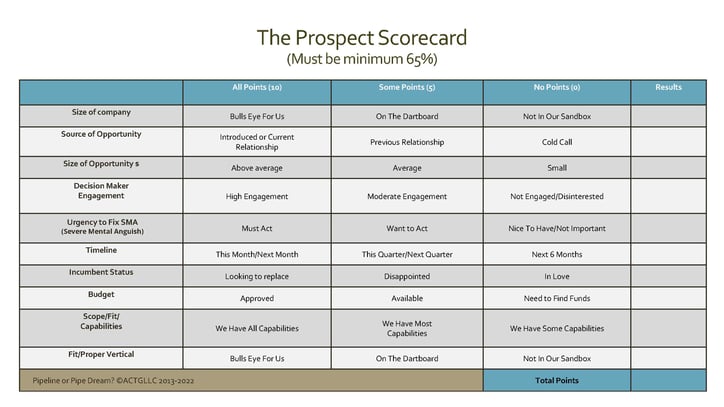
So, let’s take a look at how we can tamp down that emotional part of this sales process for the salesperson. We recommend using a tool called the Prospect Scorecard to teach your sales team how to qualify prospects more effectively: (free PDF download below!)
How to Qualify Prospects With a Prospect Scorecard
The Prospect Scorecard helps remove some of the subjectivity from selling and gives salespeople a more objective view of an opportunity. The scorecard identifies what you know about an opportunity and what you still need to discover.
Think about your top five opportunities and rate yourself on the information you know about each prospect:
- Give yourself a 10 if you have the answer
- Give yourself a 5 if you have partial information
- Give yourself a 0 if you have not uncovered the information yet
If you end up with a really low score, ask yourself why you are trying to win this business when the probability of winning is minimal. Or maybe you are simply missing too much critical information to determine if they are truly a qualified prospect.
Then go uncover the answers.
Understanding these key areas is an important part of learning how to qualify prospects effectively.
One of the Most Important Factors in Prospect Qualification
We have learned over our 30 years of sales training that the source of the opportunity is one of the most important indicators. If you are introduced, you will have a higher probability of winning that business. Makes you think you should go out immediately and ask your current advocates to introduce you, doesn’t it?
Look at this Prospect Scorecard as a living document and a continual monitor of how to qualify prospects. Today you may give yourself a four or a lower number on a prospect, but as you’re progressing through the sales process, that number should go up or they should come out of the pipeline. We’ve had some companies we work with that will not release a term sheet or a quote until this probability score is 65 or higher.
Why a Prospect Scorecard Improves Sales Opportunities
Once you have a scoring mechanism like this, you can look at opportunities more factually.
-
What do you know?
-
What do you still need to know?
This process helps salespeople take emotion out of the opportunity and evaluate the situation more objectively. When you use this tool, you may find that some opportunities disappear from the pipeline. While the quantity of opportunities may go down, the quality of those opportunities can improve significantly.
As a result, salespeople often improve their close ratios by focusing on more highly qualified prospects!