
Sales organizations typically have plenty of sales data due to the growth and usage of CRM systems, which have become critical to capturing the activities occurring with the sales team. But using sales performance data to run effective sales meetings is often the greater challenge for sales managers and leaders. In our coaching platform, we offer several tools to help in this area, and one of the most effective, easy-to-understand, and easy-to-use tools is the sales data insights that come from holding regular Sales Huddles.
Why Huddles Help Coaches Run Effective Sales Meetings
Huddles, as defined by Verne Harnish, founder and president of Gazelles, are:
- A communication process or system that allows for the sharing of real-time information
- An opportunity to focus on "burning platform" issues for a team or company
- A way to bring sharp focus and attention to a critical business driver
- The most important 15 minutes in any company meeting
Each company should start by determining the most important sales activity data points to capture in their huddle regularly each week or month, such as contacts, appointments, proposals, COIs, sales, etc. If a sales manager does not schedule a regular means to monitor what is going on in the field in real time, they cannot coach, adjust the play, or get in front of any client issues or trends.
Huddles provide real-time information so that sales managers can make real-time decisions and provide real-time feedback or coaching. This is vastly different than waiting for month-end or quarter-end reporting on results because huddles capture what is happening now, this week. The sales performance metrics that are captured in Huddles are a means to run effective sales meetings and can then be used to coach salespeople to impact current deals.
Coaching with Sales Data Insights from Where’s Walter
We suggest a technique that we call “Where’s Walter,” pictured and explained below.
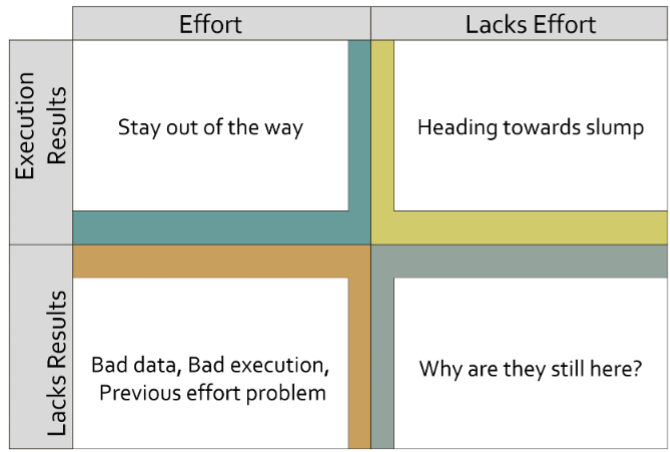
Coaching a salesperson’s activities can be simplified into two areas: their effort vs. their execution. Effort is described as evaluating if they are doing whatever it takes in the area of outreach and working hard to attain their goals. Execution evaluates their effectiveness in the sales process. Are they doing the right things to take a prospect through an effective sales process, or do they have a problem?
Using Where’s Walter for Coaching
As a coaching approach, we recommend sales leaders place their people into one of the four boxes noted above and then have the conversations below with the salespeople in each quadrant. These are guidelines, of course, and can be adjusted. One word of caution: do not soften too much. Leaders must be tough and direct at times to identify real areas of concern and development.
Execution Results & Effort
“Bob, thank you for the results you are generating. You must be thrilled, as this will help you achieve your personal goals and objectives. Just as important, though, I also want to thank you for your consistent effort. You may not realize this, but others on the team look to you and follow your lead. The way that you execute on sales skills week in and week out sets a great example for the rest of the team. Thank you. Now, Bob, what else can I do for you?”
Execution Results but Lacks Effort
“Bob, I want to thank you for the results you are generating. You must be thrilled, as this will help you achieve the personal goals and objectives you have for your family. I am worried about one thing, though; can we talk about that? Bob, how long is our sales cycle? (120 days).
Okay, so based on that and looking at our success formula, then the results you are getting today are a result of what? (The activity I did a while back).
That’s what I was thinking, and that is why I am concerned. Based on the activity here (show them the data), you are headed for a slump. Is that where you want to be?”
Effort Is There but Poor Execution Results
“Bob, obviously, based on the numbers you see here, you are not on schedule to achieve the extraordinary year you committed to managing yourself toward. But this is where I’m confused. The data I have, which tells me about your effort, indicates that you should be at or above your goals, but that isn’t the case.
My experience tells me that it can only be because of one of two things: either the data you are entering is not accurate, or you are failing to execute properly. Which one do you think it is?”
Lack of Effort and Results
“Bob, I have to tell you that I cannot figure this out. Your effort and results are a total surprise to me. If several months ago, someone said to me that you would be failing, I would have said, ‘No way.’ (Show Bob the job posting you used for the position he is in and his resume, then show him his current sales activity and results.)
Bob, I take a look at this (job info) and I think, ‘This is what I hired.’ I look at this (the results), and I’m thinking, ‘This is what I got.’ Bob, did I make a mistake?”
Collecting the right data utilizing Huddles can help leaders run more effective sales meetings. Then, using the Where’s Walter platform gives sales coaches a framework to use performance metrics from Huddles to generate conversations, identify areas for salespeople to focus on, and gain insights for immediate coaching. This helps improve skills, performance, and results.