ACTG Sales Management Blog

Sales & Sales Management Expertise Blog  

Tony Cole

Recent Posts

Elevate Your Bank's Performance with One-on-One Sales Coaching

Posted by Tony Cole on Fri, Aug 11, 2023

In the fast-paced world of banking sales, staying ahead of the competition requires continuous improvement. While group training sessions have many benefits, there's no denying the unique benefits of personalized one-on-one sales coaching. With over 30 years of experience working with banks, we have found that tailored coaching can be the key to unlocking your team's full potential.

Advantages of One-on-One Sales Coaching

  1. Customized Learning Experience: One-on-one coaching allows for a highly personalized learning experience. No two banking sales professionals are the same, and their strengths, weaknesses, and learning styles can vary widely. Your coaches need to take the time to understand each individual's unique traits and tailor their coaching approach accordingly. This personalized attention leads to faster skill development and better retention.

  2. Targeted Skill Enhancement: Group training sessions often cover a wider range of topics, some of which may not be directly relevant to every team member. One-on-one coaching enables a laser-focused approach, targeting the specific skills that need improvement. One-on one-coaching allows sales leaders to help refine prospecting techniques, perfect consultative selling, or enhance negotiation skills for the individual.

  3. Immediate Feedback: One of the most significant advantages of one-on-one coaching is the instant feedback loop it establishes. As bankers work on their pre-call strategies, coaches can provide immediate feedback on their approach, helping them make necessary adjustments on the spot. This real-time guidance accelerates skill mastery and builds confidence.

  4. Confidence Boost: Banking sales can be demanding, and confidence plays a crucial role in success. One-on-one coaching fosters a safe environment for salespeople to practice new techniques, role-play challenging situations, and receive constructive feedback. With increased confidence in their abilities, your team members will approach each interaction with clients more assuredly, leading to improved results.

  5. Accountability and Goal Setting: Accountability is essential for consistent growth. One-on-one coaching allows your coaches to work closely with their RMs to set actionable goals and track progress. Regular check-ins ensure that goals are met and challenges are addressed promptly. This accountability-driven approach keeps the momentum going and empowers your team to strive for continuous improvement.

  6. Adaptability to Change: The banking landscape is dynamic, with market trends and customer preferences constantly evolving. One-on-one coaching equips your team to adapt quickly to these changes. Coaches help individuals stay updated with the latest industry insights, competitor analysis, and market shifts, ensuring that your team remains agile and competitive.

    In the world of banking sales, where every interaction can make a significant impact, investing in one-on-one sales coaching is a strategic move that yields substantial returns. At Anthony Cole Training Group, we leverage our 30 years of industry experience to provide tailored coaching solutions that elevate your team's performance. Let us know if we can help your bank.


Learn More About Our  Bank Sales Training Approach


Elevate Your Bank's Performance with One-on-One Sales Coaching


Topics: Sales Training, banking sales training, sales training tips, one-on-one sales coaching

7 Activities for Your Sales Team Success

Posted by Tony Cole on Fri, Aug 04, 2023

In analyzing those salespeople who are successful year after year, we have found significant consistencies in behavior, sales skills, and practice management. We call these The 7 Activities for Sales Success. If your sales team can adopt these 7 habits, you will be amazed at how your sales will improve.

  1. The ONLY “A” priority is prospecting. Successful salespeople service accounts just like everyone else. They also have“fires” to extinguish and meetings to attend. But they let nothing get in the way of consistent prospecting. They don’t have to like prospecting; they just have to do it. Of course, if your salespeople learn to like prospecting, they will do more of it. A sales leader’s coaching of this important sales behavior is also critical for success.

  2. Don’t look, act or sound like every other salesperson calling on the prospect. Create a unique approach – your salespeople can’t just say that they are different. They must also demonstrate it. As sales leader, if you were the prospect, would you take their call? If not, then their approach needs some work.

  3. Have an ideal prospect profile and look for candidates that fit this profile. You can help your salespeople do this by evaluating their best clients. Are their best customers typically Fortune 500 size or small family-owned companies? Are they regionally based, national, or are they local? Do they have thousands of employees? Are they retail organizations? , etc. Your salespeople must know who they are targeting.

  4. Successful prospectors understand that the purpose of a call is to set an appointment with a qualified candidate. Your salespeople must stop seeing everyone and anyone who will see them. They must make sure the prospect qualifies to do business prior to setting an appointment. They also must stop selling on the phone.

  5. The quality of the phone call determines the quality of the appointment. The goal, while on the phone, is to identify if the prospect has a problem that can be solved. First, they must establish that the prospect would like to fix the problem. Even though the prospect may identify a “problem” on the phone, this isn’t typically the real problem. Your salespeople must ask questions like “Why is that a problem?” and “How much is the problem costing you?”
  1. Prospects want to meet professionals through introductions, not cold calls. Help your producers learn how to ask for introductions from their COIs and current clients as their first prospecting strategy. This is a proven practice of “elite” producers.

  2. “Drill down” past the pain or problem indicators (symptoms). Here are a series of questions to provide and help your salespeople get past the initial symptoms that a prospect will verbalize:

    • Tell me…
    • How long has this been a problem?
    • What have you done…?
    • When you spoke with…?
    • What has your current provider done to make this problem go away?
    • What happens if you don’t fix…?
    • How much is it costing…?
    • Is that a problem?
    • Do you want to or have to fix it?

As sales leader and coach, you must track their activity and look for ways to coach and improve revenue by improving technique. For instance, your salesperson may be great at getting a first meeting, but not adept at uncovering real opportunities. There is your area to coach them. If you track these vital numbers, you can start to improve the areas where they fall short.

Review The 7 Activities for Sales Success with your sales team and ask them which sales skill or habit is most important today andfor the next 30 days. Then have them commit to adopting or changing that one behavior or practice and track their success.

Need More  Sales Management Training?


Topics: Sales Training, banking sales training, sales training tips

Manage Your Selling Priorities: Ready for Takeoff

Posted by Tony Cole on Fri, Jul 07, 2023

When you are in an airplane, you may or may not pay much attention to what is going on in the cockpit. You may happen to glance at the massive control panel with all the switches, gauges, nobs and buttons, but it’s just a glance… before you hustle on to your seat to get settled in for the flight.  But the pilot does, thankfully.

When you are getting ready to start your day, you may not pay a lot of attention to what is happening in the cockpit of your sales aircraft or to “the dashboard” that provides critical information about the state of your business. Normally, you jump in the pilot’s chair and fly off into your day. You have a pretty good idea of where you are going THAT day… so you probably don’t give much attention to the “preflight plans” for the rest of the week, month or quarter. If this doesn't apply to you, it may apply to some of your salespeople. 

But, if you stop to think about your flight/business in longer terms, you know that, over the year, you will probably hit a lot of turbulence. And if used properly, your business dashboard, like the control panel of a 757, could provide you with the critical information that you will need to make the vital decisions required at those critical moments. In other words, it would be nice to have a system of alerts to give you warning BEFORE you are on the verge of crashing.

Have you looked at YOUR dashboard lately? Have your salespeople been checking theirs? What does it tell you? What alerts or warning systems do you have in place to let you know when you are losing altitude and attitude? How do you know if all systems are working properly and that your sales aircraft will get you safely to your destination – on time and on target? What should you be monitoring and doing every day (priorities) in your “preflight inspection” to make sure that you improve the probability of “getting there”? Think about these questions in regards to you and your salespeople.

Here’s my suggested short list of selling priorities:  Prospecting, talking to people, scheduling appointments, conducting qualifying (and disqualifying) appointments, presenting and getting decisions. Just like for each engine of the aircraft, each of your priorities should have a gauge (a standard of performance) and a RPMS, or required ground speed (a set time frame), necessary for safely lifting-off and landing your aircraft at the proper destination.

Having a thoroughly monitored dashboard of sales priorities to help you execute a safe landing (your goal) is a MUST! Share this blog with your team to start the conversation about their own "dashboards."

Need More  Sales Management Training?

Topics: Sales Training, banking sales training, sales training tips

Identifying Sales Coaching Needs: An Analysis EVERY Company Should Execute

Posted by Tony Cole on Wed, Jun 14, 2023

Regardless of the current state of affairs, GREAT organizations go through a constant assessment of where they are. They look at lagging metrics, leading metrics, and success metrics.  They consider that data to help them identify the answer to these three questions...

  1. What should we keep doing?
  2. What should we start doing?
  3. What should we stop doing?

Note: Often the 3rd question is the most important of the three.

Here are examples. 

  1. There is a scene in the movie Dumb and Dumber, where is Lloyd talking to Mary and he asks her about his chances of them being an “item”. She says “not very good”. He asks something about the odds. Mary responds with 1 out of a million. Lloyd responds with; “So you’re telling me there’s a chance!”
  2. The second example is personal. I kid with my family that all babies and dogs love me. They know that to be NOT exactly true. Dogs have a tendency to hunker away, and babies often run the other way. Alex’s daughter, Harper, is a great example of the latter.  Jeni’s dog Stella is the dog that hunkers or sneaks away whenever I am in the kitchen cooking.  Juliet, Alex’s youngest, on the other hand gets this radiant glow on her face, smiles, waves, signs “more” and starts the motion of playing patty cake. She loves me. This morning I am having that discussion with Alex and she says the following: “Well, there was bound to be one [that liked you].”

My point is stop doing this one thing: Stop believing that isolated instances are a trend.  Just because one of your salespeople:

  • Had 1 good month of activity
  • One nice size sale
  • Got an introduction from a client
  • Showed up at your sales meeting without complaining

To identify sales coaching needs, trends, potential of current team members, and candidates for sales you need data. To get this data, START DOING the following:

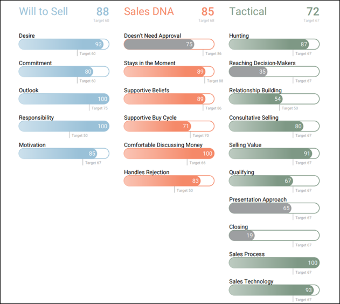
  • Do a complete assessment of your current sales team so that you can identify their Will to Sell, Sales DNA, and Sales Competencies. With 92% predictability, this will help you identify what coaching areas need to be addressed so that your people can get better. Click here to learn this information about your sales team.
  • Build a Sales Success Formula based on Milestone-Centric Sales Process. This Milestone-Centric Sales Process should have workflows and checklist.
  • Implement huddles. Read information from Verne Harnish on the value of Huddles and or click here to learn more.


Free eBook Download: Find Out if Your  Bankers Can and Will SELL

Topics: Sales Process, sales skills assessment

How Your Sales Coaching and Method Have a Direct Impact on Your Results

Posted by Tony Cole on Fri, Jun 02, 2023

Every organization has sales coaching and a sales method. What many companies either don’t know or unsure of is this: What direct impact does our sales coaching and sales method have on improving sales?

 I can’t answer that question, but I can with 100% certainty make this statement: Your current coaching and methods are perfectly designed for the results you got last week, last quarter, and last year. Furthermore, they perfectly designed to get you your future results.

This is also what I know to be 100% true: If there is something about your sales outcomes that do not meet expectations, then something has to change. As the saying goes, you can’t keep doing the same things and expect different outcomes.

Often companies turn to sales training and management coaching to help with sales outcome problems. The positive impact you might be planning for as a result of any sales training will only happen if...

  • You have the right people on the team today.
  • You replace under-performers with those “that are highly likely to succeed’ (click this link for free download of Sales Candidate Assessment with 92% predictability)
  • Your analysis of your sales systems and processes point you in a direction to implement and or fix required supporting sales systems and processes.
  • You have the sales management DNA required to be successful at coaching, performance management, recruiting, motivation and upgrading.
Finally, do your sales managers have the sales management competency skills required to change outcomes?

The approach to improving sales skills (using SMART Goals and SMARTER Data) and coaching must help your people adjust several skills:

  • Getting to Decision makers
  • Using storytelling, metaphors, and analogies to make a point about how a solution might help a prospect.
  • Outbound lead nurturing practices
  • Finally, no excuses for lack of EFFORT

Having what we call a Sales Managed Environment® helps companies understand what needs to be changed and how to change and adjust to the moving landscape of pricing, availability, and competitors looking to buy market share. It’s tough to be successful at overcoming challenges and obstacles if you don’t have a built-in process that includes Performance Management, Skills Coaching, Hiring, and 1 on 1 deliberate coaching specifically to improve skills and change behavior.

Bottom line, you cannot possibly control all that is going on around you and your people. But you can control the habitus they live in, the quality of coaching support they get, and the availability of improving skills.

Sell Better. Coach Better. Hire Better.

Topics: Sales Training, increase sales, hire better salespeople, consultative selling, consultative sales coaching, sales training courses, online sales training, hire better people, insurance sales training, train the trainer, driving sales growth 2020, sales training workshops, sales training seminars


    textunder

    Subscribe Here


    Most Read


    Follow #ACTG


    About our Blog

    Anthony Cole Training Group has been working with financial firms for close to 30 years helping them become more effective in their markets and closing their sales opportunity gap.  ACTG has mastered the art of using science-based data and finely honed coaching strategies to help build effective sales teams.  Don’t miss our weekly sales management blog insights from our team of expert contributors.


    Recent Blogs