
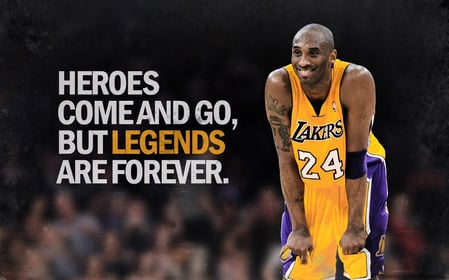
Kobe Bryant will be retired from NBA basketball when the final buzzer sounds in tonight’s game against the Utah Jazz. If you are not a basketball fan or sports fan, this may mean nothing to you. My intent is to frame a very important discussion about performance around a living legend of the LA Lakers and NBA.
As I listened to ESPN Radio Mike and Mike in The Morning, I heard commentary from former teammates, coaches and opposing players. There was a common theme in there discussion about Kobe Bryant and elite performers in athletics. To be clear, I don’t believe the common theme is limited to athletic top performers.
As I started this article, I sent a question to my niece, Laura Wehrmeyer Fuentes. Laura is an elite performer and vocalist who performs in the greater DC/Baltimore area. I asked her if she ever bailed on a performance because she felt a little off or hadn’t prepared properly. Her response: “No way! I’ve sung through bronchitis and pneumonia hopped up on steroids when I had to. The show must go on!”
Elite performers prepare and perform at the highest capabilities regardless of the situation, the score, the environment or circumstances.
Some comments made about Kobe made me think about the content and theme of this article. Here is just a sampling of what was said about Kobe and other top performers:
- They demanded the best of others. When others were not performing at their best, giving it their all in practice or in a game, they call them out.
- When it’s game time, nothing else matters. When Kobe’s family came to LA to watch him play, they stayed at a hotel instead of his spacious home. He focused on the task at hand.
- Regardless of the score of any game, if you watched Kobe play, you would swear that the Lakers must be down by 20. His intensity for playing the game rather than playing the score made him elite.
- When comparing Kobe to Magic Johnson, the comment was made about Magic after they lost the championship to the Lakers. “You couldn’t find Magic in LA. Here is a guy that likes to be out, is normally seen out and is everywhere where the lights are. After the loss you could only find him in one place – the gym.”
- Elite players make other players better. They recognize that they are a big piece of the puzzle, but still only one piece. They elevate the game of others in order to win the team
- Elite players have a tendency to rub others the wrong way. Not because they are arrogant individuals, but they have an arrogance about how they view the game and how it should be played and how one should be prepared to play. They are haters – haters of losing and those un-willing to pay the price to win.
I could go on, but this makes the point and takes me to the question in the title of this article – Who are your elite players and are they doing the things that superstar/hall of fame players do?
- Are they elevating others?
- Are they demanding of others?
- Are they team-objective focused or focused on their own stats?
- Do they do everything possible to win individually and get others to win as a team?
- Are they your go-to people in a crisis?
- Do they grind and grind to get it done?
- Do they work relentlessly on their skills?
- Do they focus on the details of the game so as to eliminate repeated errors or mistakes?
- Do they call others out?
*Data on approximately 100,000 sales managers
- Have, on average 43% of the Sales Coaching Competency
- Only 39% have at least 50% of the Sales Coaching Competency.
- Only 7% have more than 75% of the Sales Coaching Competency and
- Only 3% spend at least 50% of their time coaching their salespeople
- Only 7% of sales people assessed fall into the elite status based on performance, sales DNA and 21 core sales competencies.
As a CEO, president, national sales manager, vice president of sales or sales manager, the responsibility you have is to drive revenue. When that seems difficult or impossible there needs to be more to the solution than work harder, see more people, increase the marketing budget, do more social networking, expand the sales force, etc. Just like you would look into the numbers (expenses) to figure out how to improve profit, you need to look at the root problems impacting revenue.
It isn’t the latest sales enablement technology that improves sales results. It is the human technology that drives sales today and will drive sales tomorrow.
Helpful Links/Resources:
Objective Management Group – White Paper on Talent Selection
Anthony Cole Training Group – Link to Sales Management Certification Program
Hirebettersalespeople.com – Self-explanatory link
Burning platform issue – You have a problem now, You want it fixed now – call me directly: Office: 513.605.1301 or call/text Mobile 513.226.3913.
Picture of Kobe – link to YouTube