
Banks and insurance firms also now realize that they need to know this same information about their current sales team. It is sometimes difficult to understand what makes the top producers so successful and how to find, attract and develop more of those types of financial salespeople. There is a science to the soft skills world of selling, and sales performance data helps make those skills measurable. We utilize the #1 sales evaluation by Objective Management Group, Inc. (OMG), and here are a few examples of why this sales performance data is so important if you are leading a sales team and must grow the company. If you are a salesperson, understanding this sales performance data is critical to honing your skills and moving up the leader board.
Understanding Sales DNA and Sales Performance Data
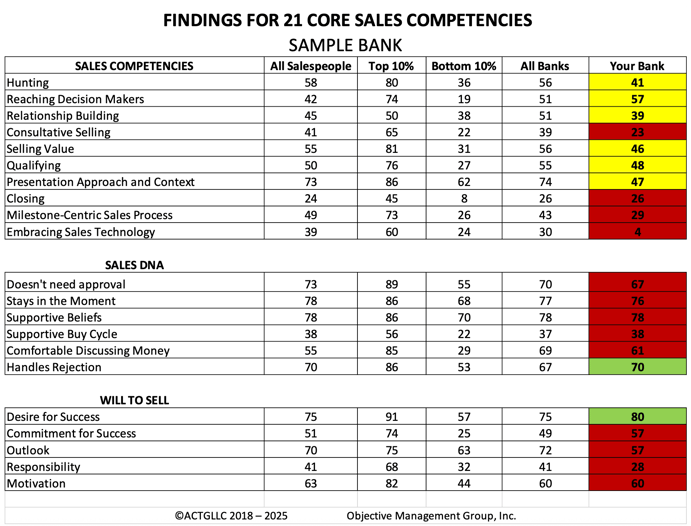
Take a look at the chart below. There are 21 core sales competencies listed here and measured by OMG. We are going to focus on the middle group called Sales DNA. Sales DNA can be coached, and it never makes sense to invest in sales training and techniques until your financial firm and salespeople understand the dynamics of Sale DNA and how it affects them and their skills.
Case Study: How Beliefs Impact Sales Behavior and Results
Case study example – It is your goal to train your team on a sales approach that they have not used before with a questioning technique that they do not understand or “believe” in, for example, asking for introductions from their current advocating clients. Some bankers feel uncomfortable or “pushy” doing this, an example of non-supportive beliefs. If we don’t train them first on the impact of their own supportive or non-supportive beliefs, many will not even try the new sales approach, and they will push back and never utilize it. Beliefs drive behavior, and behavior drives outcomes and results. If no change is made, then sales training budgets are wasted on this approach.
Case Study: Staying Present in Consultative Financial Sales
Another case study example – If your salesperson is unable to “stay in the moment,” they are likely to miss critical cues from the prospect because your agent or banker are already thinking of their next question or how to answer the prospect. Many salespeople struggle with this particular Sales DNA factor because they are good at presenting and telling. They are not as skilled at asking more questions, like “Why is that?” or “When did that problem begin?” or “What has your current bank done to address that issue for you?” This more consultative approach is what elite salespeople have mastered. They can listen very closely to the prospect, follow their lead and ask the right questions to help the prospect self-discover why the problem must be fixed. They stay in the moment and are not distracted by previous conclusions they might have had.
Case Study: Discussing Money Confidently in Sales Conversations
One last case study – Your salesperson might have great relationship-building skills, be strong at qualifying, and ask all the best questions of the prospect, but what if they are uncomfortable discussing money? They will often not ask about budget or fees and proceed to the proposal stage without a clear understanding of what the prospect will pay to solve their problem. This is very common with salespeople because, from a young age, they are taught that talking about money is inappropriate and can be uncomfortable. If a salesperson recognizes that they feel that way, then they can practice and become more skilled at asking the money questions.
The reason sales performance data is so important is this: You cannot change what you cannot see. If you need to improve your sales team’s performance and are considering sales training, make certain that your sales training provider utilizes a sales-specific evaluation. It is critical that you understand the data beneath the behavior and can address the root of the sales problem to achieve long-term, meaningful change and results.