ACTG Sales Management Blog

Sales & Sales Management Expertise Blog  

Critical Sales Performance Data for Financial Services Selling

Posted by Alex Cole-Murphy on Thu, Jan 15, 2026
 
Many industries will not hire a salesperson without an evaluation to determine the candidate’s level of sales skills. Most of the companies we work with are banks and insurance firms, and while these are not industries that have typically been committed to evaluating, we are seeing a movement in that direction. Bank and insurance leaders now understand that the sales performance data behind that robust resume or smooth interviewer can reveal critical tendencies and potential weaknesses that they need to know before making a job offer.

Banks and insurance firms also now realize that they need to know this same information about their current sales team. It is sometimes difficult to understand what makes the top producers so successful and how to find, attract and develop more of those types of financial salespeople. There is a science to the soft skills world of selling, and sales performance data helps make those skills measurable. We utilize the #1 sales evaluation by Objective Management Group, Inc. (OMG), and here are a few examples of why this sales performance data is so important if you are leading a sales team and must grow the company. If you are a salesperson, understanding this sales performance data is critical to honing your skills and moving up the leader board.

Understanding Sales DNA and Sales Performance Data

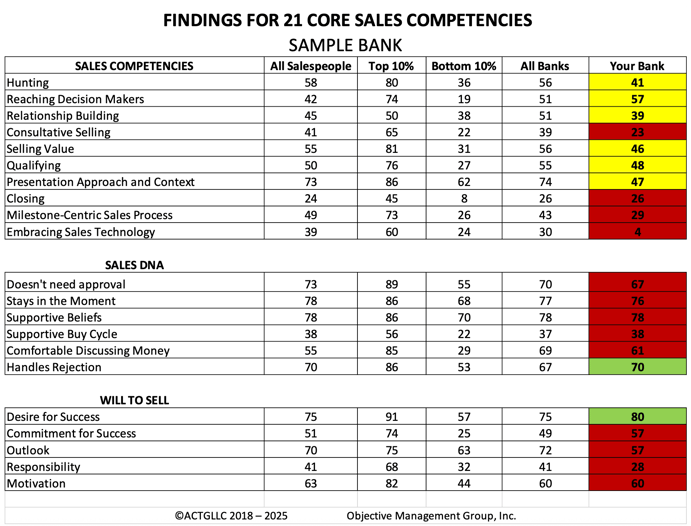
Take a look at the chart below. There are 21 core sales competencies listed here and measured by OMG. We are going to focus on the middle group called Sales DNA. Sales DNA can be coached, and it never makes sense to invest in sales training and techniques until your financial firm and salespeople understand the dynamics of Sale DNA and how it affects them and their skills.
Screenshot 2026-01-15 at 9.38.53 AM

Case Study: How Beliefs Impact Sales Behavior and Results

Case study example – It is your goal to train your team on a sales approach that they have not used before with a questioning technique that they do not understand or “believe” in, for example, asking for introductions from their current advocating clients. Some bankers feel uncomfortable or “pushy” doing this, an example of non-supportive beliefs. If we don’t train them first on the impact of their own supportive or non-supportive beliefs, many will not even try the new sales approach, and they will push back and never utilize it. Beliefs drive behavior, and behavior drives outcomes and results. If no change is made, then sales training budgets are wasted on this approach.

Case Study: Staying Present in Consultative Financial Sales

Another case study example – If your salesperson is unable to “stay in the moment,” they are likely to miss critical cues from the prospect because your agent or banker are already thinking of their next question or how to answer the prospect. Many salespeople struggle with this particular Sales DNA factor because they are good at presenting and telling. They are not as skilled at asking more questions, like “Why is that?” or “When did that problem begin?” or “What has your current bank done to address that issue for you?” This more consultative approach is what elite salespeople have mastered. They can listen very closely to the prospect, follow their lead and ask the right questions to help the prospect self-discover why the problem must be fixed. They stay in the moment and are not distracted by previous conclusions they might have had.

Case Study: Discussing Money Confidently in Sales Conversations

One last case study – Your salesperson might have great relationship-building skills, be strong at qualifying, and ask all the best questions of the prospect, but what if they are uncomfortable discussing money? They will often not ask about budget or fees and proceed to the proposal stage without a clear understanding of what the prospect will pay to solve their problem. This is very common with salespeople because, from a young age, they are taught that talking about money is inappropriate and can be uncomfortable. If a salesperson recognizes that they feel that way, then they can practice and become more skilled at asking the money questions.

The reason sales performance data is so important is this: You cannot change what you cannot see. If you need to improve your sales team’s performance and are considering sales training, make certain that your sales training provider utilizes a sales-specific evaluation. It is critical that you understand the data beneath the behavior and can address the root of the sales problem to achieve long-term, meaningful change and results.


Find out how you can evaluate  your team's Competencies!

Topics: sales performance, data driven sales

Data Driven Sales: Proven Concepts, Proven Results (Full Article)

Posted by Tony Cole on Thu, May 26, 2022

If you and your organization don't have a data-driven sales approach and process, you could be missing out on some key information that would help increase sales success.


person-writing-on-notebook-669615

As I thought about this article, I figured it would only be fair to present separate information important to the three primary sales roles in a company. These include; the president, the VP of sales or leading sales manager, and the actual producer in the field responsible for generating sales revenue.


However, I encourage you to read all three sections as there is critical and useful information that will benefit you regardless of your role or responsibilities.


Presidential Data: Top-level data tells you the story of who is and who isn’t

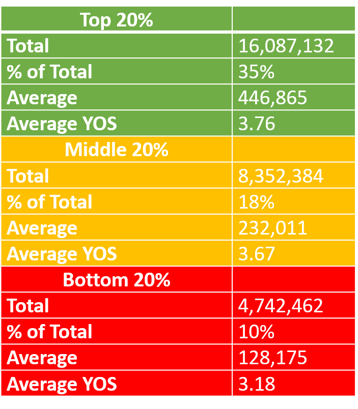
President DataIf you are the president of a company with a sales force of over 30 or so people, you should pay attention to the chart above which reflects 183 salespeople. The findings here will probably be pretty close to what you would find in your organization.  

What stands out to you vs. what should stand out are two different things. What should stand out for you as a president are the following:

  • The 80 / 20 rule isn’t applying here. Not even close. It’s not a good thing or a bad thing. But if I were you, I would check my team to see if we are hitting our numbers on the backs of a few. If so, that makes you vulnerable to a key loss by design or by default. It also makes you vulnerable to creating a “just enough is good enough” culture.
  • The middle 20% is being outperformed by the top group 2 to 1. If you are president, you should be asking why that is the case. All of these people have been hired to do the same job, are all in similar markets, and are all paid the same. Most companies think it’s a longevity thing. It is not. Notice that the average Years of Service (YOS) are only marginally different.
  • The bottom 20% is being slammed by a 3.39 to 1 margin on total and about the same for average production. So, what is going on there? Again, no major difference in YOS. Ask yourself what is that bottom 20% costing you in salary, benefits, lost opportunities, additional coaching and managing, and recruiting turnover?

Sales Manager Data: What does it take to be successful?

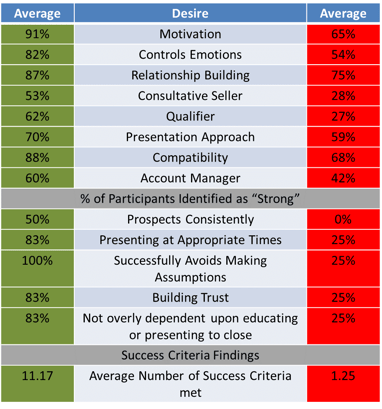
VP DataFor the VPs of sales and sales managers, this tells you why there is a difference between your top performers and bottom performers. In this graphic, evaluated salespeople from all industries and over 25,000 companies are on the left, and the non-performers are on the right. 

As you consider your training, coaching, and recruiting, how much time do you spend making sure that your salespeople have what it takes based on data vs. gut, instinct, or feel?

When you consider the training dollars spent on technique, approaches, pitches, and presentation skills, do you wonder why:

  • Your people don’t change their behavior
  • Skills don’t improve
  • You constantly work on the same "choke points" in the sales process with the same people
  • Prospecting is a never-ending problem
  • The pipeline continues to be anemic or constipated
  • New hires that cost you a fortune take too long to ramp up or fail out of the company

Salesperson Data: Target your top 36% average account

SP Data

For years, salespeople have tried to figure out how to get to the next level of success. Certainly, it takes the Will to Sell, the Sales DNA, and the sales competencies identified in the Objective Management Group Sales Evaluation that has 92% predictive validity. But in addition to that, it requires that you have a business model that is built to help you sell more business, more quickly, at better margins.

The model represented here is not new. If you’ve read any sales books in your, career you have probably heard of the Pareto principle or the 80/20 rule. I’ve taken it one step further.

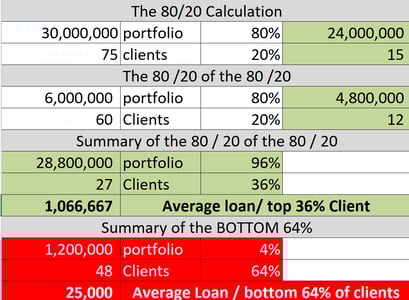
Focus on the cells in green and plug in your own numbers:

  • This book of revenue represents 30,000,000 in loans. Yours could be premium, units, revenue, or renewals. It doesn’t matter. Take that number and multiply it by 80%.
  • There are 75 clients in the portfolio and we’ve multiplied that number by 20% to get to 15.
  • In short 15 clients represent 80% of the entire book of business.
  • Go 1 step further and do the math again. You’ll find that 96% of the entire $30,000,000 is;
    • Represented by 36% percent of the clients = 27
    • The average loan represented by this group is 1,066,667

Here is what takes you over the top:

  • Compare the average loan from the top 36% to the loan average of the bottom 64%.
  • Who would you rather be selling to?
  • Assume that your top 36% of clients know at least 5 other people like them
  • Ask your top 36% of clients for an introduction.
  • Assume you get 50% to say yes, half of those people qualify, and half of those that qualify do business with you.
  • Using the numbers above, that would be 6 new clients at over $1,000,000 in loans.

The closing question is this: How many sales would you have to make from your bottom 64% of clients to equal one from your best client group? The answer: 40.

STOP selling those that look like your bottom 64%.

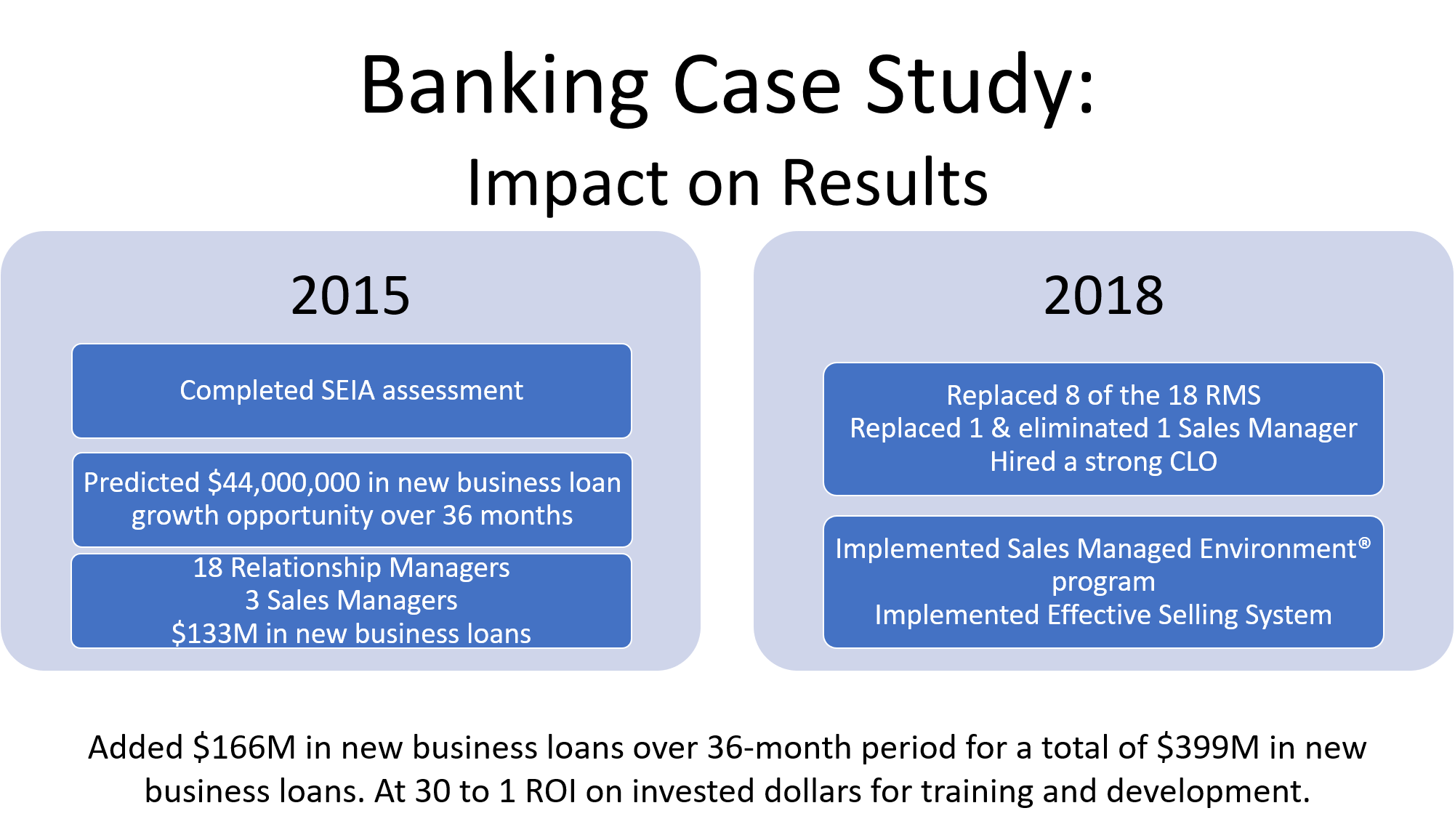
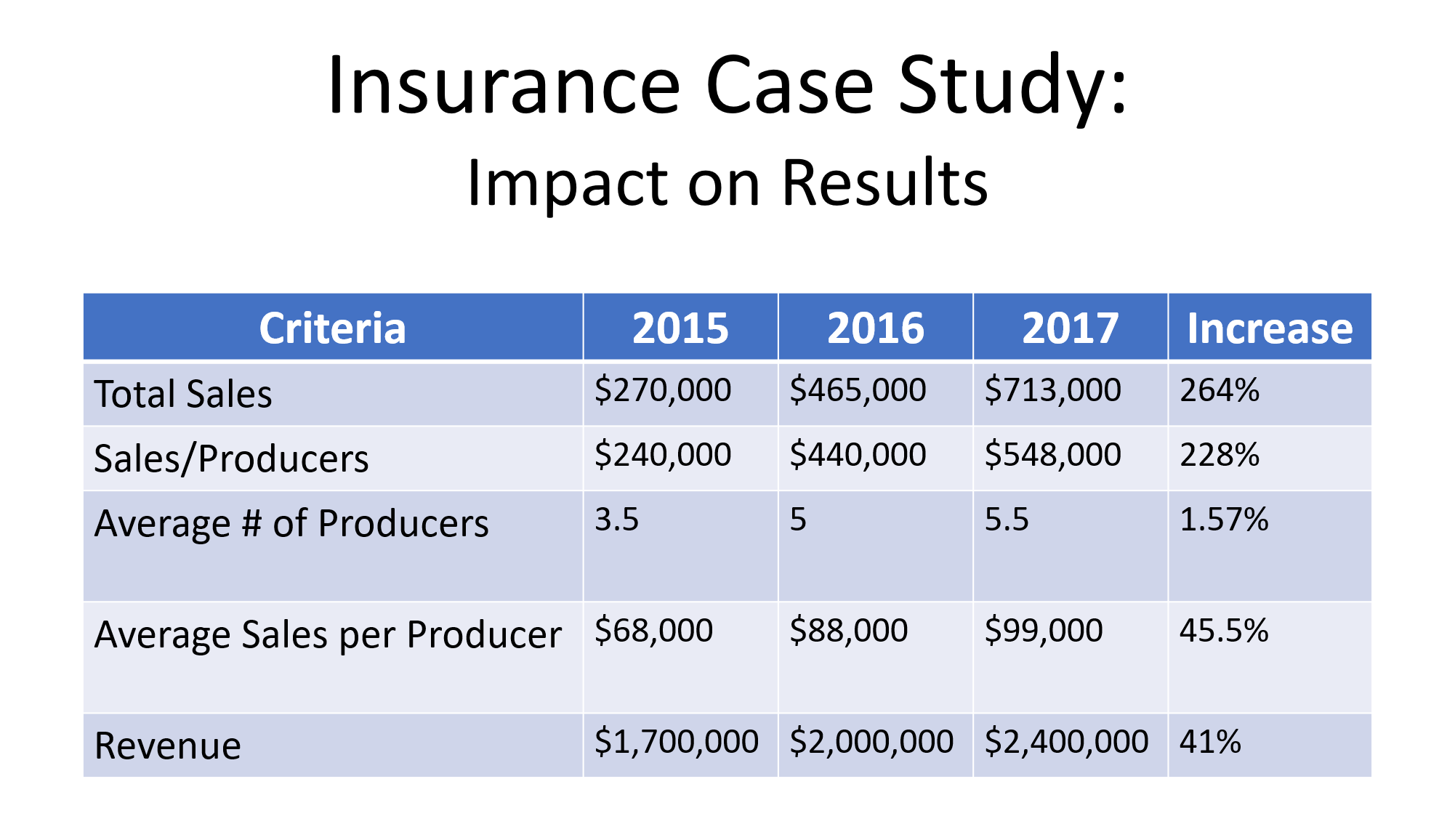
Don’t believe me? Look at these results from our clients who have implemented this process:

Banking Case Study


Insurance Case Study

Need a Sales Training  Workshop?

Topics: data driven sales, data driven sales approach


    textunder

    Subscribe Here


    Most Read


    Follow #ACTG


    About our Blog

    Anthony Cole Training Group has been working with financial firms for close to 30 years helping them become more effective in their markets and closing their sales opportunity gap.  ACTG has mastered the art of using science-based data and finely honed coaching strategies to help build effective sales teams.  Don’t miss our weekly sales management blog insights from our team of expert contributors.


    Recent Blogs