
ACTG Sales Management Blog

Sales & Sales Management Expertise Blog  

Building Rapport in Sales: The Foundation of Every Successful Deal

Posted by Alex Cole-Murphy on Fri, Feb 06, 2026
 
Nothing is more important in selling than the relationship. And nothing is more important than a salesperson's ability to build that relationship quickly.

Sometimes rapport happens naturally: the conversation flows, trust forms easily, and the prospect seems ready to engage. Other times, it takes persistent effort to gain enough confidence and trust for a prospect to move forward. So what separates salespeople who build rapport effortlessly from those who struggle?

Start with the Right Mindset

A recommended first step is to read Go-Givers Sell More by Bob Burg and John Mann. They offer powerful insights on redefining the sales process as an opportunity to give and help, rather than simply to take and close.

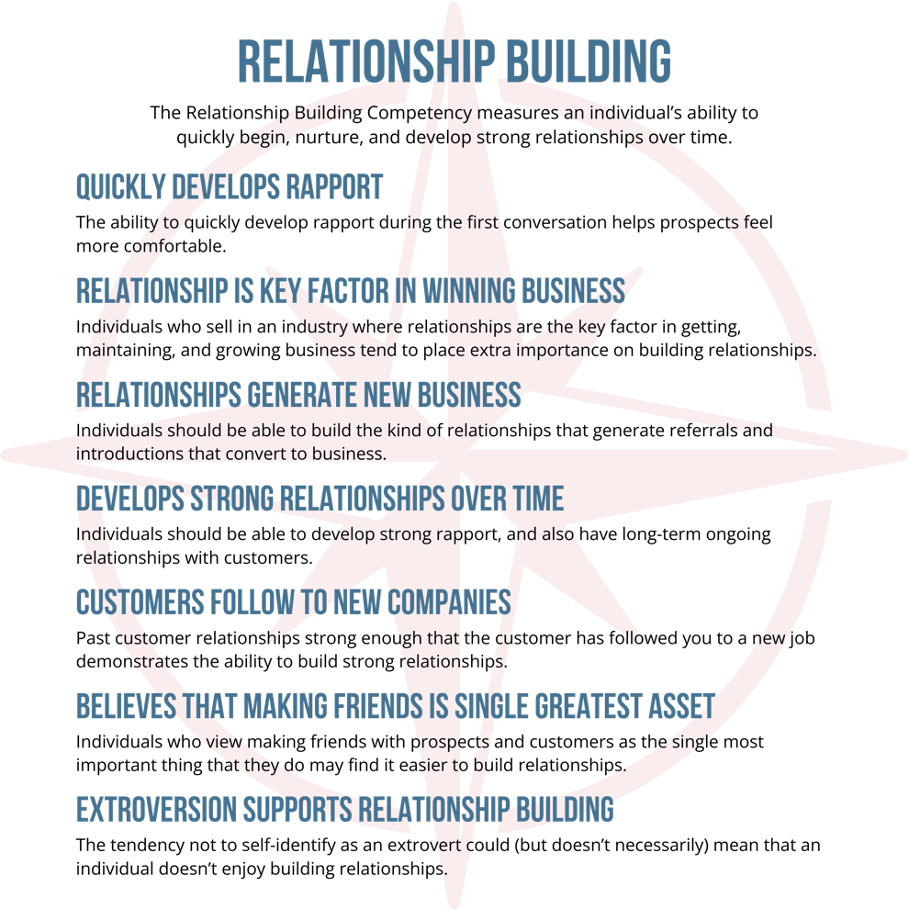
At Anthony Cole Training Group, we use the #1 sales assessment in the industry by Objective Management Group, which defines the 21 Core Sales Competencies needed for sales mastery. Among these, the competencies for the Relationship Builder are critical to success. See below.
Picture1-Feb-06-2026-12-47-17-8840-PM

The Seven-Second Window

Here's an important reality: seven seconds is the average length of time a person has to make a first impression.

If that first impression falls flat, a salesperson is unlikely to get another chance with that potential client. But when they nail it, the client takes them seriously from the start. Trust begins to form immediately.

And trust is everything. Without it, prospects won't share their real issues or discuss money. They won't consider making a change, and they certainly won't commit to a next step.

Whether the initial meeting is face-to-face, over the phone, or via video, salespeople don't have time to waste. Understanding how people form first judgments (and what they can control) makes all the difference.

What Really Influences First Impressions

When meeting face-to-face, a majority of how a salesperson is judged comes from non-verbal data: appearance and body language. Less than 10% is influenced by the words that they speak. People do, in fact, judge a book by its cover. When the initial encounter is over the phone, 70% of how a salesperson is perceived is based on their tone of voice and 30% on their words. Clearly, it's not what a salesperson says - it's the way they say it.

Building Credibility Fast

Another excellent resource on this topic is The Speed of Trust by Stephen M. R. Covey. According to Covey, "The good news is that we can increase our credibility and we can increase it fast, particularly if we understand the four 'cores' that are fundamental":

  1. Integrity - Do you walk your talk?
  2. Intent - Are you genuinely seeking mutual benefit?
  3. Capabilities - Can you actually deliver what you promise?
  4. Results - Do you have a track record of success?

A Proven Opening Approach

With the need for strong first impressions in mind, here's a suggested approach to open a first meeting that accelerates rapport building:

  • Thanks for inviting me in… (or meeting on Zoom)
  • I’m glad we could carve out the time today, and I’m looking forward to hearing more about the issues we discussed over the phone.
  • As you think about our discussion, what would make our time together today a great and productive use of your time?
  • At the end of this meeting, I would like to set aside 5 minutes to determine where we are headed next, if anywhere. Does that make sense?

Understanding the Prospect's Mindset

Of course, prospects bring their own barriers to building rapport. They're busy and distracted. They've done their homework and know more than salespeople often assume. And they've had experiences (good and bad) with other salespeople that shape how they view this interaction.

Here's a valuable exercise for every salesperson:

Think about a recent encounter where you were the buyer and a salesperson really "got" you. Maybe it was at a store, a service provider, or even a B2B situation.

  • What was that experience like? What made it stand out?
  • What specific things did that salesperson do or say that made you feel understood?
  • How did their approach make you more willing to open up or move forward?
  • What can you replicate from that experience in your own sales conversations?

This reflection can reveal powerful insights about building rapport that textbooks can't teach.

Going Deeper Than Surface-Level Questions

In early conversations with prospects, a salesperson's goal isn't just to qualify or pitch. It's to uncover the prospect's real pain. What problems are they actually facing? What have they already tried to solve them? How is their current provider performing, and where are the gaps?

These conversations aren't just about gathering surface-level information. They're about building genuine insight so the salesperson can determine whether a true, mutually beneficial relationship can form. Because at the end of the day, the best sales relationships are built on a foundation of understanding, trust, and the sincere desire to help.


Ready to develop stronger relationship-building skills across your sales team? Download our free eBook The Relationship Selling Guide for proven strategies and frameworks, or contact Anthony Cole Training Group to learn how our assessments and coaching can transform your team's ability to build rapport and close more business.

free download


Topics: building rapport in sales

Building Rapport in Sales

Posted by Jeni Wehrmeyer on Thu, Jun 30, 2022

Building rapport in selling is really all about being caring and friendly, asking the right questions, and offering great advice and solutions.

There are 5 competencies that make a salesperson strong at developing relationships in sales.

pexels-christina-morillo-1181562-2

The title of this blog is also a highly searched keyword phrase on Google. Because we always try to write about topics that salespeople want to read, we are going to focus on this very important topic of how to build rapport in sales. I want you to think about a business relationship that you have that you think highly of, recommend, and will likely never leave. For my example, I will talk about our auto servicing and repair group, Donovan’s.

We have two cars in our family so we need a good service provider and we keep our cars on a regular maintenance program, so you might say, we are good prospects for this type of service. I found Donovan’s by following the general manager Chris over from another auto servicing group that was not nearly as good or memorable, but Chris was and is!

How to build rapport – Chris has always been courteous, happy to speak to me, remembers me and my car, does not keep me on hold, asks the appropriate questions about the issue needing service, calls me with the estimate, and has the car ready on time. In essence, he delivers. I would say that these are the components of rapport with Chris: genuine friendliness – he cares, consistency in availability, delivering the service needed, and advice and recommendations simply explained. When something expensive needs to be addressed, he will tell me what it is, why it needs to be fixed, and what happens if I don’t fix it. I never feel like I am being sold but I do feel like I am being taken care of.

Read the book – Go-Givers Sell More by Bob Burg and John Mann for more on this topic. Building rapport is just part of the business process for Donovan’s – if Chris does not answer the phone, whoever does is also friendly, caring, and helpful. They have found a recipe for success and it works. All of their people follow an approach that stands out from the auto servicing crowd. Additionally, after every service, their owner texts me to ask how they did. Now that is unique! I typically do not allow texts from companies but he is very specific in his question and once I answer it, that is that. That is not marketing or selling, it is building rapport! I feel like I can call the owner of Donovan’s at any time and talk to him directly, and would bet he will be as helpful, gracious, and caring as Chris.

One last thing about how to build rapport. When my son Steven was learning to drive, I reached out to Chris and asked if one of them would be willing to spend 15-20 minutes walking him around the car, helping him to change a tire if needed, checking the air pressure in the tires, checking the oil, etc. Chris (who is also the manager) did this himself and Steven learned some very valuable things about his car. He also remembers Chris each time he takes our car in for service. Did I mention that Donovan’s is not the cheapest auto service provider? That is not what I am looking for when it comes to something we depend on every day. However, they deliver more than what's expected at a fair price. Think about your business, do you do that? Nothing builds rapport like overdelivering on a service.

We use the #1 sales assessment in the industry by Objective Management Group which defines the 21 sales core competencies needed for sales mastery. Here are the competencies for Relationship Builder:

  1. Quickly develops rapport
  2. The relationship is the key factor to winning business
  3. Develops strong relationships over time
  4. Customers follow them to new companies
  5. Is extroverted

I would say that Chris and the folks at Donovan’s do a very good job on these 5 competencies, wouldn’t you? Building rapport in selling is really all about being caring and friendly, asking the right questions, and offering great advice and solutions. Think about what you and your people can do differently to build better rapport with your clients. It will extend the life of your relationships and they will tell others!

Free Evaluation of the  21 Core Competencies!

Topics: how to build rapport in sales, building rapport in sales


    textunder

    Subscribe Here


    Most Read


    Follow #ACTG


    About our Blog

    Anthony Cole Training Group has been working with financial firms for close to 30 years helping them become more effective in their markets and closing their sales opportunity gap.  ACTG has mastered the art of using science-based data and finely honed coaching strategies to help build effective sales teams.  Don’t miss our weekly sales management blog insights from our team of expert contributors.


    Recent Blogs