ACTG Sales Management Blog

Sales & Sales Management Expertise Blog  

Leading a Sales Team: 10 Keys to Success (Part 1)

Posted by Jeni Wehrmeyer on Thu, May 12, 2022

This article is the 1st place winner of the 2022 Sales Pro Central MVP Awards on Sales Leadership!

In our sales management training, we have developed 10 keys and a framework of activities that provide a new or tenured sales leader with a roadmap they need to put in place to help lead their team to greater sales success.

Screen Shot 2022-03-08 at 10.18.18 AM

Most companies engage in sales training, but we have found over our 29 years of business that few invest in sales management training. In part, due to the theory that a successful salesperson can transition to teaching and coaching others to do the same. This theory is flawed because there are very different skills required of sales managers than salespeople- the most important being the driving desire to develop and achieve success through others. Both roles do include a focus on relationship selling and the ability to quickly and effectively find and develop a bond with others. However, the core skills of a sales manager involve understanding how to transition from actively doing to teaching and coaching. In our sales management training, we have developed a framework of activities that provide a new or tenured sales leader with specific activities they need to put in place to help lead their team to greater success.

Here are 10 keys to success for leading a sales team:

  1. Guiding the team to set extraordinary goals
  2. Managing excuse-making
  3. Understanding the Will to Sell and Sales DNA factors beneath sales behavior
  4. Following a coaching process
  5. Coaching the deal and coaching for skill development
  6. Establishing personal and business goal setting
  7. Leading consistent sales huddles
  8. Creating a hiring profile and having a candidate pipeline
  9. Coaching a stage-based sales process
  10. The shadow of the leader

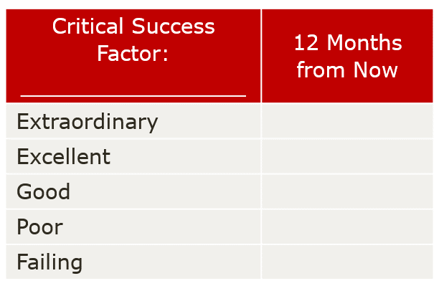
Guiding the team to set extraordinary goals: One of the biggest complaints of most salespeople is that their goals are set by the company and are not realistic. What is interesting about that is if a sales leader effectively takes their salespeople through a process of establishing their own goals, salespeople will typically set them higher than the company might. In our sales management training, we help managers with a specific approach of establishing Extraordinary Goals. Utilizing a matrix like the one below, a sales manager begins by asking the salesperson what a good goal for their year is, then discusses poor and failing levels. Once those are established they have a conversation about what an Excellent year would look like and then what an Extraordinary year would be. Numbers are essential, along with a discussion of what would be needed to achieve these levels. Once all those numbers are established the sales leader asks the salespeople to which level they want to be managed and coached. Most high-performing salespeople will choose the top level. The key, however, is the sales leader must ask the salesperson if they will allow them to be coached to that level, and gains the understanding that it will be hard and challenging. Utilizing this process, the salesperson has established their own goal and will be more committed to doing what it takes to achieve it.
CSFManaging excuse-making: We all make excuses, but one of the skills of top-performing salespeople is their ability to own their outcomes and results. In our sales management training, we help sales leaders understand the commitment levels of their salespeople and then how to coach to those various levels. We can all recognize some salespeople will do Whatever It Takes, which we call WIT. These salespeople rarely, if ever, blame the market, the company, or anything other than their actions for lack of success. So here is the strategy. When asked, "Why do you think you did not reach your annual goal, Joe?” Joe says, “Look how many accounts I am managing! How can I do this client servicing work and still bring in new business?” The sales manager replies, “If I did not let you use that excuse, what would you have done differently?” This approach reaps great success because it puts the ball squarely back in the salesperson's court, and they must think about how they could have adjusted their activities to achieve a different result. They must own it.

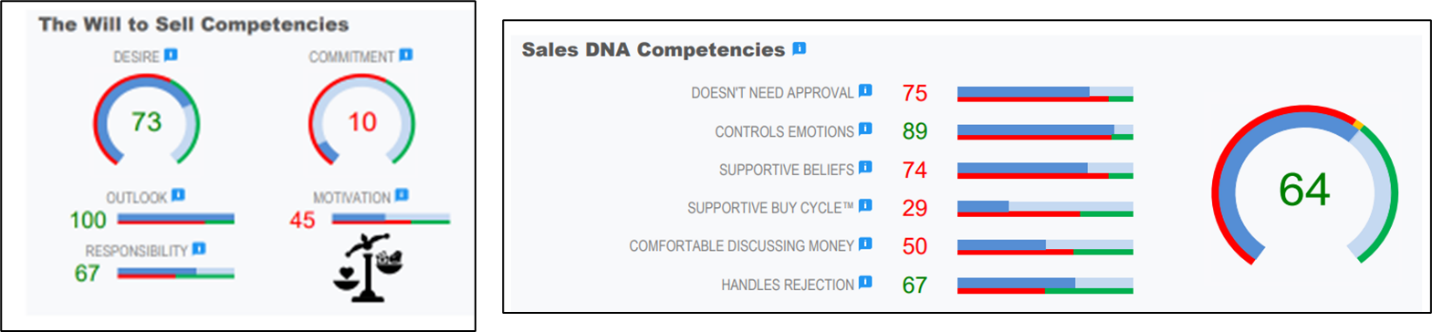
Understanding the Will to Sell and Sales DNA factors beneath sales behavior: When a salesperson does not prospect enough, avoids asking about the budget in the sales process, or does not ask enough strong qualifying questions, it is often the result of their underlying Will to Sell and Sales DNA. It is impossible to coach these behaviors without understanding what lies beneath the salesperson's actions. Relationship selling is a complex skill, and a sales coach will want to understand these underlying factors about their salespeople to effectively coach them to higher levels of performance. For example, if a salesperson does not believe that they have the right to ask budget questions or is uncomfortable doing so (uncomfortable discussing money), they won't ask. It is easy to teach a technique and help them with questions they can be comfortable with once they understand what is getting in their way.
Will to Sell & Sales DNA-1

Following a Coaching Process: Much like mastering a sport like golf and tennis, there are different styles and approaches, but there are technical factors involved in becoming adept at these sports. Similarly, in our sales management training, we help sales leaders with the technical side of coaching with a 5-step coaching process. Yes, they must be adept at each of these steps below, but if they commit to coaching their salespeople in this manner, they will see a lift.
  1. Gain insight: find out what is happening or not happening through huddle data or observational coaching, schedule a coaching session
  2. Provide feedback: have quality conversations that are timely and specific, asking questions of their salespeople to help them self-discover, and gain agreement on the real problems
  3. Demonstrate and instruct: Identify skill gaps, demonstrate mastery of the skill, and instruction on critical steps to improve
  4. Roleplay: Complete a pre-call for an upcoming call, RM roleplays, complete a post-call debrief together, coach gaps
  5. Develop an action plan: determine action steps, observe, inspect and coach again, celebrate results, and address failure

Coaching the deal and coaching for skill development: Many sales coaches are great at coaching the deal, helping a salesperson understand if the prospect fits their target, researching the industry and issues, the complexities of the structure of the deal, etc. However, at a separate time, sales managers must focus on sales behaviors to help a salesperson make improvements in their strategies, skills, and approach. We recommend establishing coaching hours on the calendar. This is when a salesperson commits to a meeting with their manager, reviews a prospect pre or post-call and reviews the questions they will ask/asked, and completes a qualifying scorecard on the prospect. This is time to sharpen their sword. One of the most important jobs of the sales manager is to practice with their salespeople, take time to help them with a new approach, ask questions differently, and help them get comfortable with closing questions. This time is set aside not to focus on a deal but to improve skills and affect behavior change. Remember, change takes repetition and practice!

Tune in to our blog next week for the Sales Leader's final 5 keys to leading their team to success!

Read Part 2!

Need More  Sales Management Training?

Topics: relationship selling, Sales Management Training

The Four Cs of Great Salespeople: Part 4

Posted by Mark Trinkle on Thu, Mar 03, 2022

We have identified the four Cs of great salespeople and how mastering these traits will lead to better relationship selling and advanced selling skills.

This week we are focusing on the critical trait of Charisma and how being able to attract, charm, and influence those you engage with will help you be more successful. 

pexels-jopwell-2422280-1

Three weeks ago, we kicked off a blog series focusing on the four Cs of great salespeople. So far, we have covered curiosity, confidence, and courage. Last week we focused on courage and the two primary challenges salespeople face that require them to be boldly courageous. One of those challenges is when a salesperson must provide pushback or challenge a statement that a prospect has made. Secondly, walking away from a piece of business when it does not qualify or fit.

This week we are turning our attention to the trait of charisma. Great salespeople are usually quite charismatic. The questions worth asking are twofold: 

  1. What is charisma?
  2. Where do you go to get charisma if you don’t have it?

Let’s start by defining charisma. It is the quality of being able to attract, charm, and influence those around you. It is generally very easy to identify when someone is charismatic. The challenge is being able to pinpoint the skills or qualities that charismatics have that others do not.

Charismatic people are very interesting to be around. I love the coaching I once received that reminded me that to be interesting you must first be interested. As in being interested in the person you are meeting with (at least more interested in them than you are in telling them about you). How much time are you currently devoting in your pre-call plan to identify the questions you intend to ask your prospect that will convey that you are genuinely interested in them and their problems?

In terms of question #2 above, I don’t know of a place you can go to obtain more charisma. Like your IQ, which is typically fully set around the age of 20, charisma is similar. Some people are simply more charismatic than others. But don’t let that deter you. You can still improve your ability to attract, charm, and influence the people around you. All you need to do is to be interested. That may lead your prospect to find you to be interesting (if not even charming).

Find out how you can evaluate  your team's Competencies!

Topics: relationship selling, advanced selling skills

The Four C’s of Great Salespeople: Part 3

Posted by Mark Trinkle on Fri, Feb 25, 2022

We have identified the four Cs of great salespeople and how mastering these traits will lead to better relationship selling and advanced selling skills.

This week we are focusing on the critical trait of Courage. There are two primary challenges for salespeople that require the most courage.

pexels-анна-рыжкова-3077882-1

Over the last two weeks, we have been building a blog series on the four Cs of great salespeople. So far, we have covered curiosity and confidence. Last week we focused on confidence and the three areas where that confidence is most evident during the sales process. Great salespeople are confident in; their company's value proposition, that they do not need to be liked to win business, and most importantly, their approach and sales process.

This week we will be focusing on the critical trait of courage. Great salespeople are always courageous. The question worth asking is, where does that courage come from? Maybe the other question worth asking is, how did they get that courage?

Mark Twain once said, “courage is resistance to fear…it is mastery of fear…it is not the absence of fear.” Great salespeople will always have moments in their sales process where they are challenged. Where they will need to have what Susan Scott calls a “fierce conversation.” For more on that topic, I encourage you to read Susan’s wonderful book titled Fierce Conversations.

It is my judgment that there are two primary challenges for salespeople that require the most courage:

  1. Providing pushback. The prospect has said something that is just flat-out wrong. They want to do something that is just not right. As a salesperson, you have two options: you can simply remain quiet and let it go, or you can push back and challenge the prospect. Remember – it is never ok to confront or challenge people. But is ok (and quite frankly essential) that you challenge the statements that people make. And this starts with asking permission. One example would be; “Hey Mary, you just said something that I have a divergent opinion on…would it be ok if I offered a different perspective?”
  2. Walking away. Salespeople hate what I call the “Crowded House” moment in a tribute to the rock band’s 1986 hit single “Don’t Dream It’s Over”. You know the words- "hey now, hey now, don’t dream it’s over." But what if it is over? Wouldn’t you want to know that so you could move on? Would you be concerned about wasting your time? Of course, you will only walk away if you have something else (other deals, other prospects) to walk away towards. If your pipeline is empty, walking away can be hard to do.

Do you want to be more courageous? Suppose I told you that you can be just that. Look for moments to push back (ask permission and be nice) and prospect like crazy, so you are operating with a full pipeline. Remember – you would like their business. But you certainly don’t need it.

Find out how you can evaluate  your team's Competencies!

Topics: relationship selling, advanced selling skills

The Four C’s of Great Salespeople: Part 2

Posted by Mark Trinkle on Thu, Feb 17, 2022

We have identified the four Cs of great salespeople and how mastering these traits will lead to better relationship selling and advanced selling skills.

This week we are turning our attention to trait #2; Confidence. Great salespeople are almost always confident and express that confidence in three areas.

pexels-moose-photos-1036622

In last week’s blog, we began a series focused on the four Cs of great salespeople, starting with the first C- Curiosity. We discussed that the two most critical skills that a salesperson must master are being good at asking questions and being even better at listening. Both of which are advanced selling skills and keys to being a great relationship selling salesperson.

This week we are turning our attention to trait #2; Confidence. Great salespeople are almost always confident, and they tend to express that confidence in three areas:

First, they are confident in their firm’s value proposition (how their firm helps businesses or people solve problems). They are believers. By that I mean they believe their company can do everything they say they can do. They have “proof of concept” and share that with confidence. By the way, these confident salespeople rarely, if ever, think they need to have the lowest price. They position value, and they defend that value.

Secondly, they are confident in their approach. They know that they must interrogate reality, as Susan Scott says in her book “Fierce Conversations.” They must figure out whether the prospect is truly a prospect with a problem they have to solve, the money with which to solve it, and the conviction and clarity to make a decision when presented with a solution. Confident salespeople ask the tough questions, and they ask lots of those tough questions.

Thirdly, confident salespeople are confident in their belief that they do not have to be liked for the prospect to do business with them. Don’t get me wrong – they do subscribe to the philosophy that people generally enjoy business relationships with people they like. But they confidently believe that the buying decision is made because the prospect has trust and confidence that the salesperson can do what the salesperson says they can do – and that is to solve the prospect’s problem. Being liked has very little to do with any of that.

So, how confident are you? And is that confidence contagious?

Topics: relationship selling, advanced selling skills

The Four Cs of Great Salespeople: Part 1

Posted by Mark Trinkle on Thu, Feb 10, 2022

The two most important skills that a salesperson must master are becoming good at asking questions and becoming good at listening which are advanced selling skills.

We have identified four traits that all great relationship selling salespeople have in common. In part 1 of this blog series, we will discuss the first most critical trait, curiosity. 

man-in-red-polo-shirt-sitting-near-chalkboard-3779448

Great salespeople are like diamonds in your collection and similar to diamonds, they have characteristics that make them shine. We all know the four Cs of diamonds are cut, color, clarity, and carat so what are the characteristics that great salespeople possess? In my role as a sales coach, I get an up-close and personal look at some of the greatest salespeople in the world. Some are young while some are older. Some are extroverted while others are more introverted. Some are extrinsically motivated, and some are intrinsically motivated. In short, salespeople come in all shapes and sizes.

But I have been able to identify four traits that the great relationship selling salespeople have in common:

  1. Curiosity
  2. Confidence
  3. Courage
  4. Charisma

Today, I want to start with the curiosity trait. Great salespeople tend to be naturally and intellectually curious in their conversations with prospects. Now if you have read this blog before, you understand I believe the two most important skills that a salesperson must master are becoming good at asking questions and becoming good at listening and these are advanced selling skills. The problem with listening is that too many salespeople simply listen with the desire to interrupt as opposed to listening to understand.

This is where great salespeople really shine. In their pre-call plan, they create questions that are tailored for resonance, meaning the questions speak the prospect’s love language. These questions are questions that invite discussion around the things that matter most to the prospect, the essence of relationship selling. And because the salesperson is “intellectually curious”, most of those questions start with why, when, how, what or when, which we know are “journalism questions.”

And that’s not all. Salespeople who are curious also rely on industry intelligence to make sure the questions they ask are both intelligent and that those questions resonate. One resource that thousands of firms around the world rely on to help in this research area is IBISWorld which can provide salespeople with real-time industry-specific knowledge. This allows salespeople to avoid having to tell their prospects how smart they are – they simply ask questions that allow the prospect to self-discover that the salesperson is knowledgeable about the prospect’s industry. As one of my mentors taught me years ago, great salespeople ask what weak salespeople prefer to tell.

So how curious are you when you speak to your prospects? Are your questions tailored for resonance? Let us know. We are curious about your skills!

Need Help?  Check Out Our  Sales Growth Coaching Program!

Topics: relationship selling, advanced selling skills


    textunder

    Subscribe Here


    Most Read


    Follow #ACTG


    About our Blog

    Anthony Cole Training Group has been working with financial firms for close to 30 years helping them become more effective in their markets and closing their sales opportunity gap.  ACTG has mastered the art of using science-based data and finely honed coaching strategies to help build effective sales teams.  Don’t miss our weekly sales management blog insights from our team of expert contributors.


    Recent Blogs