ACTG Sales Management Blog

Sales & Sales Management Expertise Blog  

Tony Cole

Recent Posts

Sales Managers, Start with the End in Mind

Posted by Tony Cole on Wed, Feb 24, 2016

In his ground breaking book, The 7 Habits of Highly Effective People, Stephen R. Covey states that highly successful people start with where they want to be – “the end” - and then work to get there. That’s great advice for managers attempting to lead for results, manage activity and coach behaviors.

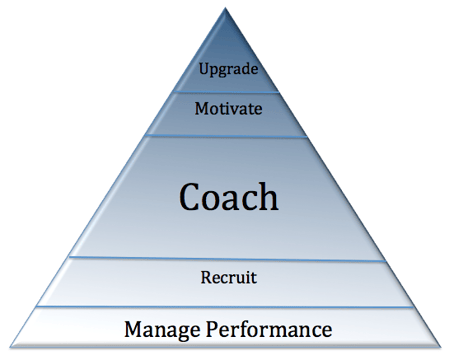
In a Sales Managed Environment®, a sales manager - in order to get the most out of their team - must execute two critical functions:

  • Performance management
  • Coaching

Both of these are contingent on knowing where your individual salespeople want to end up. What is it that is important to them? What is their motivation to do what they have to do to succeed in selling? Knowing that information and using that information to build a solid sales success plan is critical. In addition, gaining personal commitment to achieve personal goals is the only way to improve the probability of professional sales success.

I recall having a discussion with a COO of a large insurance holding company. He was about to address one of the agencies the following day and, as we were eating dinner, he was sharing with me his message. Most of the message was about the company growth and the importance of shareholder value. As gently as I could, I reminded him that the group he was addressing the next day didn't really care about shareholder value. They were more interested in making college payments, getting out of debt and building the cabin on the lake.

And so it is with your salespeople. Unfortunately, you can count on at least 75% of your people failing in the area of setting goals and having a solid goal achievement plan.


OMG-table.png

The information in this chart comes from the Sales Effectiveness and Impact Analysis produced by Objective Management Group – the world leader in sales team evaluations. In a group of 50 salespeople, you can see that 77% of them do not have written goals or a goal management plan.

What does this have to do with a sales manager and starting with the end in mind, you ask? Everything.

  • The people that you have today who are performing in the middle of the bell curve or the wrong end of the 80/20 power curve:  Did you hire them that way or make them that way?
  • Those salespeople who seem to have gotten stuck at a certain level of performance - could it be that they just stopped thinking bigger or are comfortable?
  • Why is it a struggle to keep your sales team motivated?
  • With changes in comp plans and implementation of incentives, why isn’t there more movement toward improvement in results?
  • Why do you find yourself always talking about the same people who don’t seem to be “lifting their weight”?

All of these questions are tied to motivation or the lack of motivation. And that starts with management. If you don’t hire motivated people, you cannot make them that way. And… even the most motivated people need a “shot in the arm” once in a while. Starting with the end in mind, your job/task/responsibility is to create an environment where your people have the opportunity to dream the big dream and have a plan of achievement.

So, start today with these resources:


Topics: success formula, sales management, motivating salespeople

What to Stop, Start and Keep Doing to Drive Sales Growth (part 2 of 3) - What to START Doing:

Posted by Tony Cole on Tue, Feb 02, 2016

Several years ago, I had an eye-opening discussion with one of my largest clients while reviewing the prior year and setting goals for the next year.  During this discussion, my client suggested several critical "Keep Doing, Start Doing and Stop Doing" items that he felt would help us to be even more effective.  This 3-dimensional discussion helped me to understand how we could grow by tweaking some of our traditional approaches.  I think this process is relative to all businesses and has a particular application in regards to building relationships with banking, investment and insurance clients. In our January newsletter, I covered what to stop doing to drive sales growth. Today, we will focus on what to start doing.

Start focusing on helping people get more of what they want: “If you help more people get what they want, you’ll get more of what you want.”  In his essay on compensation, Ralph Waldo Emerson alludes to the law of the universe. The law of the universe fundamentally means that you can neither add nor take from the whole of the universe. If that’s the case and you spend time and energy trying to get more out of the universe, then you must start putting more into it.

Start spending more time on recruiting: One of the reasons managers end up with the wrong people is that they are reactive instead of proactive (this is just one of the many reasons). When you are reactive, you feel desperate, you cut corners, you allow for a wider margin of error and you take on the belief that a warm body is better than no body in the seat.

Start effective performance management: Gathering data in Sales Force or any other database is not performance management. Sending out reports on pipelines and production results is not performance management. Having and implementing a PIP process is not performance management. Performance management is having multiple data points to assess behavior, skill and performance. You then must use that data to develop business intelligence for intentional coaching. Performance management should be about helping people succeed in their selling process rather than using punitive measures.

Start coaching: Coaching is getting the sale pushed through the pipeline to closure. Coaching to change behavior and improve skill is what builds the foundation for long-term growth and success of your people and team. Make sure you have Coaching time scheduled on your calendar each week!

Start making your bottom better: Assume for a minute that you have a sizable sales team - one that has more than 10 people. If you break the group down into quintiles, you have 5 groups of 2. Each of the groups performs at a certain level. Understand that you will always have a top quintile and a bottom quintile. All the Jack Welch’s “fire the bottom 10%” in the world will not actually eliminate the bottom 10%. If you have 10 people, there is always going to be someone who is number 10 or last in the ranking. However, each quintile this year ought to out-perform the same quintiles of last year. Manage to that objective and you will blow your numbers away.


15858808_l.jpg

Start accepting responsibility for results and start making your people do the same: On the stop list was “stop making excuses”. It’s only logical that, on this list, I would include “start taking responsibility”. Own your outcomes. Make your salespeople own their outcomes. If they have no one to blame, they will find a solution or be forced to leave.

Start getting your people to think “extraordinarily”: The standard in too many organizations for too many managers and too many sales people is this: “Just enough is good enough.” The Pareto Principle (80/20 rule) proves this. Implement a goal setting and work plan development strategy.

Start planning and executing effective sales meetings: Did you attend sales meetings that were boring and ineffective? How good are yours today? Do people miss or find excuses/reasons to not be there, come late and/or leave early? Do you find that the sales meetings are having ZERO impact on attitude, activity, performance and results? If they are not having an impact, then just stop doing them. However, if they are something that you are committed to doing, then act like they are more important than any meeting you have. Prepare as if your job depended on it!

Start each year with individual work plans already in place: Time and again, I hear sales managers working with their salespeople on business plans in December. This makes sense ONLY if you have a 30-day sales cycle. For most B2B sales, the cycle is a bit longer. If your cycle is 90-days, then the business/work plan for the coming year should be completed in September.

Start: Today! 

If you missed the What to Stop Doing to Drive Sales Growth article, go to my blog.


Additional Resources:

Personal Goal & Work Plan DevelopmentWorkshop

Questions to Determine Their CommitmentA PDF worksheet

Are My People Motivated?Sample Sales Force Evaluation


What Would You Do with a Non-Performing Stock?

Posted by Tony Cole on Thu, Jan 28, 2016

Suppose… you had a non-performing stock (salesperson).

If you had a stock that hadn’t performed as expected, how long would you hold onto it? Six months, a year, 18 months? Maybe it’s performing like the rest of the stocks in a similar portfolio but not growing as you expected. What do you do with that individual stock? What do you do to the entire portfolio when it’s under-performing?

The answer is simple – you manage it!

As portfolio manager, you:

  • Set metrics for success and standards for each of those metrics.
  • Conduct research/due diligence to make sure that you are adding investments to the portfolio that are consistent with your investment and long term financial goals and risk standards (Cash, Income, Income with growth, Aggressive growth, International growth or a Hybrid)
  • Determine your strategy on buy, hold or sell
  • Establish a method of inspecting what you expect
  • Gain intelligence from the information you gather from quarterly reports and you determine next steps
  • You either buy, hold or sell based on the information you have and the impact that an investment is having on your ability to achieve your goals

What can be accepted as true is that every portfolio is perfectly designed for the results it generates. There is cause and effect. If you are not happy with your results, you change your objectives or portfolio management strategy, right?

Well then, how about the portfolio of investment advisors you have on your team? As program/sales manager you have objectives that you have set out for the entire team/portfolio and when you added investments (people) you had performance expectations. Based on performance, what has to change if anything? Are individual performers pulling their weight or are they a drag on the performance of the team? When you assess your investment in each of the individuals on the team, where do you need to buy, hold or sell? Finally, when you assess the managers managing the portfolio, how effective are they?

You have the awesome responsibility to the stakeholders to put together the best portfolio in order to maximize return on investment. Failure to do so creates a failure in fiduciary responsibility.

See you tomorrow.

Topics: sales management, sales metrics

What to Stop, Start and Keep Doing to Drive Sales Growth (Part 1 of 3)

Posted by Tony Cole on Tue, Jan 19, 2016

stop.jpg

What to STOP Doing:

Stop Worrying About Sales Production!

You can stop worrying if you do the things you should be doing as a sales executive/sales manager. Understand that “doing” doesn’t always mean “start doing”. It does mean that you should stop doing certain things. Bob Newhart in this YouTube video clip coaches this concept very well. Start the start doing by watching this video. Go ahead… I’ll wait…

Stop It!

Stop Recruiting the Wrong People: You know what they look like, act like and sound like. You see it in the current team you have today. Take a look at performance records, daily activity, improvement in skill and you know which people you have that are/were hiring mistakes.

Stop Collecting Data: You are probably collecting data and one of two (maybe three) things is happening: 1) You are doing nothing with the data. In other words, you aren’t taking the time to derive business intelligence from the information. 2) You are only collecting lagging indicator information – pipeline and sales. Neither accurately predicts the future success of an individual performer or the team as a whole. 3) Your coaching from the information is ineffective. Telling someone they need to make more calls, see more people or increase their average size sale isn’t coaching. It’s reporting the weather.

Stop Assuming You are Hiring Nothing but Skilled/Experienced Sales People that Can Get the Job Done: Yes, they might have the experience and they might have a track record. Remember this: sales people are like mutual fund investing – past results are no guarantee of future results. AND even the best require some level of performance management and coaching.

Stop Thinking that “Coaching the Deal” is the Same as Effective Coaching: I come from an athletic background. I played and coached football from the age of 9 to 22. I can probably figure out all the competitive games I played, but I cannot count the number of practices and time outs. Practice is where you coach to improve skill and change behavior. Time outs are for coaching in the moment – to help move a deal or close the deal. They are not the same – don’t treat them that way!

Stop Making and Accepting Excuses: Excuses are the answers to the performance questions of why or how come. When you are attempting to find out from a sales person why the results are not as planned, an excuse maker will blame you, the company, the economy, the pricing, the competition or the dog that used to eat their homework. Stop lowering the bar of acceptable behavior and stop accepting excuses. ALSO stop taking bullets for those that are not performing. Simply admit that you are not developing, coaching, or motivating them appropriately. Or admit that you made a hiring mistake.

Stop Setting Goals from the Top Down: It is not motivational; it doesn’t create ownership and it actually sets up a discussion somewhere over the next 12 months that sounds like – “It wasn’t my goal to begin with” or “I never agreed to that goal.”

Stop Conducting Sales Meetings that People Miss or Want to Miss: Sales meetings should be about selling. Effective sales meetings have 3 rules: 1) Make it a meeting that no one ever misses or finds reasons to miss, show up late or leave early. 2) Focus on nothing but sales –such as ops meetings or emails for ops and administrative issues. 3) Provide  ideas or information that they can leave the meeting with and use RIGHT NOW to drive more sales.

Stop Accepting Mediocre Performance: How do I know you do this? I know this because you probably have a performance chart that looks like a bell curve. You have 3 to 4 standard deviations from the median consisting of people that are underperforming. Your sales results probably resemble the 80/20 rule. But that isn’t unusual. As a matter of fact, it would be expected. You have people on your team that are close to retirement, so their goals may not be as high as middle career sales people. You have new hires that are to the left of the bell curve. But, my guess is that you have others populating the middle of the bell that are simply failing and continue to fail because you let them.

Come back to see the next step – START DOING!

Topics: managing sales people, Sales Growth

Why Sales Practice is Important

Posted by Tony Cole on Wed, Jan 13, 2016

Sales managers, why is it important to practice sales skills?

I watched two field goal kickers kick the ball in the closing minutes of two different games this past weekend. If you’re not a football fan, you probably don’t care about this but you may have heard about it. One kicker kicked a 35 yard winning field goal with 14 seconds left in the game. The other kicker missed a 27 yard field goal with 22 seconds left in the game. One team moved on the other went home.

I don’t know anything about the habits of these two kickers. I can only speak to the kickers I saw practice when I was at the University of Connecticut, the University of Cincinnati and Iowa State University. Greg Sinay, Rich Karlis and Alex Giffords. All three of them spent HOURS on the sideline during practice kicking. Kicking down the sideline, kicking into nets, kicking over goal posts. At the end of practice we would practice ‘special teams’ where the kickers would come onto the field and kick in ‘game like’ situations.

They were prepared to do their best when they were needed the most.

Unlike other position players kickers are called on maybe 3 to 6 times depending on the game. Also sometimes they are called upon to make a play that decides the game. Very rarely are other players ever put in that position.9723670_xxl_team_hands.jpg

How often are your sales people put in a position where they need to be at their very best? How often do you have them practice so that when that moment comes they can perform at their very best? How often do you create ‘game’ situations so that they are prepared for anything a prospect ‘throws’ at them?

Effective selling is a combination of:

  • An effective, consistent approach to the market
  • A strategy to conduct sales calls that focuses on
    • Uncovering the ‘have to fix’ problems of the prospect
    • Providing a solution that fits the requirements of the prospect
    • Presenting a solution so that the prospect values the value proposition
    • Asking for and getting a decision
  • Sales skills
  • Sales DNA

With the right sales DNA, a solid approach to the market and a strategy that is proven to be effective the only piece to the puzzle left is the set of skills piece.

Like all physical and mental skills, sales skills can and will deteriorate over time if not honed. Borrowing from president Lincoln who when asked what he would do if he had 4 hours to cut down a number of trees he responded that he would spend time sharpening the axe. Abe was known as the ‘rail splitter’. He knew how to wield an axe, but he realized that occasionally the axe needed sharpening.

To improve the productivity, the effectiveness and the efficiency of your sales team make sure you spend 1 on 1 time with the and time during sales meetings to practice perfecting sales skills.


Additional resources:

On-Line Library Demo - On Demand Sales Training Content

Talent AssessmentOn-Line Sales Evaluation

Sales Management ResourcesSales Management Environment Certification

Call / Text Tony – 513 226 3913

Topics: sales practice, highly successful sales people


    textunder

    Subscribe Here


    Most Read


    Follow #ACTG


    About our Blog

    Anthony Cole Training Group has been working with financial firms for close to 30 years helping them become more effective in their markets and closing their sales opportunity gap.  ACTG has mastered the art of using science-based data and finely honed coaching strategies to help build effective sales teams.  Don’t miss our weekly sales management blog insights from our team of expert contributors.


    Recent Blogs