ACTG Sales Management Blog

Sales & Sales Management Expertise Blog  

The 2 “MUST TAKE” Steps for Guaranteed Sales Results

Posted by Tony Cole on Mon, Mar 20, 2017

In many cases, here’s the problem: Sales results are not what you expected.  Regardless of your role - sales manager or salesperson - you are looking at your sales results YTD and you are:

  • Not ahead of last year’s production
  • Not on pace to hit this year’s goals (personal or corporate)
  • Not keeping pace with those in your peer group (those you should be able to compete with based on experience and previous success)
  • Not up to par with your efficiency (conversion ratios aren’t the same, average size deal isn’t the same, you’re not getting the leads you used to)
  • Taking longer to get sales closed
  • Running out of time at the end of the week to get your prospecting done


Those are just a few of the symptoms observed by me, my staff and the many companies we work with when attempting to get our heads and arms around driving sales growth.  I have discovered that there are 2 “MUST TAKE” steps to address this; but, first…

I’m shooting in my first ever National Field Archery Association Indoor Nationals Tournament.  My brother, Michael, and his wife, Gwen, owners of Insight Archery in Binghamton, New York, have participated in this tournament for years.  This year, it is in Cincinnati, so I thought I’d enter.  The first round is today.

Yesterday, we went to the Duke Energy Center where the tournament is being held.  We registered, stored our bow cases and made our way to the practice venue.  I’ve been practicing some, but not enough, in the basement of my house.  My wife, Linda, is not thrilled with this, but I'm a pretty good shooter and honestly, there is very little down there for me to damage. 

The range I have in my home is about 11.5 yards long. The scores I am shooting (25 points per end) are really not a good indicator of how I’m shooting because the distance is too short.  The other night I shot a 244 out of a possible 250 and one floor joist when my release strap broke from my wrist and the arrow in the bow got away from me.

(Nice Shot!)

basement arrow.png

Yesterday, we practiced awhile and I realized that the shooting regulation distance – 20 yards – is a WHOLE lot different than the 11.5 yards I’ve been shooting at home.  The main problems, of which there are many, are

  • I can not see very well out of my right eye due to recent surgery.
  • The vision in my left eye isn’t nearly what it used to be.
  • Wearing glasses is not an answer because I haven’t figured out how to see around the frame of the glasses.
  • I shake a little more than I used to when I get up to about 50 shots because I haven’t had the time to practice to build up my endurance.
  • When I shoot by myself, I'm by myself. When you shoot in a tournament, there is someone right behind you and right in front of you creating a heck of a distraction.

When we finished practice, we walked over to another practice range and met up with Hilda, a friend of Mike’s and Gwen’s, who is also shooting in the tournament.  Right next to her was an older large gentleman with his bows and arrows… who  only had one arm.  He’s shooting at the same type of target I am …but minus his right arm.

I’ve seen videos of people doing this and I’ve heard stories about this, but I had never before witnessed it live.  He placed the bow (to rest on the stabilizer) on the floor between his knees.  He notched his arrow and lifted the bow with his left hand to bring the bow string close to his mouth.  He grabbed the release with his teeth and pushed the bow out to full draw with his left hand. He steadied his left arm, sighted slightly with his head and, finally, released the arrow by opening his mouth.

Then and there this article hit me!  I realized that the solution to sales success, sales growth and sales results really comes down to 2 basic fundamentals.  Sure, the man has skills, strength and stamina to do this, but he has 2 other things that trump everything else:

  1. Effort
  2. No Excuses


You don’t just show up at a tournament and NOT put forth the effort to compete... and then expect to compete.

AND… You don't allow excuses to get in the way of the effort (like I did - see above).

Sir, I don't know who you are. But I hope I see you again today, so I can say hello and let you know what an inspiration you are to me and maybe to anyone else who might read this article.

Additional Resources:

The What Works for Biz Interview (Greg Miller interviews Tony Cole): Peak Sales Performers ARE Out There

Master the Sales Managed Environment® with the SME Video Practice Center

Are You Owning Your Sales Results? Listen here

Topics: close more sales, how to improve sales results, no excuses

Defining Sales Success – The Art and Science of A Sales Managed Environment®

Posted by Tony Cole on Tue, Mar 14, 2017

I'm sure someone from the Harvard Business Review or the University of Pennsylvania Wharton School of Business could prove otherwise, but when it comes to defining success, I don’t believe there is an art to it.

Artbusiness.com

  • DeWitt Cheng, freelance art writer and critic, Bay Area, CA: Jorge Luis Borges wrote," Art has become, in the experimental 20th and 21st centuries, impossible to define."
  • Robert Berman, Robert Berman Gallery, Los Angeles: "Reality is by agreement. The reality of art is usually by some kind of agreement. The arbiters are the museums, the museum curators, the people who spend their lives and their time actually being critical of what they see and judging what they see. If you add in four or five art critics who are then able to write about it, if you get four or five major collectors who are passionate about what they collect to patronize it, and several major auction houses to auction it, then a consensus or vetting process begins to unfold."cat art.png

I don’t have the space to include, and you don’t have time to continue to read, all the articles available when I google "What Makes a Work of Art Successful", so we’ll let these two quotes validate that, when it comes to defining sales success, it is best not to be arbitrary or hope for a consensus.

Science Defined by Merriam Webster:

1:  the state of knowing :  knowledge as distinguished from ignorance or misunderstanding

2a :  a department of systematized knowledge as an object of study the science of theology  b :  something (as a sport or technique) that may be studied or learned like systematized knowledge have it down to a science.

It is safe to say that if, within your sales managed environment®, you have "defining success" down to a science, then you will be in a better position to identify:

  • Metrics that determine success
  • What leading indicators lead to success (kind of like a math problem – although there are a multitude of formulas you could use to arrive at the number 4, there are probably only a couple that people would use:
    • 2 +2
    • 3 +1
    • The square root of 16
  • Define the goal to be achieved – it’s a number or a definitive outcome.

But…

Maybe there is something beside the math/science that has to go into it.  I’m not sure it’s art (so I would love to hear from you what you think it is…) but here is what’s been noodling in my head for a couple of days.

This basketball season, Northwestern University of the Big Ten Conference, beat Michigan (Sorry, Jack, Mark and Marty...) with a buzzer beater full court pass and short jump shot.  Take a look here:  NCAA Video

In the aftermath, every sportscaster was talking about how this was the most wins in NWU history, it will be the first time EVER that the school has made it to the NCAA tournament and the coach, Chris Collins, has increased the number of wins every year he has been the head coach at the University.  With the win over Michigan, they recorded their 21st win of the season.  This information would lead us to believe that Coach Collins is successful because you are comparing his results to a standard that is generally accepted as success:  Winning 20 games a season and qualifying for the NCAA tournament.

The head coach at Columbia University with the most wins is Lou Little.  Lou coached the Lions to 110 victories!  When Coach Ray Tellier retired from Columbia in 2002, the article announcing his retirement declared that he was the 2nd all-time “winningest” coach in Columbia’s history behind Lou Little.  When I read this, I was impressed and happy for him; Coach Tellier was an assistant coach at the University of Connecticut when I played there.

What I didn’t know at the time of the article, but found out later, was that Coach Tellier, over a 13-year period, lead his teams to victory 42 times - a 30.7% winning record.  And he was second on the list at Columbia.  Coach Little, with the most wins, had a winning percentage of 48.8% and averaged just over 4 wins a season over a 26-year career as the head coach at Columbia.

What does this have to do with selling and determining sales success? Everything.

Companies collect lots of data and sales managers do their very best to spin a good story when outcomes are not equal to or greater than expectations (goals).  Here are some examples of how outcomes are described when attempting to put a good spin on a bad outcome:

  • We are trending the right direction
  • Our year over year production is positive
  • We are outperforming our peer group
  • We have gone from #____ in stack ranking to #______
  • We will finish in the top percentile of our district
  • _____% of our team will qualify for incentive compensation

Those descriptions tell you nothing about how a team is actually performing.

What to do instead:

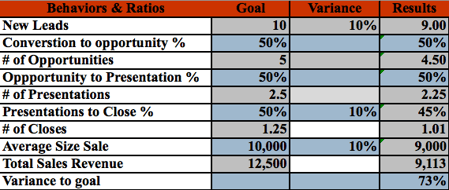
  • Identify metrics that are critical success factors for your organization. (In most organization the #1 metric is revenue – it pays the bills.)
  • Establish standards for those metrics that exceed previous performance levels and are consistent with what the market will allow. (You wouldn’t expect an operating unit in Bangor Maine to produce the same loan revenue as you would an operating unit in Manhattan.)
  • Make sure you are looking at execution metrics so that your success is duplicable and you can identify choke points when there is failure.

Do this now:

  • Call me about Scorecards for sales opportunities – 513.226.3913

Topics: Sales Tracking, sales performance coaching, responsibilities of sales manager, how to hit goals in sales

Why Do Sales People Leave Companies? - Management

Posted by Tony Cole on Wed, Mar 01, 2017

MANAGEMENT RESPONSIBLE FOR A $450 BILLION PROBLEM

According to the article, People Leave Managers, Not Companies by Victor Lipman, the research is unanimous in the premise that managers are directly responsible for the productivity of the people they manage.

Gallup data shows 30% of employees “engaged.” Towers Watson data shows 35% “highly engaged.” Dale Carnegie data shows 29% “fully engaged.” And these aren’t small studies; the Gallup survey includes more than 350,000 respondents and the Towers Watson survey includes more than 32,000. Gallup goes on to estimate an annual cost in lost U.S. productivity of more than $450 billion. This is a staggering figure. Even if it’s imprecise, it gives a sense of the magnitude of the problem.”

INTERESTED IS NOT ENGAGED

My mandolin teacher is a better player than he is a teacher. I’ve not had music lessons before so I may not be an accurate judge of what makes a good music teacher, but I have been taught and coached before.  The best ones have always engaged me by first understanding what I wanted to accomplish, getting a feel for my current state (skill level) and assessing my commitment to being better.  I’ve not had this discussion with John at all. The starting point in my lessons was him jumping in and telling me about keys, chords, progressions and scales.  I might as well take Greek lessons.  I was interested… but not engaged.

lessons-playing.jpg

“LOSING THE SCHOLARSHIP”

I will not seek out another instructor… nor will I tell him he’s ineffective as a teacher because he spends his time showing off stuff that will take me years to learn while I pick my way through the Godfather Theme for the 1000th time.  Why?  Because I don’t have time to seek out someone else, I am learning something and, most importantly, I'm not going to “lose my scholarship” if I don’t get Country Boy by John Denver.

What does this have to do with managers, specifically sales managers? Everything.

I will admit that I just signed up for the music instructor that they had available.

  • Kind of like a salesperson taking a job and really not knowing the qualifications of the manager that will be leading them to success.

I will admit that I’m approaching music as a pastime and not like my life or my retirement plans depend on my music skills.

  • Kind of like a salesperson taking a new sales role and really not understanding what the expectations are for success in the first 90 days
  • Kind of like salespeople already on the staff that are “at leasters” and aren’t worried about their position because, as long as there are people below them on the stack ranking, they won’t “lose their scholarship” (job).

TWO POSSIBILITIES… ONE EVENTUAL OUTCOME

Eventually, one of two things happen:

  1. The company catches up with the WITALAIITUs and the salespeople get put on PIPs. They respond well enough to keep their job or they immediately start looking for a new one.
  2. Or they get fed up with the hassles of performing better without any significant support, training or coaching to help them get better and so they leave.

THE PROBLEM PERSISTS BECAUSE BUSINESS ALLOWS IT

At the end of the day, the turnover ratios in the company continue to put a drain on profitability. HR and hiring managers explain it all away as “the nature of our business”. 

It’s the nature of the business only because business allows it to be so. They allow ineffective recruiting, poor on-boarding, sloppy or missing solid performance management and last, but not least, the continuation of ineffective of coaching.

3 SOLUTIONS TO ADDRESS THE PROBLEM NOW

What to do?  These three things will get you started:

  1. Start with Better Ingredients - Like the cooking analogies I’ve used before, start with fresh ingredients. In this case, I mean start with better people.  I don’t mean people that are just better from a moral or ethical perspective, although that's normally pretty important.  In this case, I mean start with people that fit your culture and will do well on the scorecard for success.

Sample Scorecard For Success:

scorecard-2.png

  1. Have a Supportive Sales Managed Environment® - You have to have the structure in place so that the person in charge of running the show won’t have excuses or reasons to fail.  Essentially, you need to have systems in place for:
    1. Performance management
    2. Upgrading the sales force
    3. Motivating the sales team
    4. Coaching for success
    5. Recruiting top talent
  2. Management with a Coaching Bias - Phil Jensen spoke of the 3rd factor (as it relates to coaching) several years ago at an Ecsell Institute Sales Management Summit. The concept is simple.  There are two factors that most of us rely on to function and succeed – Nature and Nurture.  Jensen suggest that people also rely on a third factor – in the case of successful managers, they have a “coaching bias”. That is their 3rd factor.  They care more about developing people than they do anything else.  They experience success as a result of the success of the people they are coaching.

Additional Resources:

No More Hiring Mistakes. Guaranteed! – http://www.hirebettersalespeople.com

Identify Your Systems and Processes – Sales Effectiveness and Impact Analysis Sample

Topics: sales talent acquisition, sales performance coaching, responsibilities of sales manager

Intentional Sales Coaching – You Can’t Coach "Tall"

Posted by Tony Cole on Wed, Feb 22, 2017

YOUR BIGGEST UNDETECTED CHALLENGE

One of the biggest challenges, mostly an undetected challenge, is providing coaching that is customized and intentional to the individual need.  I say “undetected” because most, if not all, of the time coaching is done based on symptoms:

symptom-chart1.png

I could add another 10 symptoms to the list, but I’m sure this has already caused you some nausea.  It doesn’t matter if you are a sales manager attempting to do the coaching or the sales person on the receiving end of the coaching, you probably feel the same way.  I’m tired of sales training, I’m tired of going to the same classes over and over again, I’m tired of telling my people they have to do a better job at cross-selling, getting introductions, networking and asking for the business.

In the end, everyone is sick and tired because, after all the training time, after all the role-playing and after all the investment of money, you look at the results and not a lot has changed.  How come? Well, because you can’t coach TALL.

YOU CAN’T COACH “TALL”

My daughter (recently engaged - thank you) played basketball in 7th grade.  She then tried volleyball but found her love of performing in front of others, not on the fields or courts of athletics, but on the stage of music and theatre. 

I was watching her basketball practice one day and was thinking she had a chance to be a player on the high school team, but she would need a lot of work on the fundamentals: handling the ball, keeping the ball up when rebounding and pivoting while in the low post.  After practice, I went to the coach and asked him what he thought. 

Like a lot of coaches who have to address parents when they ask about their child’s skill and potential, he couched his remarks carefully.  He stated what I had been thinking about her skills and fundamentals and then he said that she would still probably be a starter.  Somewhat surprised, I asked, “How come?”  He said, “You can’t teach tall.”

You see, Alex in 7th grade was already almost 6’ tall.  She could out rebound people because they simply couldn’t reach the balls that she could reach.  She was good enough on defense and blocked out well so she had some things going for her that helped her overcome any weaknesses she had that might have kept a shorter player from being a starter. (Watch this exception to the rule.)  Besides, she had dad, a former coach, to keep her working hard and disciplined. 

Alex-tall.png

 **Note:  Alex’s height created an interesting sight on the stage when she played the queen in Cinderella.  With her hair pushed up on her head and a crown she was at least 6’4”.  The leading man… about 5’4”.  It was funny.

INTENTIONAL COACHING IS ALL ABOUT THE ROOT

The thing about intentional coaching is that, in order to get changes in behaviors and improvement in skills, you have to understand the root cause of the problem:

symptom-chart2.png

The coaching required to address the symptoms is not teaching them a new technique or process.  It is not enrolling them in a wealth certification program.  It is not having them take a time management course.  The coaching required has to address the root issue.  For example...

Problem: I don’t have time to prospect. I have too much account management work to do.

Solution(s):  Assign account managers (and they still won’t prospect, they’ll just find another excuse) or enroll them in a time management class.

ADDRESSING THE ROOT CAUSE IS REALLY THIS SIMPLE

SO…that isn’t the answer for dealing with excuses (audio). 

The solution is to ask them, “If I didn't let you use that as an excuse, what would you be doing differently?”

This addresses the root issue.  I can guess that you’re thinking that it cannot be that simple. I assure you can call anyone of the hundreds of salespeople we’ve coached or salespeople we’ve trained and they will ALL tell you that IT makes a difference.  It changes things because you’re now dealing with the correct end of the problem!

KNOW ABOUT ROOT ISSUES WHEN HIRING

Finally, think about the candidates that you are hiring. There are things they have to come to the table with that you cannot coach or you don't have time to coach. Take a look at this screen shot of the sample pre-hire assessment we use to guarantee no more hiring mistakes:

omg-pic-2.pngWouldn’t you want to know in advance that they had desire and commitment to be successful in SELLING?  How helpful would it be to know in advance that they will struggle with rejections but they will be great talking about money?  Take a look at the next shot:omg-pic-3.png

Even though there are some obvious areas of weakness, this candidate is recommended for hire. (When a hire is made based on a "recommended for hire" finding, like this candidate, 92% of the time that candidate will be a successful sales person.) The benefit of having this information is that, if you were to hire this individual, you would know the extent of your "project" and exactly what you would need to do to help them be successful in your organization.

However, having said that, there are still factors that need to be considered. Look at the work that has to be done... AND notice this: the findins say they are trainable but are not considered coachable.  Do you want to take that on? Do you have the bandwidth to take that on?  If not, then this is a hire that shouldn’t be made.  Now, consider how many of your people today might look like this and what’s that costing you?

Additional Resources:

Topics: improve sales, sales performance coaching, development of sales, sales recruiitment

Why Prospects are Like Fruit

Posted by Tony Cole on Fri, Feb 17, 2017

Years ago, while attending the Objective Management Group International Sales Conference, Dave Kurlan, president of OMG, talked about how to effectively manage opportunities through the pipeline.  He made the analogy that prospects are like fruit and vegetables in the produce section of your local grocery – they are all perishable.

“In The End, We’re All Just Fruit” – Watch the video!

we-are-fruit.jpg

That phrase has stuck with me all these years, and we continue to reference it when we are presenting our Effective Sales System (this article has 2600 views – it’s worth reading) workshops and when we are working with our new clients for hirebettersalespeople.com. 

NOT EVERYONE HAS THE SAME "SHELF LIFE"

Prospects:  They have a shelf life just like fruit: some of them a little longer than others.  Bananas – not so long, apples and mandarins a little longer, potatoes – not forever, but if they start to sprout, you can at least plant them in the ground and get more potatoes.  The bottom line is that none of them last forever.  You need to either eat them or find a way to preserve them for later.

As you go about looking at the shelves (prospecting in the market) for the produce you need for tonight’s meal or for meals over the next couple of days, you need to be somewhat selective so that the food you select today is fresh enough for cooking and or consuming over a short period of time.  I can buy a bag of potatoes and probably use them in two weeks.  Buy a bunch of bananas and we’ll need to eat them soon or else next week we will have to turn them into banana bread.

WHEN IT'S TIME, IT'S TIME

The same holds true for prospects relative to their buy cycle.  They are not in that cycle forever. Depending on what services you sell, they could be off the shelf in a week.  They may be in the looking, considering, “thinking about” cycle for a while, but once they decide to buy – it’s time to buy!

Years ago, I was in the market for a new vehicle.  The Chevy Avalanche had been out for a couple of years and I knew, when the day came, that was going to be my purchase. There is a Chevy dealership just down the road from my house in Montgomery, Ohio where I had purchased vehicles in the past from the manager Bill Wentzel.  When the day came – my lease was expiring – I went to Bill, told him I had a check in my pocket and would like to test drive the red Avalanche. I asked him if he would get me a salesperson who wouldn’t get in the way and just let me buy.

Two hours later – that’s because the paper work takes that long- I drove off of the lot in my new shiny red Avalanche.

***Note to bankers, advisors and insurance sales people***  
Your prospects are ALWAYS in the market.  EVERYONE you sell to is using, consuming and/or shopping for the services you offer.  Your timing has to be good, but it doesn’t have to be great. What has to be GREAT is your constant contact with them so that, when they are ready, you are top of mind.


DON'T LET PROSPECTS PERISH

Here is my real point.  When going out into the market, you can find yourself wasting your time with produce/prospects that aren’t quite ready or are already past their prime time for consumption:

  • Potatoes too green
  • Bananas too green
  • Tomatoes too yellow
  • Peaches too mushy
  • Stickers on meat packages that say “reduced”
  • Just renewed my insurance
  • Our lease expires in 11 months
  • We have to wait until this election is over

If you want to close more business, more quickly at higher margins, then find the highly perishable prospects – work with them on solving their problem. Present a solution to them and get them off of the shelf.  Do not neglect the potatoes, bananas, tomatoes or green beans; continue to check on them, plant them in your database (your CRM) and, when the time comes to make potato salad, they will be ready.

Additional Resources:

How Effective is Your Sales Process?

Do You Need Better “Shoppers” (sales people) Who Won’t Perish? Sales Mistake Calculator

How to Determine a Qualified Prospect – Post-Call Checklist/Scorecard

Topics: Pipeline management, sales prospecting, closing sales


    textunder

    Subscribe Here


    Most Read


    Follow #ACTG


    About our Blog

    Anthony Cole Training Group has been working with financial firms for close to 30 years helping them become more effective in their markets and closing their sales opportunity gap.  ACTG has mastered the art of using science-based data and finely honed coaching strategies to help build effective sales teams.  Don’t miss our weekly sales management blog insights from our team of expert contributors.


    Recent Blogs