ACTG Sales Management Blog

Sales & Sales Management Expertise Blog  

Sales Management Mindset: The 10% Difference

Posted by Tony Cole on Thu, Aug 07, 2025

Increase sales with your team by coaching them to a simple 10% increase in effort and skill. With this sales management mindset and the right resources, sales leaders can mentor their salespeople to better performance and results.

Most organizations are evaluating where they stand to date and how their performance projects out for end-of-year results versus growth goals. It is past the mid-year mark, and sales leaders are working to determine what they can do to drive focus, increase sales, and improve results. Those who have a sales management mindset understand that a little goes a long way. Here is a strategy to help organizations achieve a 10% difference that can equal a 67% return on investment.

The 10% Difference begins with 10% more effort. It does not seem too tough to ask your team for 10% more effort, nor is it usually received negatively. Translating it: if a producer makes 15 calls a week, asking them to make 2 more calls is not a huge stretch. For those salespeople who truly want to improve and increase their revenue, they will welcome the challenge, especially when you explain that this is the first step to increase sales and potentially drive a 67% increase in their results.

Using your sales management mindset, it will be helpful to provide suggestions and training to help them accomplish their increased effort. Putting 10% more into prospecting can mean asking for more introductions, meeting with centers of influence, connecting on social media, and turning association meetings into new suspects. It does not mean they have to cold call more, so spend time in sales meetings and huddles focusing on warm introductions and networking skills.

The steps to increase sales are straightforward. They just take consistent and persistent application. Salespeople do not have to invent a whole new way of doing things. They just need to improve on what they are already doing by 10%. Here are the areas that will make a huge difference in improving results:

  1. Effort – 10% more effort will result in more appointments, even without skill improvement.

  2. Phone Skills – Improve phone skills and convert 10% more contacts to appointments. Ask your top producers to share their approach or try our 8-Step Phone Approach.

  3. Qualifying Skills – Improve qualifying skills by 10% and gain 10% more opportunities. Share a list of “drill down” questions with your team and role play important sales calls.

  4. Conversion Rates – Even if salespeople maintain their current conversion rates, they will increase results simply because they have added more prospects to the pipeline.

  5. Increase Average Sale – Increase the average sale by 10%. For example, instead of $10,000 deals, aim for $11,000 deals. Helping the team understand and communicate their value can support this.

In case you receive the time objection when introducing the 10% Difference, here is how to address it:

“I Don’t Have Time” Myth – We know that if a salesperson attempts to call ten people a day, they will not talk to eight of them. So, how long does it take to not talk to eight people? Eliminate excuse-making by asking, “What would you do differently if you could not use that as an excuse?”

Sales leaders, if you can get your team to increase effort, qualifying skills, and average deal size, they will achieve much more than a simple 10% improvement. We say 67% increase because it catches attention and we have math to back it up. Go see what kind of increase in sales you can achieve with the 10% Difference.


Topics: Sales Training, Sales Management Training, sales management mindset

Sales Management Mindset: Are You Thinking Presidentially?

Posted by Tony Cole on Fri, Aug 01, 2025

Are you thinking presidentially? Not the Obama, Bush, Lincoln, Washington kind of presidential. More like the thinking of Larry Ellison, Alan Mulally, and Beth Mooney. All are or were chiefs, and, at one time, were also presidents. But prior to that, at some point in their careers, they were managers of something.

One quality that separated them was their sales management mindset of thinking presidentially. They looked at the role of manager through the eyes of a president. In other words, I’m sure they thought, “If this were my company, what would I do?”

At a recent leadership conference, there was a breakout session just for business leaders focused on discussing the challenges they were having with building, growing, or sustaining their businesses. Here is the list of items identified by this group as necessary for growth and sustainability. Reviewing this list with your sales management mindset in place, are you thinking presidentially about your business or sales team?

Thinking Presidentially with a Sales Management Mindset

Diverse Revenue Generation (products) – Are your people selling only one solution to your clients? Or are they developing multiple financial relationships through multiple solutions?

Multiple Generations – Are your people talking to the families of those they work with, developing relationships that last for multiple generations? Here's a startling statistic: $84 trillion is expected to transfer from Boomers to Millennials within the next 15 to 20 years. Financial institutions need to deepen and broaden their relationships within their customer bases.

Diverse Revenue Streams – As a manager, is your success dependent upon the few? If 80% of your business is coming from only 20% of your producers, your performance is at risk if you lose one or two salespeople from the 20% side of the equation.

Systems and Processes – Think dashboard, not just odometer. Knowing how much has been sold and how much is in the pipeline is a look back. What systems and processes do you have in place to help you predict how many calls to quality prospects your team makes, and how many appointments, proposals, and wins you can count on?

Reasons to Stay – If you have only two or three people keeping your sales numbers healthy, what are their reasons to stay? Understanding the motivation of individual producers is critical to retaining quality people.

Management of the Firm – If something were to happen to you, what would happen to the team? If the answer is “nothing changes,” is that because you are having little impact on the outcomes or because you have built a structure that allows for sustainability?

Financial Predictability – This ties back to systems and processes. If your president asked you what you thought would close in the pipeline in 6 days, 6 weeks, or 6 months from now, what could you tell her?

Cash Flow – How do the presidential numbers look? The “sales numbers” are just part of the equation. You have business contracted for, realized revenue, and profit. It isn’t just about what is sold or top-line revenue. It is also about how much are we keeping and when the money will be realized.

Risk Management – Where are you at risk today? Competition, losing key salespeople, pricing, the economy, investment in bad hires? Are you aware of the risks, and what are you doing about them?

Thinking presidentially is a critical sales management mindset for anyone who is leading or managing a sales team.

Now is a great time of year to work on your business. Take a look at the list and do an honest evaluation of where you are and how you stack up. This may not be the end-all list of things to consider when building or managing your sales team, but it’s a great start.


FAQs

1. What does it mean to “think presidentially” in sales management?
Thinking presidentially means managing beyond just sales numbers. It involves considering long-term sustainability, risk management, team structure, cash flow, and financial predictability—much like a president would oversee the entire organization.

2. Why is it risky to rely on only a few top producers for revenue?
If 80% of your business comes from 20% of your team, losing even one top performer can drastically affect your performance. A healthy sales organization diversifies production and builds strength across the team.

3. How can sales managers improve financial predictability and reduce risk?
By implementing systems that track leading indicators like calls, appointments, and proposals—not just past sales—managers can better forecast revenue, manage cash flow, and proactively address risks such as turnover or market shifts.

Can we help you find the right  approach for your company?


Topics: Sales Training, Sales Management Training, sales management mindset

Developing Your Unique Sales Approach

Posted by Tony Cole on Fri, Jul 25, 2025

In today’s world of marketing and sales, a significant key to generating leads is a company’s ability to get potential buyers to find them. Hence the success of inbound marketing and social media management companies such as HubSpot, Marketo, and Pardot.

If you go to their sites you will find an endless number of free products and services that help drive potential buyers to your website, your blog, and any social networks you might be using. All of this is important, but the systems and processes don’t stand alone when it comes to gaining attention and driving internet traffic toward your sales offerings and online resources.

Powerful messaging is still needed; a unique sales approach that captures the attention of your specific market. A unique sales approach that helps the market become aware of one or two things:

  • A problem or potential problem they were unaware of, or
  • A growth opportunity or positive outcome that is available.

Mark Roberge, in his book The Sales Acceleration Formula, describes this first step in a prospect’s buying process as the Awareness Stage. Effective marketing helps create awareness. But there are many stimuli, which aren’t internet-based, that would cause someone to buy, change behavior or take action:

  1. A neighbor raves about a new movie – you go see the movie.

  2. A friend suffers severe water damage in their 25-year-old home, hires a company to repair the damage and relates the story to you – you call the company to inspect your basement to head off potential problems.

  3. A co-worker talks about completing a financial plan that will help them secure their future – you want to know who they are working with and you call that advisor to set up an appointment.

These “leads” for the movie, the basement sealant company, and the financial advisor take place because of great reviews by current clients. These informal introductions/referrals have always been, and probably always will be, the best way to get GREAT leads. But what else should you be doing—must you be doing—to generate leads that don’t come from personal introductions and referrals?

You must have your own unique sales approach that stands alone; a message that when read, heard, or seen causes awareness that takes a buyer from passive to active. The question becomes: “What must that message say to procure this transition?” This may take some time and mind space to figure out.

No one communicates to the marketplace the negative aspects of their products. Everyone has top-of-the-line products, great pricing, unparalleled service, professional and courteous sales associates who care only about you and your family. With that as the backdrop, in creating your unique sales approach, the question becomes “What is the one thing I can say or do to differentiate and get the market’s attention?”

The answer? Deliver a message that doesn’t look, act, or sound like everyone else’s message. Communicate in such a way so that people instantly think “This is different.”

  • The elevator pitch
  • The value proposition
  • The 30-second commercial
  • The Unique Sales Approach
  • The brand promise

The Unique Sales Approach Message

The message has many names, but it should communicate, in a brief, appealing, and effective manner, how the company and product will work for the end user. You must of course have the broader talk nailed to support the brief intro.

  • Nike – “Just do it.”
  • The Late John Savage (Insurance professional) – “I deliver buckets of money when people need it the most.”
  • Geico – “15 minutes or less can save you 15% or more on your car insurance.”
  • Verizon – “Can you hear me now?”
  • Anthony Cole Training Group – “We help organizations sell better, coach better and hire better.”

Your compelling message should elicit one of the three following responses:

  • “Tell me more.”
  • “How do you do that?”
  • “That’s me (us). How can I fix it?”

The best way to create a powerful unique sales approach is to listen to your message as if you are a prospective buyer. Better yet, gain the feedback of your message from current clients within your niche market. When you deliver your message to you, do you look, act, or sound like everyone else? If so – change your message.

Can we help you find the right  approach for your company?


Topics: Sales Training, unique sales approach

The Real Power of Predictive Sales Assessments: Seeing What Others Can’t

Posted by Objective Management Group on Fri, Jul 18, 2025

This article was originally published by Objective Management Group and written by Ben Tagoe, CEO of OMG. It is shared here with permission. Anthony Cole Training Group is a Certified OMG Partner, helping organizations hire and develop high-performing sales teams using OMG’s industry-leading assessments and insights.

Why the strength of any model lies in its ability to separate success from struggle.

At OMG, we believe in empowering sales organizations through clarity. And clarity starts with knowing who will thrive—and who may need support.

In sales, not all assessments are created equal. The true value of any predictive model—whether you’re measuring creditworthiness, ad targeting, or sales skills—is in how well it can forecast real-world outcomes.

In our case, the outcome we care most about is success in sales.

At Objective Management Group (OMG), we use data to predict whether a salesperson is likely to succeed. But we don’t stop at theory—we track how well our model actually works by comparing assessment scores to real-world sales performance.

So, how do we know it’s working?

We look at two groups:

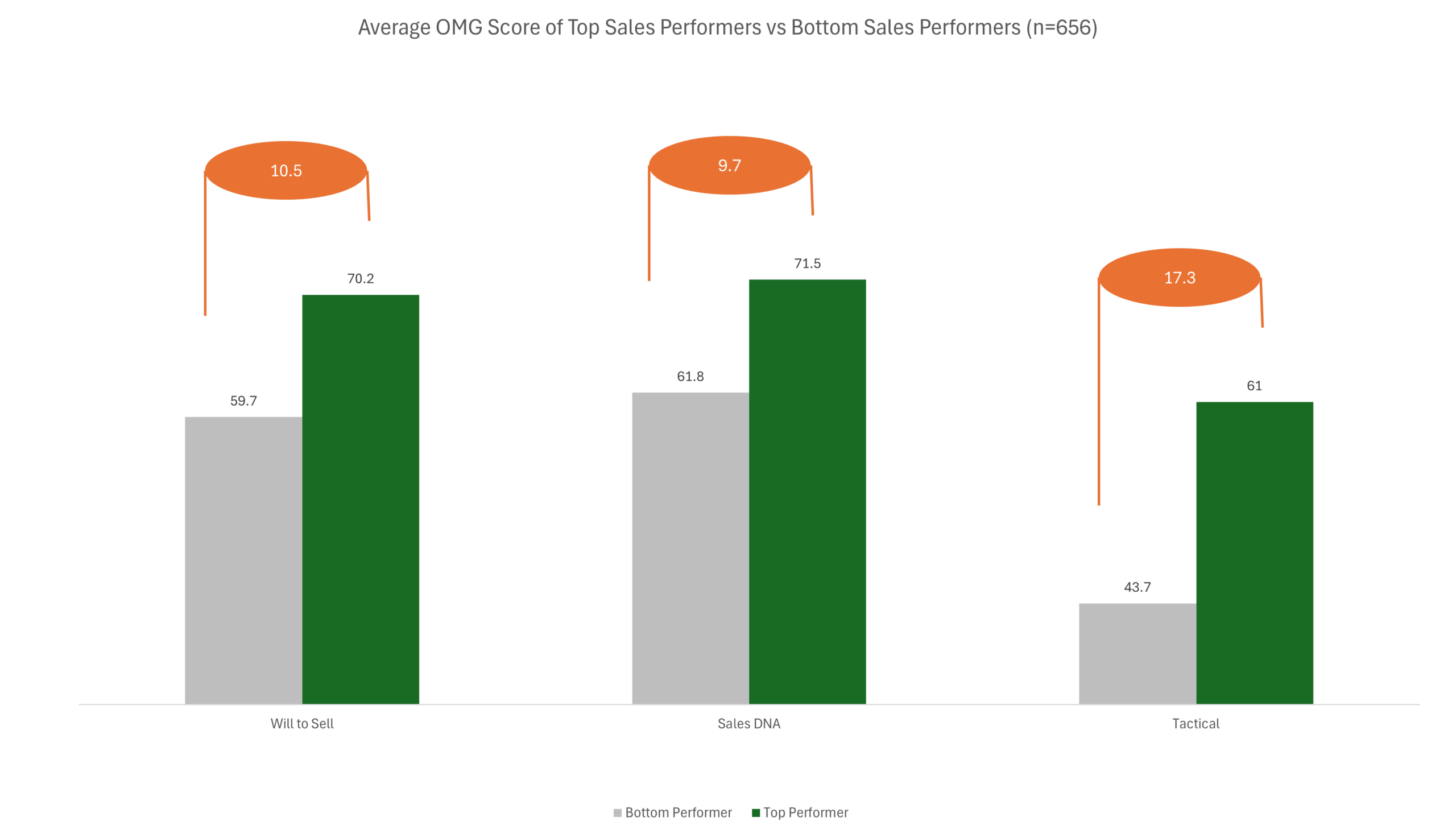
Top performers—those with above-average win rates and high-performance ratings from their companies.

Low performers—those who fall short on both.

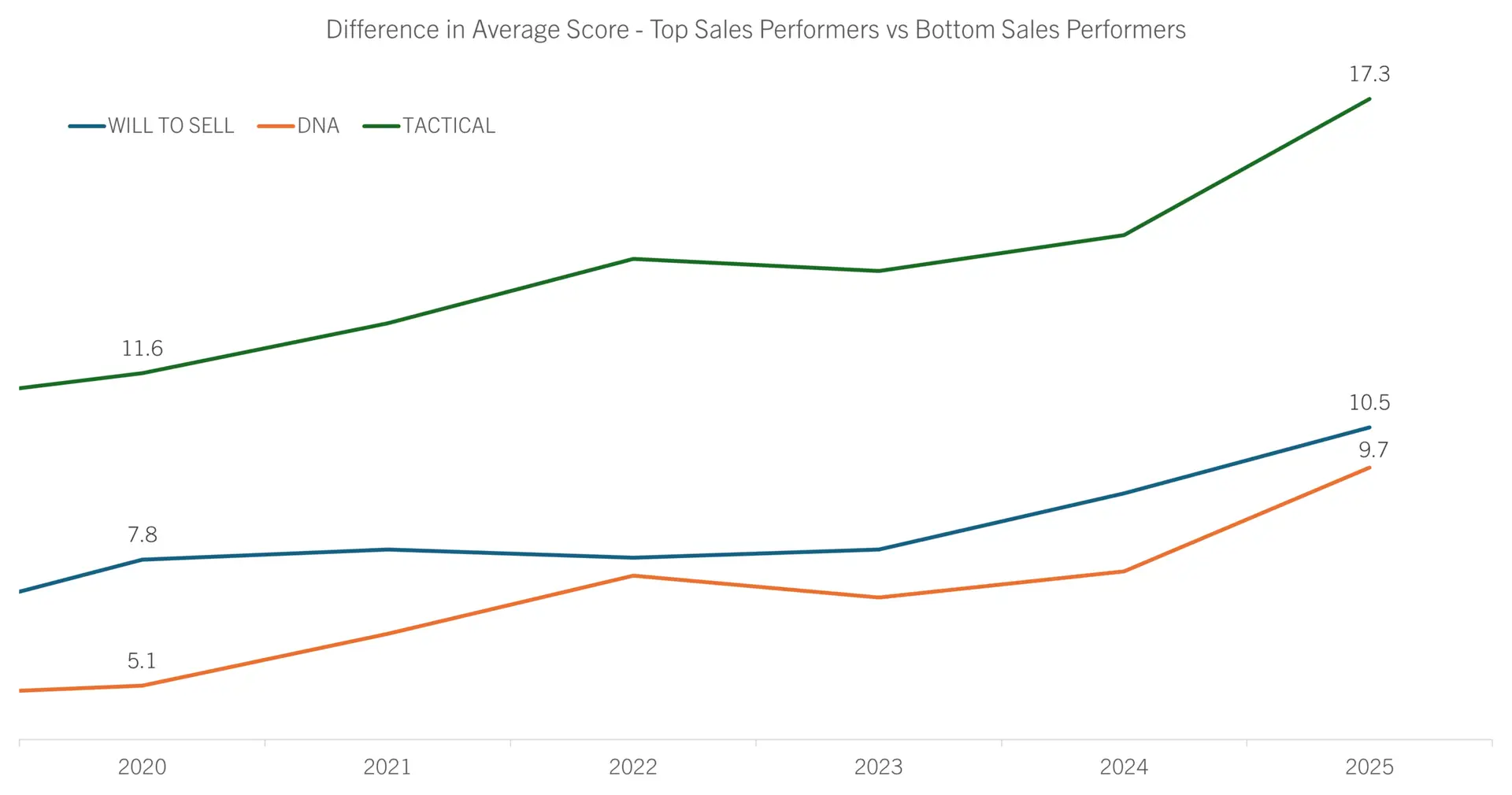
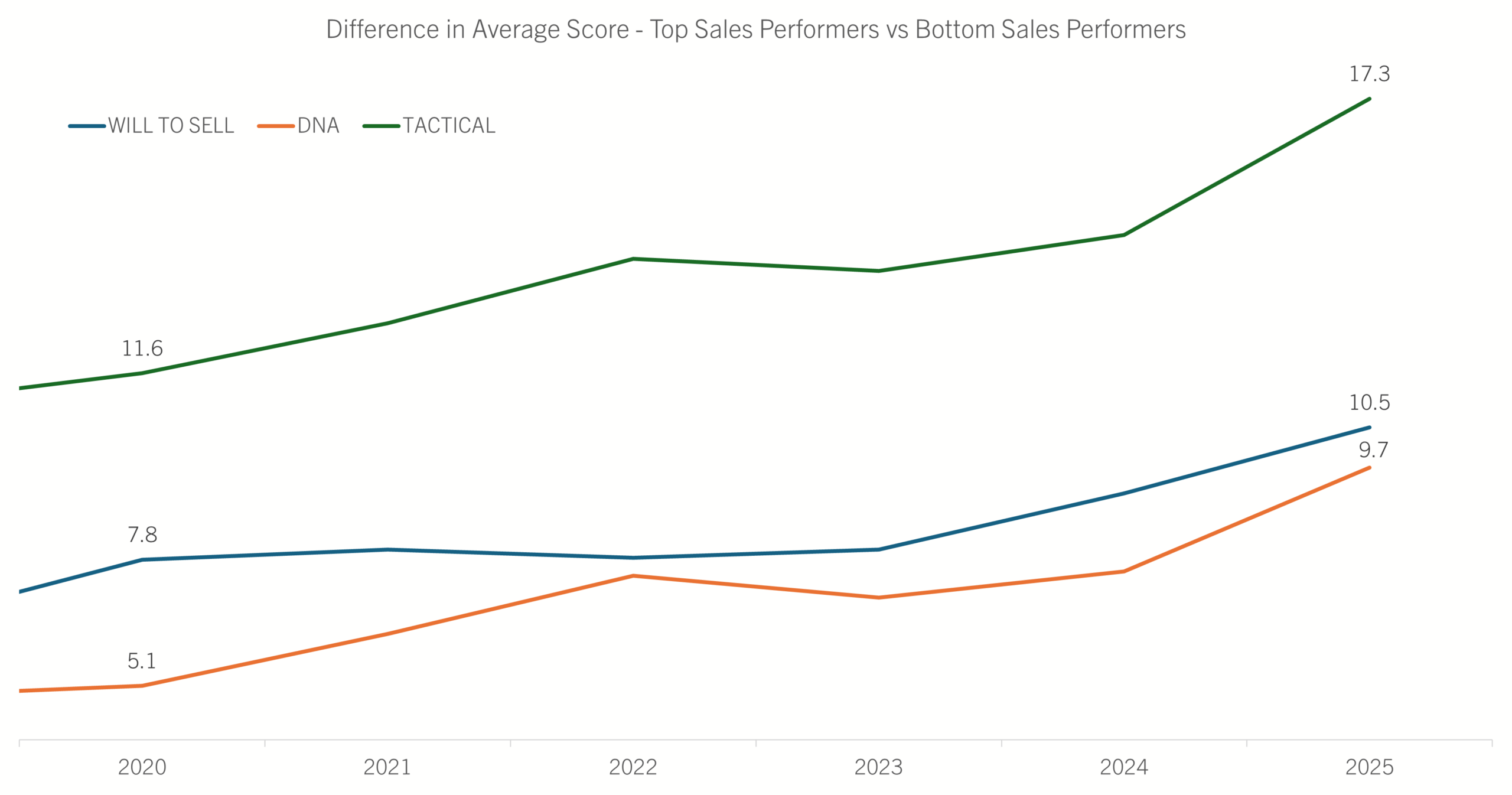
And the difference between these two groups? It’s not just noticeable – it’s statistically significant. Our top performers consistently score higher on OMG assessments, with results separating out by a margin of three standard deviations. That means the model isn’t just accurate—it’s highly predictive.


Getting Stronger with Time

What excites us even more is this: the gap between high and low performers is growing.

Over time, our model has become even better at identifying the attributes of successful salespeople. That’s because we’re constantly learning. As more data flows in, our understanding sharpens—and so does the assessment’s predictive power.

This matters, because it helps sales organizations make better hiring decisions, build stronger teams, and provide the right coaching where it’s needed most.


Why it matters: It’s not just about predicting performance – it’s about unlocking potential.

Our goal isn’t just to sort people into “good” or “bad” buckets. It’s to give sales leaders clarity. To help them recognize top talent, support those on the rise, and invest in the kind of coaching that changes careers.

That’s what predictive modeling should do.

It should see what others can’t—and help people grow because of it.

Request Free  Sales Force Performance  Evaluation Samples


Topics: Sales Training, sales assessment

A Smarter Way to Generate Leads

Posted by Tony Cole on Thu, Jul 10, 2025

Selling to Zebras is a focused and effective lead generation strategy. There is no mistaking a zebra when you see one. If you book a safari to see the great African elephant and all you see is zebras, you're going to be disappointed. Maybe not the first couple days, because zebras are pretty cool—they’ve got those stripes. But eventually, you want to see that elephant. And when you do, there will be no mistaking the elephant for the zebra.

So it is with effective lead generation. Generating leads for new business isn't just a combination of behaviors and skills. As a sales leader, make sure that your salespeople are growing their business using the solid practice management strategy called Selling to Zebras. This concept came from Chad Kozier, the author of the book Selling to Zebras, and here are a few key concepts to implement with your team:

Three Simple Lead Generation Steps to Selling to Zebras

1. Segment your book into thirds.
Take a look at the top third of your business. If your business is like most, that top third represents over 90% of your revenue. These are your best clients. The idea behind Selling to Zebras is to ensure your lead generation strategy focuses on attracting more active buyers who resemble those top-tier clients.

2. Identify common traits and demographics.
What do your top clients have in common? Consider factors like industry, point of contact, how you made the connection, volume of sales or size of the organization, and key trigger points that signal they’re ready to buy.

3. Focus your time wisely.
Commit at least two-thirds of your lead generation time to looking for or attracting only those companies or individuals who resemble your top third. Avoid wasting time on unqualified or mismatched leads.

Bonus Tip for Your Salespeople

Chances are, the top third of each salesperson’s clients know at least five other companies like them. They should ask them for introductions. It’s a powerful way to leverage their existing network for growth.

Of equal importance is for every salesperson to know and be able to clearly articulate what isn’t a Zebra for them. This helps to bring clarity to their network and prospecting efforts. Here are some reasons why knowing what isn’t a Zebra is so important for salespeople:

It Eliminates Ambiguity

  • If you aren’t specific about who you serve best, it’s hard to get introductions. If you are vague in your prospect description, it will be more difficult to ask your advocates for introductions. Introductions have been proven to be the #1 lead generation strategy for top producers to grow their business. You must be specific and clear about what type of Zebra you serve best.

It Reduces Your Opportunity Cost

  • Every salesperson’s opportunity cost is simply this: if you called on Company ABC, that means you aren’t working on Company XYZ. Your opportunity cost is what you aren’t working on that might be more viable for you and your organization.

If you know what you don’t want and the reasons why, it might reduce the quantity of opportunities in your pipeline, but the quality will increase dramatically. As a sales leader, take some time in your next team meeting to help your sales team improve their lead generation efforts and success with Selling to Zebras.

Free eBook Download: Find Out if Your  Salespeople Can and Will SELL


Topics: Sales Training, generate leads, lead generation


    textunder

    Subscribe Here


    Most Read


    Follow #ACTG


    About our Blog

    Anthony Cole Training Group has been working with financial firms for close to 30 years helping them become more effective in their markets and closing their sales opportunity gap.  ACTG has mastered the art of using science-based data and finely honed coaching strategies to help build effective sales teams.  Don’t miss our weekly sales management blog insights from our team of expert contributors.


    Recent Blogs