ACTG Sales Management Blog

Sales & Sales Management Expertise Blog  

Tony Cole

Recent Posts

6 Lessons for Sales Organizations I Learned on Summer Vacation: Part 1

Posted by Tony Cole on Fri, Aug 28, 2020

Everyday, there are things that can be learned that can impact our personal and professional lives.


In this week's blog, our Chief Learning Officer Tony Cole will discuss a few of the sales lessons he took away from his summer vacation.

MIvacation

Linda and I just came back from our first big RV camping trip where we visited Michigan. Upon my return, I received an email from Alex asking me if I had any brilliant insights to share with you all from my trip that might relate to growing sales. Here are the first 3 of 6 lessons I learned during our trip.


1. Enjoy the journey. We learned that there is normal travel time, and then there is RV time. My google maps would tell me I had a 240-mile, 4-hour journey, and I would arrive at 2:14 PM. I would drive for 30 minutes, look at my google map only to discover that I now had a 241-mile journey and I would arrive at 2:22.

  • As you plan your sales success, you must understand that the journey will take longer, and you will likely run into detours, accidents, and slowdowns.

  • If you do not slow down and enjoy each stop along the way, you will become irritable and frustrated. This will cause you to move things along faster and, when you do, you will miss steps and sights along the way, damage relationships, and potentially get lost.


2. Have a process and follow the process. For those of you that have RVs, you understand what I am talking about. You have to make sure that certain steps are taken so that you don’t; rip vents off of the roof, have contents falling out of your storage bins, leak your freshwater reserve, run out of propane, or get a flat tire.

  • What we know thanks to the Objective Management Group is that 95% of Elite or Strong Salespeople (roughly only 25% of all 2 million salespeople assessed) follow a consistent sales process. What is important to note today though, is that the process is more of an approach so that the salesperson can focus on the buyer’s process.
  • Don’t assume you’ve followed the process. Have a milestone-centric system within your CRM system (Membrain) so that you can check off each step along the way. There were at least 3 occasions on our trip when Linda would ask me, “did you…” and I would have to review my steps just to make sure I covered every detail.


3. Sales growth requires nurturing. Driving through Ohio and Indiana, you will see more corn then you ever imagined. As you get into the western region of Michigan you start to see signs for cherries, apples, blueberries, corn, peaches, and all manner of fruits and vegetable stands. It reminded me of my days on the farm and how we had to nurture plants to maximize production. It did not matter how old or young the plants were. They needed soil, water, sunshine, and food.

  • No matter where you are in your career, you need nurturing. You need to be replenished with new information, be reminded of what you’ve done in the past that led to success, and receive coaching to improve skills and change behaviors.
  • Nurturing requires balance. Too much of one thing is not good. So micromanaging is not a solid strategy. Self-management and openness to corrective coaching is the solution for consistent sales growth.

I am Interested in the  Sales Growth Coach

Topics: Sales Growth, sales development, Sales Coaching, Sales Process, driving sales growth 2020

2 Keys for Improved Sales Performance: Perception and Consistency

Posted by Tony Cole on Thu, Aug 13, 2020

Perfect practice prevents poor performance! To improve your overall sales effectiveness, you must become masterful at the skills required to be successful.

In today's blog post, you will learn why perception and consistency are critical factors when it comes to upgrading your selling results.

pexels-markus-spiske-114972

I’d like to blame my actual visual perception on my crappy golf game but the real problem is my consistency in practice. I’m not consistent. Therefore, my consistency on the golf course is non-existent, which leads to scores anywhere between 92 and 102. 

I can shoot a 44 on the front and a 54 on the back. Don’t get me wrong being virtually blind in one eye doesn’t help with depth perception, which sucks when you are trying to figure out how far the pin is from your ball. Yes, I have a device on my phone that tells me the distance, but I assure you it doesn’t help. And it makes for some good laughs when I’m trying to light candles on a birthday cake. Just ask my daughter Alex.

Let’s talk about these two contributing factors and how they impact sales performance.

Perception

It has been my observation for over the last 25 years that salespeople tend to lump all sales calls into product categories:

  • If you are a lender, most all of your sales calls start with you talking to someone to figure out if they need a loan or how you can help them have access to capital.
  • If you are in employee benefits solutions, you approach all of your calls with the intent on how to help them get better coverage and better pricing.
  • If you are a property and casualty agent, you focus your attention on risk vulnerabilities, risk assessments, and price.
  • And finally, if you are an investment advisor, you tend to focus on where people can put money to generate a great return, minimize taxes, or reduce the risk of losing money.

All of these scenarios occur because of our perception of what the client wants or needs. The perception exists for one of two reasons:

  1. Our years and experience in the business
  2. The words the prospect used when we set up the initial call

There are two problems here: 

  1. Years of experience have nothing to do with the current condition. Let’s go back to golf for a minute. One of the things that make the game so interesting, great and frustrating is that you never really play the SAME course twice. The weather conditions are different. The conditions in the fairway are different. The roll of the ball on the green can be different. And the pin placement always requires a different approach to your putt.
  2. What the prospect tells you initially is never the truth. Not that they are lying to you but they are not telling you the real problem. They normally describe a symptom to the problem or ask you to solve a problem that is actually caused by a bigger problem.  

If we close our eyes and don’t count on what we hear, then we would have to expand our thinking, which will change our perception of the problem we need to solve.

Trial the Highly-Predictive  Pre-Hire Sales Assessment

Consistency

In the elite and strong categories, we know that 80% of the top 25% of all salespeople follow a consistent sales process. What does this mean?

  • They have a process that is milestone-centric - it’s systematic in that when the steps are followed they lead to a conclusion of getting a decision thus eliminating think it overs and delays
  • They document the process and what happens at each step so they know if they are on the right track and if they need to go back and uncover information they may have missed
  • They can look at data to determine what choke points they may have that are keeping them from generating more sales, more quickly at higher margins
  • They can use the data to model success and repeat the process over and over again

Again, very much like a good golfer. During practice, or while on the course during a match, really good golfers have a systematic approach to their game. They approach the ball the same way on the tee. They position their hands the same way when attempting a bunker shot. They line up consistently when making a putt. Those that are consistent in their approach to golf will be more consistent in their scoring and will more than likely have lower scores than someone like me.

The reality is I would like to be better at golf, but I lack commitment. I’m not willing, at this time, to do everything possible to succeed at a higher level. The same might be said of your approach to selling. If you are not selling more, more quickly, at better margins, it might just be a commitment problem rather than a perception or consistency problem.

Sign Up for our Sales Brew

Certificate_Tony Cole (002)


Topics: sales performance, improving sales results, How to Increase Sales, consistent sales results, increase sales cincinnati

7 Things Companies Do to Thrive Anywhere, Anytime

Posted by Tony Cole on Tue, Aug 04, 2020

Regardless of the current state of business, it is easy to get caught up in managing day-to-day tasks. It's also easy to lose focus on the end goal and continue to take the necessary steps to move your business forward.  

If you and your organization need to thrive and not just survive, these 7 things can and will help!

JeffBezos-2This Photo by Unknown Author is licensed under CC BY-SA

With so much noise about the current environment, I wouldn’t blame you if you stopped reading now, but don’t! This is not the same old message about what to do in the middle of a crisis. This is information and direction for any organization any time they need to thrive.

Things companies do to thrive anywhere, anytime.

  1. To borrow from Jim Collins's book, Built to Last, great companies lean heavily on their core ideology. This emphasis is what makes companies visionary. Re-state your core ideology at every opportunity. Take this moment to become the visionary in your segment or industry. Make sure you have people that drink the ideology Kool-aid.
  2. Increase the intensity around achieving objectives. This doesn’t mean don’t have empathy for those that suffer either financially, medically, or socially. It does mean that the core of your organization will see you and your people through difficult times, but only if you remind them of the objectives, do not allow them to wallow in a pity party, and support them so that they can succeed.
  3. Focus on cash in the door. That means sales. Yes, sales will be tougher to get, and maybe fewer and farther between, but that just means you need to be more diligent about sales activities upfront. Raise the standards for activity, increase the frequency of huddles, use more data to help coach, and support and hold salespeople accountable.
  4. Hire great talent. Not just occasionally but all the time even when you don’t have the money or don’t have an open spot. What we know from our work with Objective Management Group is that of the 2M salespeople assessed, only 7% of them are at the "elite" level (Sales Quotient over 139). Another 18% score as "strong" (Sales Quotient between 130-1390). If the axiom is true – nothing happens until something is sold – then find great salespeople and hire them anytime, at any price. (Smartsize your organization NOW!)
  5. Improve the knowledge, behaviors, and skills of your people. There is a commitment to invest time, money, and resources to the development of the talent you hire. Recognize that your people, just like professional athletes, need constant conditioning, training, performance management, and coaching. Failure in this area is what leads to the "reverse" Pareto principle. I describe this concept in a recent article – The Evolution of Sales in 2020.
  6. Stay optimistic despite all of the evidence to the contrary. (Click HERE for the ‘There’s got to be a pony in there somewhere’ joke). When we started our work with Key Bank, Beth Mooney was fond of discussing the concept of "Shadow of the Leader". Quite simply it means that you as a leader, set the tone, posture, mental stability, and emotion for your organization. If you want your people to be energized and enthusiastic then it starts with you!
  7. They pick the can up and do something with it, instead of kicking it down the road hoping for a better time, a more appropriate set of circumstances, or for things to turn around. Great companies make things happen. They are creators rather than creatures of circumstance.

This brief outline requires many things from many people in your company. We can help in three areas:


  • Leading Through Change
  • Selling in Any Environment
  • Hiring Better Salespeople

Sign Up for our Sales Brew

Topics: Selling Success, sales management success, improving sales results, increase sales, upgrade your sales force, sales advice, sales acceleration, sales productivity tools, driving sales growth 2020

What Motivates Your Sales Team? How to Motivate Your Sales Team

Posted by Tony Cole on Thu, Jul 16, 2020

In today's blog post, we discuss motivation in sales.  The problem, in many cases, is that the sales executive in charge of getting more out of their sales team has no idea what motivates those people on the team.  

Without knowing what motivates his/her employees, how could you possibly create a motivating environment?

silhouette-photography-of-person-standing-on-green-grass-in-746386

How to Motivate Your Sales Team

Sales is the lifeblood of most businesses.  If you're a sales manager, or sales leader, you might be wondering how to better motivate your sales team.

Unlike most sales activities that can be measured, motivation is a more difficult metric to assess, but still vital to your sales team's success.

Here are a couple of ideas to help inspire your sales team.

How to Motivate Sales Team:

  • Build trust among your sales reps
  • Understand what motivates them 
  • Set daily, weekly, monthly sales goals
  • Give and promote recognition
  • Lead with empathy


As many of you know, we use the Objective Management Group's (OMG) assessment to evaluate every organization that we do sales and sales management training, coaching and consulting for. 

The process helps us (and our clients) determine with great accuracy the answers to these 4 questions:       

  1. Can we be more effective (sell more, more quickly at better margins)?
  2. How much more effective could we be?
  3. What would it take?
  4. How long would it take?

Answering these four questions requires the ability to uncover at least two important contributors to improved effectiveness:

  1. Their “will” to improve in selling and sales management
  2. Their ability (sales and sales management DNA)


6 Factors That Determine Sales Motivation

There are 6 known contributing factors that OMG uses to determine “will to sell”  (click here to inquire about the pre-hire assessment tool).

  1. Desire to succeed in selling
  2. Commitment to succeed in selling
  3. Motivation
  4. Outlook
  5. Responsibility
  6. Enjoyment of selling

A CONSISTENTLY RECURRING QUESTION

I don't believe there is a way to effectively rank those factors in terms of relevant importance.  Having used the tool and delivered results to dozens of companies and hundreds of people, my experience is that these 6 work together to form a puzzle that gives you an overall picture of someone’s “will to sell”.  In this article, however, I want to focus on motivation because,often, when attending my workshops, attendees consistently the question,

“How do I motivate my sales team?”


ARE YOU MOTIVATED?

What motivates you?  If you are a manager, what is motivating your people?  If you are not motivated to:

  • Be more effective
  • Be more successful
  • Compete to be the best
  • Sell more to make your lifestyle dreams a reality

I have to ask: Why?

ALL ENCOMPASSING - MOTIVATION INVOLVES EVERYTHING

Let me address two things:

  • Personal motivation
  • Motivation of others

My experience – my own true, personal experience - about motivation is that when you desire something greatly in your heart, then you will live and breath the desire to make the dream a reality.  Many of you know I played football at UConn.  I always considered myself blessed beyond reason to have had the opportunity to make my dream a reality.  But blessed does not stand alone as the only contributing factor for the scholarship. 

Yes, I had some God-given talents (nature), but I also had some external factors (nurture) that contributed to my success.  Those factors were Mom and Dad and the attitudes they instilled in me regarding hard work, anything is possible, don’t give up, and success requires commitment.  I learned early on that, if you really want to accomplish something great in your life, you must be willing to give up some things to get where you want to go.

  • When my classmates were going to Lee’s house to party after a game, I did not.
  • I hated vegetables, but my dad told me he would tell Coach Cacia I wasn’t eating right – I wasn’t going to let that happen.
  • At the end of a long day – 12 hours – working on the farm, I still ran my miles and lifted weights.
  • When I got beat on a certain play during practice, I would make that person pay the price on the next play.
  • I ran sprints every day at the end of practice.

THE REAL DEAL – MOTIVATION IS PERSONAL

When I answer the question - How do I motivate my people? - for workshop attendees, I tell them, “You cannot motivate them.  Motivation is an inside-out job and they have to come to the table with their own motivation.  The best you can do is create an environment where people want to come and they want to be motivated and excited because they have personal reasons to be successful.”

While assessing numerous organizations, we have found three things that hinder the motivation and success of the sales team: 1) 90% of the sales managers don’t believe they need to know what motivates their sales people.  2) 25% of the sales managers are not motivated to be successful in the role of sales manager and 3) Virtually 100% of the salespeople lack personal goals, lack a personal goal plan and fail to have a process in place to track if they are achieving goals.

Without knowing what motivates your salespeople, how could you possibly create a motivated environment or sales team? 

Topics: effective sales coaching, sales leadership development, sales motivation, sales skill assessment, sales growth and inspiration, banking sales training, professional sales training, consultative sales coaching, online sales training, sales training programs, consultative selling cincinnati, banking sales training cincinnati, professional sales training cincinnati, sales training cincinnati, sales training seminars cincinnati

Why Are My Salespeople Not Perfoming as Expected?

Posted by Tony Cole on Fri, Jun 26, 2020

Why do so many of my salespeople fail to perform as expected?  It's a loaded question.  Or, is it?  In our corporate sales training experience, we've seen that evaluating underperforming salespeople in the pre-hire sales assessment is crucial for success in your business.

From poor diagnosis of the right contributing factors for success, to other candidates being eliminated due to weaknesses rather than hiring on sales STRENGTHS, there are specific reasons that not all of your salespeople are performing the way that you thought they would.

Did you hire them this way or did you make them this way?  Let's take a look...

analysis-analytics-analyze-590022

If you are a sales leader and you look at your numbers and the people producing those numbers, do you ever scratch your head in confusion over why you are looking at a lack of sales results?

Certainly, you didn’t hire these people to be in the middle of the pack or at the tail end of the conga line, but that is right where they are.  I know you don’t believe you hired them that way, but it’s either that, or you made them that way.

Don’t get upset with me here.  The reality is that your team’s performance is a result of who you’ve hired or what you’ve done (or not done).

So, in general, why do so many salespeople fail to perform? I have detailed answers to that question that you will be hard pressed to find anywhere else besides right here.

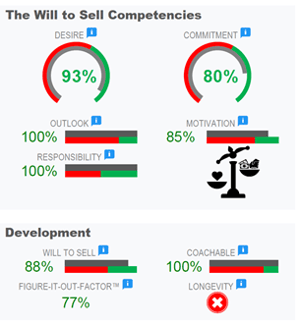
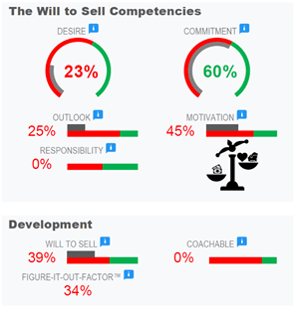
  • Underperformers have 80% of the desire of top performers. *Note – not all performers have off-the-chart desire – that is about 7% of all top sales people.
  • Those that underperform have about 44% of the commitment to succeed in selling that top performers do.
  • These two factors combine to measure motivational level. Underperformers have about 60% of the motivation of your top people.

SUMMARY – Underperformers just are not as motivated to succeed.

SOLUTION – STOP hiring people that are not motivated to succeed at the highest level of performance!

Using the Objective Management Sales Evaluation, there are over 100 data points to measure the opportunity for sales growth of a sales team/organization.  Additionally, this data helps us to predict the likelihood of success of new sales people and managers. 

Here are some interesting findings based on the raw data I have from assessing salespeople (as well as firsthand knowledge of some of the people in the study).

  • Top performers are trainable and coachable
  • Top performers have a high figure-it-out factor
  • Top performers have a low need for approval and…
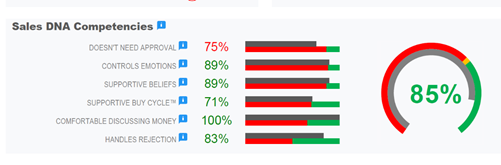
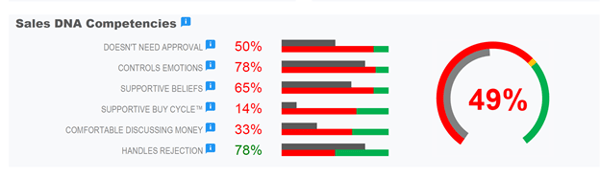
  • Top performers score an average of 86.8 (higher score is better) and underperformers score 39.6 for handling rejection!
  • Top performers are hunters, consultative sellers and closers (average score for skills is 55% of required skills while underperformers average 39.6% of required skills)

SUMMARY  Salespeople – regardless of tenure or previous success - need training and coaching. Also top performers handle rejection extremely well and move on.

SOLUTION  Do not hire based on past performance. (It’s like investing in a mutual fund – past performance is not a guarantee of future returns.)  During the interview process, reject the heck out of the candidate – the strong ones will recover and attempt to close you over and over again!

Register for our Virtual Selling Live Broadcast

The following data indicates that sales strengths are better indicators of success rather than sales skills:

  • Underperformers have 85% of the sales skills of top performers and have…
  • Only 71% of the sales strengths that support execution of sales skills and…
  • The severity of their sales weaknesses are 52% higher than that of top performers

SUMMARY – The skills are about the same, but those with strong strengths of desire, commitment, outlook and responsibility win.

SOLUTION – Make sure your pre-hire assessment process looks for strengths and “will sell” rather than just skills, personality and behavioral traits.

So, back to the original question:   “Why do so many of my salespeople fail to perform as expected?”:

  • Poor diagnosis of the right contributing factors for success
  • Candidates eliminated due to weaknesses rather than hiring for sales strengths
  • Too much credit given to sales skills exhibited during interview process
  • Lack of solid training and development on the root causes of poor performance

Now that you have the answers to the question, what will you do about it?

Topics: improve sales, sales management secrets, sales meetings, individual sales success, sales management responsibility, humor, inspect what expect, sales management skills, 8 Steps for Closing, hiring salespeople, sales practice, sales management, sales results, sales management success, improving sales results, sales metrics, inspiration, sales problems, hiring sales managers, sales management, sales success, keys to selling, sales pitch, sales performance management, sales prospects, how to manage salespeople, sales onboarding, hiring better salespeople, sales menagement, sales management tools, #1 sales assessment, hunting for sales prospects, how to improve sales results, initial sales meetings, how to get a commitment to buy, how increase sales, hiring top salespeople, sales recruitment, sales motivation, how to close a sales deal, how to hit goals in sales, sales skill assessment, consultative selling, 5 keys to coaching sales improvement, how to prospect, sales productivity tools, professional sales training, consultative sales coaching, insurance sales training, 5 keys to sales coaching, online sales management training, insurance prospecting system, consultative sales coaching cincinnati, consultative selling cincinnati, sales management training cincinnati, sales productivity tools cincinnati, hiring sales people cincinnati, increase sales cincinnati


    textunder

    Subscribe Here


    Most Read


    Follow #ACTG


    About our Blog

    Anthony Cole Training Group has been working with financial firms for close to 30 years helping them become more effective in their markets and closing their sales opportunity gap.  ACTG has mastered the art of using science-based data and finely honed coaching strategies to help build effective sales teams.  Don’t miss our weekly sales management blog insights from our team of expert contributors.


    Recent Blogs