ACTG Sales Management Blog

Sales & Sales Management Expertise Blog  

Tony Cole

Recent Posts

What is the Most Powerful Management Question Ever?

Posted by Tony Cole on Wed, Jul 31, 2019

In most companies, we find that the bottom 40% of producers are responsible for less than 20% of the total sales production (in many cases less than 10% of new business- even when we take out new hires with less than 2 years of service).

So the question must be asked– did you hire them this way or make them this way?

pexels-photo-1483907

While driving into work a few years ago, I heard an incredibly powerful performance question while listening to the Dan LeBetard with Stugatz ESPN radio show. An ardent Michigan Football beat writer asked this question during the Big 10 media day

“You came to Ann Arbor with perhaps the most hype of any coach in the history of the Big Ten. Maybe in all of college football. A few years later you’ve got a third place, a third place and fourth place finish. And you’re 1-5 against Michigan State and Ohio State. What do you have to do this year to demonstrate to the Michigan community that you are on the path to achieving what they hired you to achieve?”

I immediately thought about all the sales managers we’ve worked with over the last 25 years and the challenges they faced getting their salespeople to perform as expected. Let me explain for just a minute:

  • New hires are not hired hoping/expecting that they will be average
  • Hiring managers search for, find, interview, screen, and contract new producers thinking/expecting them to be great
  • According to Geoff Smart in his book Topgrading – 75% of new hires are no better and often perform worse then the people the replaced.

In most companies, we find that the bottom 40% of producers are responsible for less than 20% of the total sales production (in many cases less than 10% of new business- even when we take out new hires with less than 2 years of service).

So the question must be asked– did you hire them this way or make them this way?

So let’s look again at this reporter's brilliant question:

Reporter's Question: “You came to Ann Arbor with perhaps the most hype of any coach in the history of the Big Ten. Maybe in all of college football. A few years later you’ve got a third place, a third place and fourth place finish. And you’re 1-5 against Michigan State and Ohio State. What do you have to do this year to demonstrate to the Michigan community that you are on the path to achieving what they hired you to achieve?”

Your Question: “You came into ABC company with high expectations and a strong track record of success that we thought you would continue here. Here we are two years later and in our stack ranking for new business you have finished 9th and 10th. And your pipeline is consistently 66% of what it is supposed to be and your average size sales is $10,000 instead of the anticipated $15,000. What do you have to do over the next 120 days to demonstrate to yourself and to the company that you are on the path to achieving what we hired you to achieve?”

This is the question you should be asking your non-performing people NOW!

This question should have been asked of an underperformer within 6 months of the end of the expected ramp-up period. In other words, if your ramp-up period is 18 months and Jamie is at 12 months and not projecting to meet and exceed expected performance, this conversation needs to take place.

Be brave, ask the tough questions about performance, improve your coaching and get better results.

If you liked this article, please share it with friends, family and colleagues below!

Topics: management, sales performance management, self management, questions for sales teams

The Coveted Habits of Highly Successful Sales Managers

Posted by Tony Cole on Thu, Jul 11, 2019

Becoming, and staying, a sales manager is hard work.  Becoming an extraordinary sales manager is grueling and time consuming.  It requires attention to detail, the ability to have tough conversations with those who are not meeting their numbers, the desire and commitment to grow yourself and your salespeople, and consistent activity and patience.

In this article, we highlight some of common habits (good and bad) of salespeople and sales managers' working today. 

mountains-cosmiques-ridge-mountaineering-mountain-climbing-442403

The sales management activities that we are performing today are creating the results we are achieving tomorrow.  What activities are you doing now that are creating your current unsatisfactory results?  It is up to us as sales leaders to set higher standards for sales behaviors and hold people accountable, so that we get better results.

It is a given that successful sales management requires contributions on many levels:  skill, time, effort, effective execution, systems and processes to support coaching, performance management and recruiting.

Subscribe to our Blog!

To help understand what makes a successful sales manager, it is helpful to review the Habits of Highly Successful Salespeople. I recently asked the participants of a workshop to identify and share those habits that they believed contributed to the success of their best salespeople. 

Below are some of the common habits identified:

  • Develops great relationships
  • Networks regularly
  • Good time management
  • Gets to decision makers
  • Is selective in prospecting
  • Provides exceptional customer service

Then I asked them to talk about the flip-side of the list – those habits that inhibited or hurt a salesperson’s ability to close more business. 

Below are some of the habits they identified:

  • Sells on price
  • Inconsistent prospecting
  • Procrastinates
  • Presents to the wrong people
  • Sells to anyone that fogs a mirror
  • Poor prioritization
  • Is too comfortable

How about you and your habits?  What are those habits that you can point to that you KNOW have a positive impact on your team’s sales behaviors and results? 

Here are some that I observe and hear about:

  • Coaches in-the-moment to get a deal closed
  • Reports sales results
  • Makes joint calls
  • Sets goals
  • Conducts regular sales meetings
  • Reviews and reports pipeline

This is a good list and with some additions, it can become a great list when we identify the skills of a great Coachone of the most critical roles of an effective sales leader. 

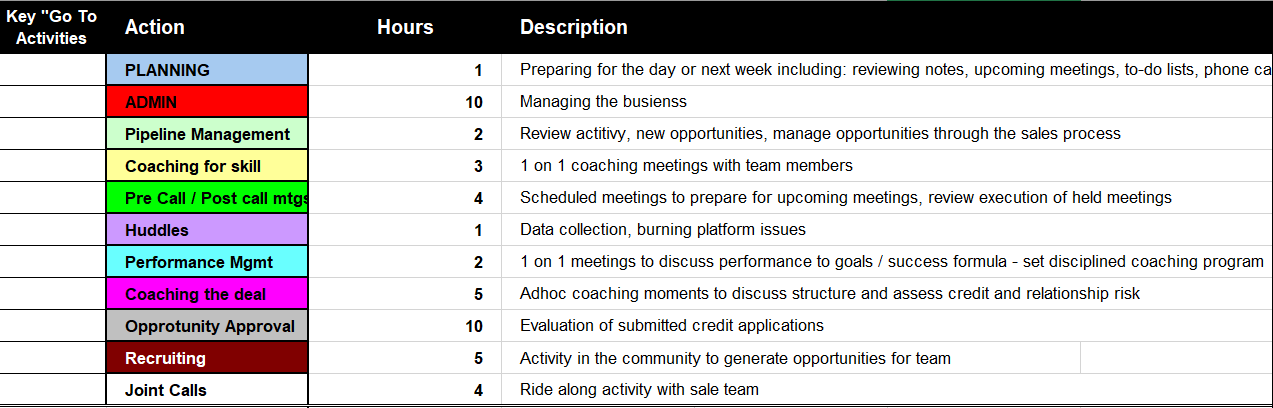
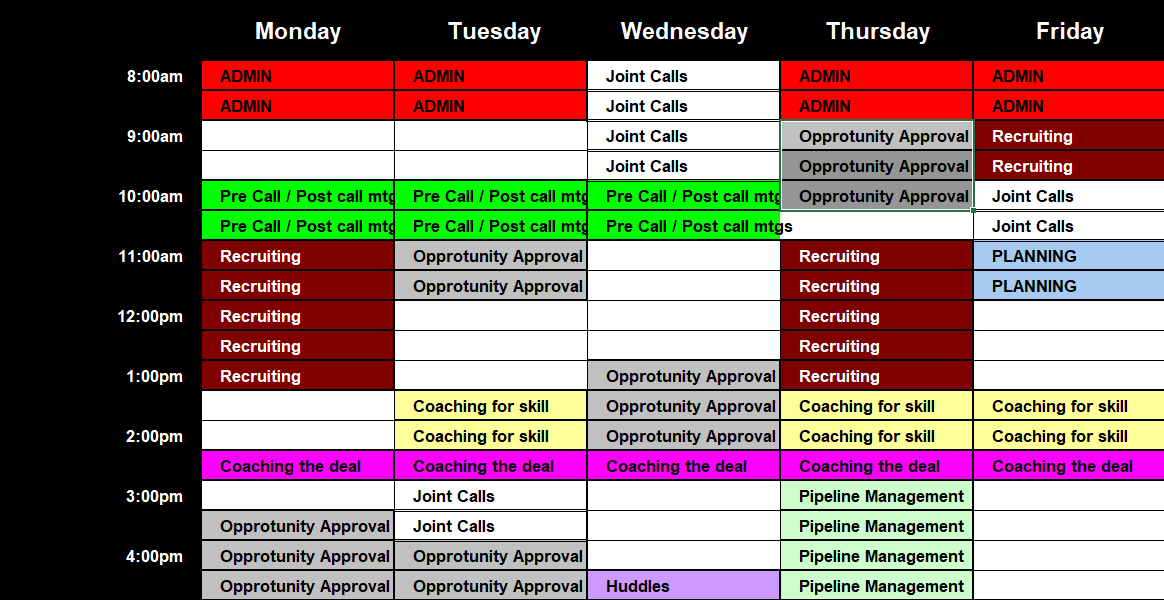
To examine what else you might want to consider, take a look at the following list of elements necessary for successful coaching:

It’s not enough to just have the skill.  In order for managers to be successful at having a sales team built for growth, the manager must be in the habit of using those skills.

Being an extraordinary sales manager is grueling and time-consuming.  It requires attention to detail, the ability to have tough conversations with those who are not meeting their numbers, the desire and commitment to grow yourself and your salespeople, and consistent activity and patience. 

Like the coach of a winning team or a conductor of an extraordinary symphony, you have the ability to positively affect the success and lives of your salespeople and company.   Are you taking the right steps to do so?

Looking for more sales tidbits, techniques and video content? Subscribe to our weekly Sales Brew email below!

Sign Up for our Sales Brew

Topics: sales management secrets, sales management responsibility, Sales Manager, responsibilities of sales manager, effective sales management

Sales Coaching for the Sales Coaches

Posted by Tony Cole on Mon, Jul 08, 2019

In this article, we focus on Sales Coaching for Sales Coaches.  Often, in sales, the sales manager is not held to the same standards as those on the sales force.  While sales people are monitored on their calls, emails, CRM activity, and follow-up methodologies, the same cannot always be said for sales management.

To fix the problem, organizations must take action by understanding the exact qualifications and skills they are looking for in sales management, using the Objective Management Sales Manager assessment tool, and having the systems and processes in place to execute a Sales Managed Environment.athlete-baseball-boy-264337

When you Google "Sales Coaching", what you would most likely find is the following:

  • Sales Rep Coaching
  • Top 20 Sales Coaching Company
  • 30 Minute Free Consultation / Increase Sales by 56% of More
  • Sales Coaching Sales Coaching / Move the Needle with LevelJump

But this post is not about those things.  If you want information on how to effectively coach sales people go here:

Why is Selling So Damned Hard.

Instead, this is about coaching the coaches. Why would we focus on that you might ask?  Let me lean on my good friends at Objective Management Group and John Pattison for some BIG DATA information.  This is what they know, and by extension, what we know about successful sales management and successful sales organizations.

  • When you have an effective sales coach, sales grow annually at an average of 26%.
  • Only 18% of the 100,000+ sales managers assessed, have over 60% of the required skills to be effective at coaching.
  • A much smaller percentage spends at least 50% of their time coaching.

Let’s do the math – if you have 10 sales managers, about 2 of them will be effective at coaching.  If you are looking for a sales manager and interview 10 of them, only 2 of them will be effective at coaching.

THAT is why I am focusing on Sales Coaching for Sales Coaches.

So, how and why do sales managers end up in the role, and why do companies continue to fail massively in an effort to effectively build and execute a sales managed environment?  Here are the answers to those questions, and yes they are in order of likely answers:

  1. Career path – Most organizations promote sales people because that seems to be the logical career path for a successful sales person.
  2. Great sales skills – The ‘career path’ sales candidates have great skills! Those include persuasion, interviewing well, presenting well and negotiation.
  3. Candidates that have a ‘sales management’ resume impress Presidents, HR recruiters and hiring managers with great talk and expertise about performance management, sales metrics, the number of sales people they have hitting  sales goals, using CRM and pipeline management technology.
  4. Companies don’t invest time money or effort to train and develop people to be effective sales managers. They assume that they come wired for success. This is kind of buying Salesforce out of the box – it won’t do the things you need it to do without hiring a Salesforce consultant to customize and build out the tool.
  5. There is failure to hold sales managers to the same rigor of performance management and coaching that is expected of sales people. Sales people are required to report sales activities and enter opportunities into the CRM. With our clients, sales people are taken through a discussion about achieving extraordinary results and building a success formula to achieve that goal. Sales managers do not typically report on the number of:
    1. Joint calls conducted
    2. Pre and post-call debriefing sessions
    3. 1-on-1 sales skills and behavior improvement coaching sessions
    4. 1-on-1 sessions to review the business plan and update the success formula
    5. Prospect / recruiting meetings they had or networking events they attended to find new sales people
    6. Sales management classes enrolled in or books they’ve read to improve skills
    7. Data analysis reports they’ve run to determine how well the bottom 2/3 of the sales team is doing as compared to the top 2/3

To ‘Fix” the problem, organizations and current sales executives must do the following:

  1. Understand the exact qualifications and skills you are looking for in the role and hire / develop the talent that can execute the skills necessary to get those outcomes
  2. Make sure that you use the Objective Management Sales Manager assessment tool to determine if the candidate has the Will to Succeed in the role, the right Sales Management DNA, and enough of the Sales Management Competencies so that you don’t have a extend yourself and your team to develop what you should have hired
  3. Have a system and process in place that clearly outlines the necessary tools, systems and processes to execute a Sales Managed Environment:
    1. Performance management and developing an no excuse sales environment
    2. Coaching for Success
    3. Motivation that Works
    4. Upgrading the Sales Force
    5. Recruiting talented sales people

Topics: sales management skills, sales management success, Sales Management Training, hiring sales managers, sales management tools, responsibilities of sales manager, develop talent

5 Keys to Improving Your Sales Coaching

Posted by Tony Cole on Thu, Jun 27, 2019

If you are not in the acquisition business, then you must develop your talent.  One of the keys to doing that is to understand how to drive sales improvement. 

You must determine what is really happening with your salespeople when they fail to acquire a new piece of business. 

pexels-photo-248547

Why is Coaching Important in Sales?

First, to address the importance of coaching in sales, sales coaching is an essential part of a successful sales team for many reasons.

Good sales coaching helps their reps improve their performance through feedback and repetition which means reps can work on improving specific areas of expertise that need more attention than others.

Also, good sales managers can pinpoint any progress or issues with process improvement projects in order to better coach their sales teams' needs.


What Makes a Good Sales Coach?

A good sales coach is able to build long-lasting relationships with their direct reports.

They demonstrate empathy, which in turn creates a more personal connection and sets the tone for success, and puts their rep's success and wellbeing above all else.

This in return, creates a deeper connection with your sales team and promotes a winning team culture that everyone can feel like they can succeed. 

And with that mentality, more sales and better performance are likely to follow.


What is the Key to Coaching a Successful Sales Team?

The key to coaching successful sales teams is focusing on the how not just telling someone what they're doing wrong. 

When a good sales coach goes beyond pointing out little mistakes and instead gives them tools for long-term success by highlighting their strengths as well as areas where improvement could be made, this will provide a more productive environment in which everyone can work together towards achieving sales goals.


5 Keys to Improved Sales Coaching

Here are the 5 steps you must take to help you determine if your people have skill issues or an excuse-making issue:

  1. You must gain insight. You gain insight by using various data points. The data points you MUST use are: 
    • Observational joint sales calls – You do not run the sales call; you observe your RM
    • Data from your CRM or SAT program (SAT – Sales Activity Tracking)
    • Sales meetings – In all your sales meetings, you need to include a segment on skill development where you drill for skill, role play and conduct strategy development discussions
    • 1-on-1 coaching – Each week, you should have time set aside for 1-on-1 coaching with those people that are NOT in the 1st quadrant of the “Where’s Walter?” matrix

  2. Provide feedback. In advance of the discussion about lost opportunities, you want to provide your RM with the data you have – no ambushing.
    • You discuss – ask the RM questions about what they see in the data
    • You provide them feedback based on what you see and where the problems might be
    • You discuss what the future might look like if the current trends continue
    • You agree that there is a problem

  3. Demonstrate – Once you identify the problem as either an excuse or a skill issue, you demonstrate to the RM what you expect them to execute.
    • If they are making excuses – ‘They didn’t understand the value of our offering” – You ask, “If I didn’t let you use that as an excuse what would you have done differently?”
    • If it’s a skill problem – “I asked them if they had a budget and they said yes.” “When you asked them what it was, what did they say?”  “They said they didn’t want to tell me.”  “When you asked, ‘why not?’, what did they say?”  “I didn’t ask that question.”

  4. Roleplay – The scenario above allows you to now role play with you playing the prospect. You need to start with Drill for Skill and then graduate to the full role play.  Getting them to practice what you expect them to do takes patience and repetition.  Do not believe for a second that one role play will be enough.  You need to start your RM on a weekly coaching session repeating the required skills over and over again. 

  5. Action steps – each coaching session must end with action
    1. Bill, so what I want you to do is call Mary and have this conversation we just role played.
    2. I want you to report back to me by end of business today what happened as a result of that conversation.

Companies are constantly trying to figure out how to drive organic growth by:

  • Acquiring a revenue stream by buying a business or lifting out talent from a competitor
  • Developing current talent

If you are not in the acquisition business, then you must develop your talent.  One of the keys to doing that is to understand how to drive sales improvement.  You must determine what is really happening with your salespeople when they fail to acquire a new piece of business.  (See LinkedIn Article: What You Don't Know Can Kill Sales Growth

Are your people just making excuses for failure or do they have deficits in the required sales competencies or will to sell?

To be successful in determining the real issues with your salespeople, you must have a system.

I read a blog the other day by Dave Kurlan.  We’ve had a strong business partnership with Dave and his company OMG (Objective Management Group) for most of our 24 years in business.  With OMG, we have the ability to determine the answer to the question – is it excuses or is it a talent issue?

Dave’s post  - 12 Reasons They Didn’t Like You Enough To Buy From You – helps address some of the issues associated with “not getting the business”.  It primarily focuses on the area of matching styles.

Subscribe to our Blog!

This got me thinking about the issue of “style” as it relates to talent, which relates to sales competencies and excuse-making.  The challenge for the sales manager is determining if the reason a salesperson did not get the sale was really a talent issue, or if they are just making excuses for failing to execute the skills or sales process of the organization.

To determine the root cause of the results, a sales manager must work more closely with the relationship managers and implement a process that Bill Eckstom calls “intentional coaching”.  This process of working closing with your RMs is addressed in our Sales Management Certification Program in the Coaching for Success Module

Implementing a process of gaining insight, providing feedback, demonstrating, role-playing and establishing action items will go a long way in helping your team discern the difference between making excuses for failure and the need for skill development.


Topics: sales skill improvement, consultative selling, 5 keys to coaching sales improvement, how to improve sales, grow sales, develop talent

The Whack-A-Mole Approach to Sales Management

Posted by Tony Cole on Mon, Jun 24, 2019

Putting forth the effort to coach and motivate people, as well as hold them accountable to performance, requires no skill.  Therein lies part of the problem with growing your sales team.  Any sales manager can attempt to do this with their salespeople, but what systems and measured techniques do they have in place to ensure that it is working?  

Before reading this article, please download our free e-book "Why is Selling so #%&@ Hard" to better understand the effort required to guide and lead your sales team to extraordinary results.

business-indoors-man-2173508

It’s been a few years since I’ve visited a Dave & Buster's establishment. There was a time when I would go at least once a year. When I was younger, my source of entertainment was hanging out at sports bars with pool tables, shuffleboards and basketball games. About 25 years ago, that entertainment became watching my kids enjoy the arcade games Dave & Buster's offered.

It was there that I learned about Whack–A–Mole and sales management. I really didn’t tie the game to sales management immediately. That is a more recent realization I have come to understand over the last 10 years as I’ve visited with executives who are trying to figure out sales growth (SGO) within their companies. 

What I learned about Whack–A–Mole is that it did not require any specific talent. It did require effort – which requires no skill. And, it did require a couple of strands of specific athletic DNA:

  1. Hand/eye coordination
  2. Fast twitch muscle fibers

The same holds true for managing salespeople relative to effort. Putting forth the effort to coach and motivate people, as well as hold them accountable to performance, requires no skill. Let me repeat – THE EFFORT requires no skill. Therein lies part of the problem with growing your sales team.

With Whack-A-Mole, I never got a sense there was a systematic way to approach the game. The moles did not appear to be popping their little heads up in a particular sequence. They appeared randomly much like they used to in my back yard when I lived in Blue Ash, Ohio.

39860632_s

This is exactly what I observe and hear when talking to executives about identifying the sales growth opportunity within their sales team. Specifically:

  • What is the ideal model being used to eliminate hiring mistakes?
  • What is the coaching routine and methodology?
  • What is the culture that helps foster motivation?
  • When performance management discussions take place, are they consistent, punitive, additive and predictable based on exact metrics and standards?

Subscribe to our Blog!

The answers to these questions are what reminds me of Whack-A-Mole. There isn’t a consistency within the organization, let alone consistency between one organization and another. To be clear, we do NOT work with broken companies. We work with companies that recognize that there is greater potential within the organization and they realize that they need to figure out:

  • What is our sales growth opportunity?
  • What would it take go from where we are now to where we could be?
  • How does our current team, systems and processes help or hurt our ability to close the gap?
  • How long will/would it take?
  • What would need to be invested to close our  sales growth opportunity gap?

The problem with not realizing full sales growth potential exists for many reasons. Too many to cover in one article so I will go about the process by writing a series specifically dedicated to help you identify what it would take to close the sales growth opportunity gap.

If you haven't already done so, please download our free e-book "Why is Selling so #%&@ Hard" to better understand the effort required to guide and lead your sales team to extraordinary results.

Looking for more sales tidbits, techniques and video content? Sign up for our Sales Brew weekly email below!

Sign Up for our Sales Brew


    textunder

    Subscribe Here


    Most Read


    Follow #ACTG


    About our Blog

    Anthony Cole Training Group has been working with financial firms for close to 30 years helping them become more effective in their markets and closing their sales opportunity gap.  ACTG has mastered the art of using science-based data and finely honed coaching strategies to help build effective sales teams.  Don’t miss our weekly sales management blog insights from our team of expert contributors.


    Recent Blogs