ACTG Sales Management Blog

Sales & Sales Management Expertise Blog  

Tony Cole

Recent Posts

Banking on a Consultative Selling Process to Meet Organic Growth Goals

Posted by Tony Cole on Thu, Aug 03, 2017

5 Reasons Consultative Selling Skills/Techniques Inhibit Organic Sales Growth

The events that Wells Fargo Bank found itself in the middle of brought to the bright lights one of the biggest challenges facing banks, credit unions and financial services (including insurance) companies.  How do we sell, distribute our products and services, gain market share, and grow organically without “selling”?

 DOWNLOAD our FREE eBOOK -   Why is Selling So #%&@ Hard?


When I got into the financial services segment in 1987, it seemed as though organizations would find every way possible to describe their representatives and the work that they do:

  • Account Executive
  • New Business Development Officer
  • Financial Advisor
  • Loan Officer
  • Insurance Broker
  • Consultant
  • Risk Manager

What is interesting is that - when you attend workshops, conferences, and industry meetings - there are always discussions about what their people/reps are failing to do.  When you look at the list of shortcomings, you see a list of things that you would normally associate with challenges of salespeople. 

  • Won’t or don’t prospect
  • Fail to qualify opportunities
  • Not getting to decision makers
  • Not fully understanding the depth of the problems of the prospect
  • Failing to uncover the strength of the current relationship
  • Challenges with overcoming budget or price issues
  • Difficulties explaining the value proposition
  • Not differentiating themselves from the rest of the market place.

What is the problem?  There are at least two BIG problems: 

  1. Perception
  2. Process


Perception:

In our first workshop of the Effective Selling System, we take participants through an interactive exercise using the old TV show, Password.  If you are unfamiliar with the game, the set-up is this:  A celebrity knows the “password” and gives clues to the contestant that might get them to correctly guess the password. 

Example: The password is Grass.  1st celebrity clue – meadow; contestant guess – cow.   2nd celebrity clue - lea, contestant guess – hill.  3rd celebrity clue – mow, contestant guess – grass.  Ding, ding, ding!!! Next word.

**Password with Emma Thompson, Michael Cera, JIm Parsons and Jimmy Fallon on The Tonight Show.  For fun, click the link and watch

So, in our workshop, the password is Salesman (this works better than salesperson). The clues and guesses given include crooked, commission, insurance, slick, Herb Tarlick, plaid pants, fast talker, product pusher, aggressive, etc.

I promise you this is what we hear.  I’ve done this for dozens of groups for almost 3 decades now and these are the responses we get. This is the perception that many people have of salespeople. Isn’t any wonder why people don't want that on their business card?


Process:

According to Wendy Connick, from the blog post, The Balance, consultative selling techniques were “developed in the 70’s and came into their own in the 80’s.”  I don’t know what “came into their own” means - I assume that it means consultative selling obtained critical mass and became part of mainstream sales thinking and approach and it was considered new-wave selling technique compared to the traditional Dale Carnegie approach. Of course, times have changed and what worked then does not necessarily work now and companies are struggling to find the latest effective sales approach.

Per Connick’s article:

  1. Think how a doctor or a lawyer treats a client: The thought here is that, as salespeople, we need to ask appropriate questions that will help to diagnose the problem(s), further our relationship with the prospect and allow us to go to the next step.  In most selling situations, the account executive is an invader and, to the author’s point, our prospect isn’t openly willing to share. The prospect almost always holds back information, thoughts and feelings and rarely commits until he has made a decision.
  2. The trick is learning the specifics. It is truly a “trick” to ask all the questions and to learn how to ask the right question at the right time and in the right way. Ask the wrong question and you won’t get the information you need. Ask too early and you risk alienating the potential buyer. Ask too late and you’ve missed an  Ask the question in the wrong way and you could be eliminated as a possible source.
  3. Online resources like Google – Online search engines have replaced consultative sales people. Not long ago, sales people provided the necessary information. Now a tremendous amount of information is researched online and purchases are made without sales people or with minimal involvement of sales people.   
  4. Once you fully understand the prospect's current situation and the problems that he's facing, it's time to present him with the solutionBe careful. This is a trap. You have much to cover before presenting. You must still cover specifics of the decision-making process, determine the budget and uncover the competition. What do you have to do to win the business? Oh, and while you are at it, make sure you say the following: “After I present to you and your people, you must give me a “yes” or a “no”.

How many times have you presented and come away feeling great about the sale? How many times have you told your boss “They loved me. They loved us.  They loved the presentation and should get back to us next week!”.  Then you are hunting them down two weeks later. They’re not returning calls and you can’t get any response at all.

  1. When you both agree on the nature of the problem, step two is showing the prospect how your product is a good solution for this particular problem. No, there are steps 2, 3 and 4 (at least) prior to showing a prospect how your product or service solves a problem.  Think about how many times you’ve demonstrated your product and the prospect said something like, “Let me think it over…It has to go to committee…I’m waiting on two other proposals…I have to crunch the numbers.”  Why does this happen?  We missed the other steps because consultative selling says to 1. find out what the problem is, 2. agree there is a problem, 3. demonstrate that your product solves the problem and, if you did everything right, voila, you’ll get the business.

DOWNLOAD our FREE eBOOK -   Why is Selling So #%&@ Hard?


Topics: organic sales growth, consultative selling, selling techniques that don't work

How to Build a Better Sales Team with Better Salespeople – 3 Critical Steps

Posted by Tony Cole on Mon, Jul 24, 2017

build-a-better-sales-team-sm.png

When talking to presidents, executive sales officers and sales managers, I consistently have heard these 5 comments:

  1. I inherited the team I have.
  2. The people that I’ve hired are doing well.
  3. About 10% of the people consistently meet and or exceed goals.
  4. 10% of the sales team is failing miserably.
  5. It’s unreasonable to expect that you can always hire ‘A’ players.

Though we started as, and remain today, a sales training and development company, how to recruit better salespeople was something we needed to add to our business solution toolbox.  As a result, we sought, found and partnered with a firm that is now the provider of the #1 pre-hire sales assessment in the world. What does this have to do with 3 things you must do to build a better sales team?

Everything!

In order to build an effective sales team to achieve systematic and consistent internal organic sales growth, every organization must do 3 things: 

  1. Make sure that your screening process has predictive validity.
  2. Mitigate future hiring mistakes by implementing a hiring practice designed to disqualify candidates
  3. Implement training and development to help your current sales manager(s) and sales team(s) adapt to overcome gaps in required sales behaviors and skills

REGISTER HERE for "Ruff" Realities Recruiting Webinar

To make these points, let me share with you articles from the Harvard Business Review:

Page 23 of the July/August 2017 HBR Magazine - How to Predict Turnover on Your Sales Team The author is talking to Jay Minks, who is the executive vice president of sales at Insperity – a business performance firm. 

  • HBR – “If you could design a dashboard to manage turnover, what would be on it?”
  • Jay: “Actually, I’d be more interested in data predicting which of the salespeople I hire will succeed; that would be the Holy Grail. Our organization could save millions if we could find a way to use data to drive this number much lower.”

Page 103 of the same magazine.  The article, Managing Climate Change:  Lessons From The U.S. Navy, is about the two approaches being used by the Navy to deal with the impact of global warming over the next 10, 20, 30, 40 and 50 years.  These approaches are Mitigation and Adaptation.

  • Mitigation – refers to actions that reduce the amount of greenhouse gas emissions that are causing climate change
  • Adaptation – refers to actions that make the organization more resilient in the face of the ongoing and forecasted changes in the earth’s systems

My tendency is to automatically start thinking about how information like this relates to sales and sales management.  In this case, I relate mitigation, adaptation and predictability to the business challenge of How to Recruit Better Salespeople.

Let’s look at just one: Predictability

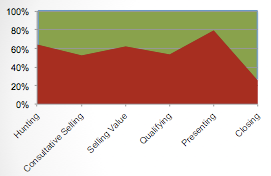
Here is a simple screen shot from a pre-hire assessment that has been tested to have a 92% predictive validity:

salesperson-not-recommended.png

This candidate is not recommended for hire.  Though the assessment indicated that the candidate has a great commitment to success in selling and a great outlook about selling AND takes responsibility for results, this candidate is missing some critical skills in other vital areas. The problem here is that these weaknesses could be hidden by the candidate’s strengths in the areas of hunting and presentation approach.

Mitigation and adaptation steps will vary widely from company to company and industry to industry.  The steps to guide those processes would look like the following:

  • Identify and confirm the severity of the gap between where you are and where you need to be
  • Identify the root cause(s): people, systems, process, or strategy
  • Determine the immediate risk(s) to revenue and profit
  • Generate 1-5 potential people solutions
  • Find a partner/take action

    Request a Free Demo or Sales Assessment Sample

Download a free copy of the Sales Effectiveness and Improvement Analysis (SEIA).  You will get...

  • Detailed information about potential breakdowns in systems and process that either help or hurt sales growth
  • Granular information about the strengths, skills, and weaknesses that hurt or help a sales leader be effective at five critical functions: Performance Management, Coaching, Recruiting, Motivating and Growing a Sales Team.
  • Critical information about the structure of a sales team and the potential for growth with the current team
  • Finally, a clear idea of the types of hires you need to make to have a growth-oriented sales team.


Topics: hire better salespeople, build a better sales team, predicting sales team turnover

5 Direct Sales Activities that Lead to Sales Success? An Update

Posted by Tony Cole on Fri, Jul 21, 2017

5 Keys to Sales Success


I originally posted this article in July of 2011.  Much has happened in the sales world in just six years.  For some reason, the original post is one of our most viewed articles.  I believe that is a result of a couple of things:

WHY THIS CONTENT IS STILL RELEVANT

  • In many cases, the fundamentals of generating sales is the same.  As my good friend, Tony Neuman, from AAA Insurance pointed out - activity leads to opportunities which lead to success.
  • Salespeople still want to know how to improve. Regardless of the technology and the sales enablement tools, salespeople recognize that, even today, it is still a people business.  With ALL of our clients, the business still depends on people buying from people.
  • The need/presssure to perform continues to mount.  Not just because of the pressure on companies to perform, but the pressure on families to meet their own financial goals, objectives and basic requirements.

With that in mind, I have taken a few minutes to revisit the original post and update some of the content so that it is relevant in today's sales climate.

Original 5 Keys article (Revised with notations)


THE 5 "GREEN" SALES ACTIVITIES FOR SUCCESS

Today, I'll focus on this: Identifying the activities that you MUST execute on a consistent basis to be successful. 

These activities MUST primarily be SALES activities or what I call GREEN activities.  GREEN means GO, which stands for "GO to the BANK".

Green activities would include and pretty much be limited to:

  1. Activities that lead to getting names - networking, speaking engagements, sponsored seminars, meeting with centers of influence and/or asking for introductions. Surprising as it might be, nothing is changed here.  As a matter of fact, the first thing on the list is still close to the top of the list in terms of ROTI (Return on Time Invested) View this YouTube Video with Seth Godin.  The only difference is you need to add  "social" to the networking. There is no doubt that today's sales professional must be extremely well-connected via the social media if they are going to be found and found to be relevant.  
  2. An outreach to assess interest or need - This step used to be focused on qualifying the prospect.  We still believe that, early in the conversation, you need to have discussions about what their needs are, what the investment perameters are and how will they go about making a decision. But, recently, I read Mark Roberge's book - The Sales Accelleration Formula. In that book, he has many great ideas and methodologies; but one that I believe is KEY to your success is understanding where the buyer (what he calls a persona) is in their buying journey.
  3. Conversations and meetings to uncover the buyers process - Another significant change in the process - Your first step now is really to help potential buyers uncover if, in fact, they have a problem that needs to be addressed. So often, prospects know they have a problem based on symptoms they see, hear or feel, but they need to know the severity of the problem.  In most cases, potential buyers don't know what they don't know. Today's salesperson has to be masterful at asking the right questions the right way in order to help them identify the problem(s). You should not discuss solutions until they have thoroughly clarified the issues. Pitching capabilities early in the buyer's journey is a big mistake.
  4. Gathering additional information for your presentation step - Once you have provided some guidance to the prospect and, yes, they have decided that they have a problem that needs to be fixed, your job is to now provide them with options, free trials, demos and comparision presentations. These resources help the buyer in their journey towards making a decision.
  5. Presentation of your product/suite of solutions - Not much has changed here except the belief that, by the time you get here, you should have prepared your prospect to make a decision. As we have always taught, get a decision one way or another - yes or no!  Be okay with a no.

Selling is hard; it always has been and probably will always will be.  If you haven't already done, so download our ebook, "Why is Selling So #%&@ Hard?"  It will provide you with keen insights into the root causes and challenges of selling and help you develop long-term strategies to keep selling from being so darn hard.

DOWNLOAD our FREE eBOOK -   Why is Selling So #%&@ Hard?

Topics: keys to sales success, sales activities for success, green sales activities, things to do for sales success

How Do I Make Sure I Hire Someone Who Has Excellent Sales Skills?

Posted by Tony Cole on Tue, Jul 18, 2017

8 Reasons Why Hiring Elite Salespeople is Difficult:

  1. It's hard to find qualified candidates - only 7% of salespeople fall into the “elite” category (What elite sales people do differently)
  2. You have other responsibilities
  3. If things are “okay”, you don’t look for someone… until you have an opening and then you feel desperate to fill the seat
  4. Elite sales professionals – those with excellent sales skills – often are not actively looking for new jobs
  5. The resumes all look the same
  6. Personality and behavioral tests tell you how they like to be managed but don’t have any predictive validity for sales success
  7. Your HR (talent-acquisition partners) really don’t understand why hiring salespeople is different than hiring anyone else for a company
  8. It’s not your go-to skill set.

how to hire top salespeople

Step 1: Make sure you know and identify exactly what sales skills make your elite salespeople ELITE salespeople. 

We just completed a Sales Effectiveness and Improvement Analysis (SEIA) for the private banking segment of a regional bank.  This is what we know separates the top performers from the bottom performers:

Distinguishing skills and sales traits of top performers

  • Hunter
  • Possess over 50% of required sales skills
  • Strong at getting introductions
  • Get past gate keepers
  • Maintain a full pipeline (convert activity – prospecting – into opportunities)
  • Reach decision makers
  • Develop trust and confidence early in the relationship
  • Present product proposal at the appropriate time
  • Keep prospects from buying too early in the process
  • Not reliant on ‘”educating” the prospect or presenting to get the business
  • Love competing against others

Request a Free Demo or Sales Assessment Sample

We evaluate over 125 different data points when using a pre-hire sales skills inventory assessment and what we have found over the years is that there are usually between 20 and 30 variables that separate the best from the rest. THIS is the first step in making sure you are interviewing candidates with sales skills needed to succeed in your organization.


Step 2:  Interview for fundamental skills

Once you’ve received an application or some notice of interest in your available career opportunity, you send the candidate a notice letting them know you’ve received their information and that, in order to move forward in the process, two steps will take place:

  1. They will be asked to complete the online sales skills inventory assessment.
  2. If the assessment findings indicate that their sales skills match what you are looking for, then a 10-minute phone interview will take place.


Why The Phone Interview

At Hire Better Sales People (White Paper), this is the beginning of Step #2.  In the 23 years of our sales consulting practice, I cannot recall a single client where phone skills were NOT critical to the success of the salespeople being hired.  With that in mind, it stands to reason that the first thing you should look/screen for are their phone skills.  Most of the time, our clients outsource that to us. The reasons for that are:

  • Consistency
  • Lack of a bias towards any candidate

In the phone interview, you want to make sure that this person can conduct themselves on the phone like you would expect them to when talking to prospects.  In order to do that, you must create a similar environment that the candidate will have to react to: 

  • No bonding and rapport done by the interviewer
  • Create time pressure so that they have to react and attempt to take control of the phone call
  • Challenge them on their answers to questions (certainly, prospects will ask them questions on the phone – wouldn’t you want to know how well they react as well as what they say?)
  • Let them know that you will be making a decision about who will go on to the interview step and see if the candidate attempts to “close” for that opportunity. If they fail to close for the next step, they will probably fail to close a prospect for an appointment.


Step #3 – Use the data from the resume, the application and the pre-hire skills assessment.

Top salespeople hunt for opportunities, reach decision makers, quickly establish confidence and trust, love to compete against others, have strong desire and commitment to success in selling, take responsibility for outcomes, are highly motivated for success in sales and have a high figure-it-out factor.  Here’s some ideas for assessing these traits in potential candidates:

  • Make the candidate bring their calendar for the next 30 days and make them count the number of new business appointments they have scheduled
  • Make them establish the bonding and rapport. Tell them to take a seat, tell them that you’ve scheduled 60 minutes, but it may only take 30, and see what they do next.  If bonding, rapport, confidence and trust are important, see what your candidates do to make that happen.
  • Ask about competitions they have won
  • Tell them to describe in detail situations where they did everything possible to succeed at something especially when they had to change, overcome a difficult challenge and they overcame despite terrific odds.
  • Ask them to tell you about a situation when they faced failure at accomplishing something personally or professionally. (Hint – they need to say “I failed…”)
  • Give them a test of any kind and see how long it takes for them to figure it out or…
  • Create a role-play scenario out of thin air, give them a couple of minutes to figure out how they want to go about the role -play and then role play.


There is certainly no guarantee for any new hire.  You still have to consider cultural and team fit.  Is there synergy between the new hire and the hiring manager?  How about their technical and professional credentials?  We’re just talking about sales skills here, but, to be clear, it’s rare that someone fails to succeed in selling because they lacked the required technical or professional expertise for the field they were in.  Nope… people normally fail because they fail to generate sales!

Busting 5 Myths (Secrets) of Successful Selling

Posted by Tony Cole on Mon, Jun 05, 2017

Ok, let’s start here - there are no secrets!  The Internet and the digital world have pretty much eliminated ignorance and secrets to success in sales... and about how to do almost anything else.  All you need is a mobile device (could even be a watch) with access to the internet and you can find just about anything you want to know.

car-duct-tape.png

Myth Busters used to be one of my favorite shows.  I searched google to find the Discovery Channel episode about lifting a car with duck tape. Here is the link (but, unfortunately, you won’t get the complete show).

With facts and strategies being so readily available, why do most salespeople (about 80%) still struggle to be successful? A lot of it has to do with beliefs and myths. What about you? Do you accept any outdated myths as facts? Since I short-changed you a little on the video, I will share a list of some other common myths:

  1. People only use 10% of their brains
  2. There is a dark side of the moon – Pink Floyd led us astray (Here you go, rockers!)
  3. Behavior is affected by the full moon
  4. Sugar makes children hyperactive
  5. Lightning never strikes the same place twice

THE BEST METHOD - GET TO THE ROOT OF THE PROBLEM

As many of you know, Anthony Cole Training Group has specialized in providing specialized sales growth solutions for banking, investment advisory and insurance.  Primarily, those growth solutions include:

  1. Hiring better salespeople
  2. Executing an effective sales process
  3. Sales Management certification

During our years of developing and delivering content to hundreds of sales organizations, we have used the #1 sales assessment tool on the planet.  Not only is the accuracy of the sales inventory assessment tool unbelievable, but the Sales Effectiveness and Impact Analysis has been game changer for every one of the clients in our niche:

“The Sales Person Skills Assessment Tool has enabled us to discover some interesting information about our sales process, current sales capabilities as well as potential opportunities for growth and improvement in sales competencies. This assessment tool has also changed how we go about hiring for our sales force.”

President & CEO
F&M Trust

One of the most interesting segments revealed in the assessments is about personal beliefs.  Each of us has personal beliefs that dictates our behaviors and thus determines our outcomes.  This holds true for all areas - sales, sales management and sales leadership.  Whether aware or not, we all have beliefs about what we do that impacts our opportunity for success. 

5 MYTHS MOST SALESPEOPLE ACTUALLY BELIEVE

Here are the beliefs that many salespeople hold near and dear to their hearts that simply are not true:

  1. People buy from people they like – Now, you may have purchased something from someone that you liked, but the “liking” didn’t drive your decision. What drove your decision was your confidence and trust in the person, the product and the company behind the product.
  2. People make buying decisions based on price – Staying with you and your purchasing habits for a second, let’s talk automobiles. According to autobyel.com, the cheapest car available today is the Hyundai Accent SE with a MSRP $15,580.00.  If you own one, then you are a rare breed.  The volume of sales of this vehicle in 2016 was only .38% of all vehicles sold in the U.S.  If people simply bought on lowest price, this would not be the case.
  3. Closing skills are the most important – This might be surprising to you, but in the last three studies I personally conducted in the banking segment, the top 33% of bankers, wealth managers and private bankers severely lack closing skills still led their teams in sales.
  4. The customer is always right – Actually, the customer is rarely They are more right today than they USED to be when it comes to product knowledge, availability, options and pricing as a result of information available on the Internet; but to assume they are right about everything is just SO wrong. However, this in and of itself is not the problem. The problem is this: if salespeople believe this, then they will never be gutsy enough to execute the challenger sale, the value-based selling system, the SPIN System or our Effective Selling System.
  5. Prospects are honest – 95% of respondents in all of our studies believe prospects are honest. That is… until we conduct our first meeting with our clients and go through the process that buyers to go through when executing their buying process. g.  If a prospect was completely honest, they would tell the insurance agent who just cold-called them that they just got a renewal that they think is too high and they want some competitive bids to keep the incumbent honest.  We all know that doesn’t happen!

TRAINING ALONE DOES NOT GET LASTING RESULTS

Time and again, companies spend money on sales training to introduce them to a new…

  • sales language
  • sales approach
  • prospecting method
  • time management process
  • cross-selling strategy

What happens is that the company spends a lot of time, money and effort and yet, at the end of the event or training, they cannot point to any discernable difference in outcomes.  Behaviors stay the same, problems that existed before are still there, effort changes for a while but soon returns to pre-training levels and salespeople still blame the economy, the company or the competition for lack of success.

Top people still are performing at the top, people in the middle of your sales bell curve are still “at leasters” and your bottom 20% are not performing any better than the bottom 20% you had the year before.  Why?  Because the root problems associated with beliefs were never addressed.

I grew up on a farm.  I know about planting things and making them grow, and if it’s a fruit tree or bush (blueberries), I know that there is a time to harvest.  What I also know is that you can buy the best plants and trees in the world, but if you don’t take care of the root system with good soil, fertilizer and water, they will not produce.

GIVE ME A CALL - I WILL HELP

For more about growing blueberries, peaches and salespeople, call me! This is your call to action to get more productivity out of yourself or your sales team, so call me NOW at 513.791.3458.

Additional Resources

  • # 1 Sales Assessment in the world
  • Identify Your Systems and Processes – The Sales Effectiveness and Impact Analysis Sample (SEIA)
  • How do my salespeople compare to industry standards – Get 3 people on your team (the best three that do the right things, have the right fit and blow out their numbers consistently) to take the sales skills inventory assessment and compare. Be prepared to take a call from us, discuss the results and answer the question: Do you want our help?

 Get a 14-DAY FREE TRIAL of ACTG's Online Sales Learning Center

Topics: close more sales, managing salespeople, assessing sales talent, getting consistent sales performance


    textunder

    Subscribe Here


    Most Read


    Follow #ACTG


    About our Blog

    Anthony Cole Training Group has been working with financial firms for close to 30 years helping them become more effective in their markets and closing their sales opportunity gap.  ACTG has mastered the art of using science-based data and finely honed coaching strategies to help build effective sales teams.  Don’t miss our weekly sales management blog insights from our team of expert contributors.


    Recent Blogs