ACTG Sales Management Blog

Sales & Sales Management Expertise Blog  

Tony Cole

Recent Posts

What is Your Sales Team's Motivation?

Posted by Tony Cole on Fri, May 19, 2017

QUESTIONS THAT COMPANIES NEED TO ANSWER

As many of you know, we use the Objective Management Group's (OMG) assessment to evaluate every organization that we do sales and sales management training, coaching and consulting for.  The process helps us (and helps our clients) determine with great accuracy the answers to these 4 questions:       

  1. Can we be more effective (sell more, more quickly at better margins)?
  2. How much more effective could we be?
  3. What would it take?
  4. How long would it take?

Answering these four questions requires the ability to uncover at least two important contributors to improved effectiveness:

  1. Their “will” to improve in selling and sales management
  2. Their ability (sales and sales management DNA)

6 FACTORS THAT DETERMINE THE WILL TO SELL

There are 6 known contributing factors that OMG uses to determine “will to sell”  (click here for a review of the OMG pre-hire assessment tool).

  1. Desire to succeed in selling
  2. Commitment to succeed in selling
  3. Motivation
  4. Outlook
  5. Responsibility
  6. Enjoyment of selling

A CONSISTENTLY RECURRING QUESTION

I don't believe there is a way to effectively rank those factors in terms of relevant importance.  Having used the tool and delivered results to dozens of companies and hundreds of people, my experience is that these 6 work together to form a puzzle that gives you an overall picture of someone’s “will to sell”.  In this article, however, I want to focus on motivation because, over and over again, when attending my workshops, attendees consistently the question, “How do I motivate or keep my people motivated?”

FINDING INSPIRATION

I was getting ready to work out at my club the other day and, when walking to the men’s locker room, I stopped and looked at this sign.  Now, I’ve seen this sign literally hundreds of times and have read it dozens of times. I have always found it interesting and a bit inspiring. 

i-am-pic.png

I can imagine being a young tennis player who has big dreams of playing tennis on a large stage someday.  And that young person might take a photo of this poster and put it on their phone, locker room, door or wall at home.  They might even post it to social media – Facebook. Twitter, Instagram or Snapchat.

It all depends on that person’s motivation.

This person could be driven by pride, satisfaction, mastery, achievement, competition, enjoyment or recognition.  They could even be motivated by the love of winning or that hate of losing. They might just be trying to prove the naysayers wrong!

ARE YOU MOTIVATED?

What motivates you?  If you are a manager, what is motivating your people?  If you are not motivated to:

  • Be more effective
  • Be more successful
  • Compete to be the best
  • Sell more to make your lifestyle dreams a reality
  • Make sure your children receive an education without the debt

I have to ask: Why?


ALL ENCOMPASSING - MOTIVATION INVOLVES EVERYTHING

Let me address two things:

  • Personal motivation
  • Motivation of others

My experience – my own true, personal experience - about motivation is that when you desire something greatly in your heart, then you will live and breath the desire to make the dream a reality.  Many of you know I played football at UConn.  I always considered myself blessed beyond reason to have had the opportunity to make my dream a reality.  But blessed does not stand alone as the only contributing factor for the scholarship.  Yes, I had some God-given talents (nature), but I also had some external factors (nurture) that contributed to my success.  Those factors were Mom and Dad and the attitudes they instilled in me regarding hard work, anything is possible, don’t give up, success requires commitment.  I learned early on that, if you really want to accomplish something great in your life, you must be willing to give up some things to get where you want to go.

  • When my classmates were going to Lee’s house to party after a game, I did not.
  • I hated vegetables, but my dad told me he would tell Coach Cacia I wasn’t eating right – I wasn’t going to let that happen.
  • At the end of a long day – 12 hours – working on the farm, I still ran my miles and lifted weights.
  • When I got beat on a certain play during practice, I would make that person pay the price on the next play.
  • I ran sprints every day at the end of practice.
  • I played hurt.
  • I studied and got the grades needed to get into college.
  • I did all of those things for 13 years.

MY STARTLING WAKE-UP CALL

On the other side of that coin are the years between 1998 and 2003.  Those 5 years are lost to me because of the event of our son's (Anthony) cardiac arrest and subsequent severe brain injury.  I could think of nothing but his full recovery to health.  Nothing else mattered and it showed up in the shrinking of our business.  One day, Linda walked into the office and said, “We need to talk.”  I thought it had something to do with Anthony.  Instead, she asked, “Are you ever going to start working again?”

Man, did that piss me off!

But, I started to work again because I had new motivation.  And that is my point.  I believe most people go through stages of motivation.  The stages probably look like the side view of a roller coaster – lots of ups and downs.  If you find yourself in the down, don’t assume that you will go back up.  You may be at the end of the ride.  If you are there, you need to find new and different reasons to get back in the seat and ride to the top.

THE REAL DEAL – MOTIVATION IS PERSONAL

When I answer the question - How do I motivate my people? - for workshop attendees, I tell them, “You cannot motivate them.  Motivation is an inside-out job and they have to come to the table with their own motivation.  The best you can do is create an environment where people want to come and they want to be motivated and excited because they have personal reasons to be successful.”

I remember having a discussion with Tom. Tom was a COO of a large insurance holding company and we were talking about his next day’s presentation to the troops.  He told me about his agenda and the key points in the speech.  One of the topics was shareholder value.  When he finished, I asked permission to ask a question and then make a comment.  “Permission granted,” Tom said.

I asked, “How many people in the audience are shareholders?” One, he said.

I then said, “Tom, with all due respect, those people don’t give a rat’s #@%  about shareholder value. What they care about is having enough money to retire, pay for a wedding, have the dream vacation, pay for college, and eliminate debt.  Talk to them about how the company will support their efforts to make those things happen and then you will have an audience who will listen and respond.”

THESE 3 FAILS = NO MOTIVATION

The problem, in many cases, is that the sales executive in charge of getting more out of the sales team has no idea what motivates those people on the team.  Without knowing that, how could you possibly create a motivated environment?

While assessing numerous organizations, we have found three things that hinder the motivation and success of the sales team: 1) 90% of the sales managers don’t believe they need to know what motivates their sales people.  2) 25% of the sales managers are not motivated to be successful in the role of sales manager and 3) Virtually 100% of the salespeople lack personal goals, lack a personal goal plan and fail to have a process in place to track if they are achieving goals.

How could you possibly have a motivated sales team?

ADDITIONAL RESOURCES AVAILABLE:

Motivation Quotes in Unlikely Places – Dave Kurlan

Pavarotti and Motivation – Music and Self Motivation

Robert De Niro Inspiring Speech at NYU School for The Arts - Youtube

Motivation – What Would You Attempt If You Knew You Couldn’t Fail?

DOWNLOAD FREE eBook -  How to Hire Advisors Who Will Sell More


Topics: developing sales talent, Motivational, getting consistent sales performance, predictable sales growth

Fixing a Broken Sales Environment with 3 Essential Sales Tools

Posted by Tony Cole on Fri, May 12, 2017

The 3 Es

work on1.png

THE 3 ESSENTIAL SALES TOOLS

  1. Speed to failure
  2. Conversation is still king (the person with the best conversation wins)
  3. Technology that supports SELLING – NOT finance

Before I get to the 3 essential sales tools, consider for a moment all the systems and processes you have in your organization:

  • IT
  • Communication
  • Marketing
  • Finance
  • Physical plant
  • Hiring
  • Technical training
  • Underwriting
  • Risk management
  • Sales
  • Customer service

(Also watch this video – it is worth every minute of your invested time).   

ARE YOU OK WITH ONLY A PARTIAL SOLUTION?

I know the list above isn’t a complete list, but let’s pretend for a minute that you just invested $500,000 in new technology.  It could be a website enhancement, new finance applications to improve billing and financial projections, improved communication equipment or a sales CRM.

Let’s pretend that the investment was for finance.  Your expectations are to “tighten up” the reporting on payables, receivables, compensation reports, taxes and forecasting.  The company you bought the service from told you that it would probably take about 90 days to work any bugs out, but certainly, by year end, your expectations would be met.  You meet with your CFO and ask, “How’s it going?”  She responds, “Pretty good!”  You then inquire, “Pretty good means?”  She replies:

  • Our payable reports are about 66% correct, but trending the right direction.
  • Our overdue receivables still average 45 days, but we’re making progress.
  • Our compensation expenses are off by about 5% and we’re not sure why, but we’re working on it.
  • Taxes? Well, my best guess is that we are going to owe between 10% and 20% more than last year.
  • As far as forecasting revenue, well…our pipeline shows $5,000,000 to be closed in the next 6 months, but we’re not confident that the number is accurate.

How do you feel about your investment?  What is your reaction to a complete lack of success at meeting expectations?  Whose head is on the block as a result of this?  How long would you tolerate the continuance of this failure?  I’m not sure you’d fire your CFO, CTO, President, HR or your consultant, but I’m pretty sure you wouldn’t say, “Okay, let’s give it another 30 days.”

WHAT NOBODY TALKS ABOUT

I know I created a bit of a stretch scenario, but the point I want to make is that you probably get a report like this about your sales team; you just don’t know it.  What isn’t revealed in a sales meeting or in your monthly meeting with your sales manager is the detail behind the big numbers you talk about.  You talk about year over year results, you talk about sales YTD against plan, you might even talk about how you are doing against other sales divisions or peers in your industry.  What you don’t talk about is this:

  • Over 90% of your results are probably coming from 36% of your sales team. (LinkedIn article on the 80/20 of the 80/20).
  • What doesn’t get reported that would make you jump out a window is that the bottom 36% of your sales team is probably responsible for less than 4% of your total sales.
  • What the sales manager doesn't tell you is that - of the last 4 hires - only 1 of them is doing better than the people that were replaced with the new hires.
  • What you won’t talk about - but need to talk about - is the cost of putting the other 3 in the market for 12 months and then the cost of replacing them with 3 more that won’t make it either. (By the way, over a 5-year period, that is a 2 comma problem).
  • What is also probably not part of the discussion is that, if you really wanted to drive profit, you could probably eliminate the bottom 36% and increase profitability significantly.
  • You probably won’t have a discussion about how some of your more senior people are not performing nearly as well as some of your new people.

 WHAT MATTERS MOST

The challenge to organizations (and what matters most) is the answer to the question:  Are we hitting our numbers?  As long as that answer is yes, you’re okay.  BUT, if you are unwilling to accept 90% correct in your tax estimate or compensation projections… or 90% of the calls getting through or 75% of the customers being happy… or your website being operational 66% of the time, why are you settling for anything less than 100% execution from your entire sales team?

What I know and what I’ve stated before:

  • You don’t intentionally hire sales people to fail; so, if they do…
  • You either hired them that way or…
  • You made them that way

HOW TO FIX A BROKEN SALES ENVIRONMENT

What does this have to do with the 3 Essential Sales Tools?  Maybe not everything, but these 3 tools have a lot to do with fixing a broken sales environment.

  • Speed to failure – With your new hires, do your best to find out quickly if both of you made the right decision. Make sure that, as you are making the offer, you let them know all the crap they are going to have to go through, what they will be managed to and what is exactly expected in the first 90 days and the following 6 months.  Let them know that the hire is going to be probationary and that you have a 3 Strike Rule.  (Call me at 513.226.3913 about the 3 Strike Rule).
  • Conversation is KING – Despite all the technology that is available to help your salespeople create opportunities, nothing yet has replaced the value of quality conversations. This means you need to have a very high standard for training, practice and preparation before you put people out into the market.
  • The technology that you buy to support sales has to support sales not finance. Finance should find its way to use the appropriate sales tool to get the information they need not the other way around.  Your sales technology should make it easy for salespeople to communicate to suspects, prospects and clients.  It should be easy to use and provide extremely useful information for the sales manager as well as salespeople.  It should make it easy for your people to consistently follow your sales process.  Finally, it should help you predict with a high level of validity what is actually going to get sold over any given time frame.

Implementing these three sales tools will go a long way to helping you improve your sales environment and improve the productivity of the entire team.  In my next blog – What do you know (really know) about your sales manager’s and your team’s WILL TO SUCCEED in sales management and sales?

ADDITIONAL RESOURCES

Call 513.791.3458 now to get a copy of a recent case study on Will to Succeed and the productivity of the sales organization –Ask to speak to Jeni.

Find out about the WILL of your sales team as defined by The World’s #1 Sales Skills and Sales Manager Skills Assessment

Find out about the #1 Assessment HERE

Topics: developing sales talent, hire better salespeople, predictable sales growth, consistent sales results

What You Don’t Know Can Kill Sales Growth

Posted by Tony Cole on Tue, May 02, 2017

I had a conversation this week with 3 executives that run bank-owned investment programs.

seia-chart.png

  • The first executive is restructuring his program to go from $3 million to $8 million in revenue and will do that via a team approach to the credit union membership.
  • The second executive is looking to improve the effectiveness of junior advisors and improve the quality of new hires. He is the president/program manager and sales manager.
  • The third executive has sales management executives, and is part of a very large bank that has a robust training department, several leadership programs, a very tenured group and a full calendar of training programs scheduled for the balance of the year.

WHERE TO BEGIN FOR SALES GROWTH

If any of these rings true for you, consider the following:

If you’ve read any of my posts over the last 10 years, you know that our initial step in any engagement is to first assess the current state of the sales organization.  In our initial conversation with any prospect, we attempt to explore…

  • What’s happening
  • What’s not happening
  • What the objectives and expectations are
  • The gap (money) between where they are and where they need to be; Attempt to uncover the symptoms that indicate the “why”
  • If the problems are “have to fix” or “want to fix”

If we arrive at a “have to fix” state, then we discuss the process required to “fix” it.  To help paint the picture, I normally describe a situation where someone has a “have to fix” problem.  I choose improving my golf game as an analogy because I’m in a constant state of saying that I want to improve my golf game.  (Apparently, improving my game isn’t that important because I always fail to take one really important step – I don’t take lessons.  But… that is another story…)

I go on to ask, if my prospect was my new golf coach and we were in our first lesson, what would the golf coach do in our first lesson?  Almost everyone (over 90%) replies, “Ask you to take a few swings with a club.”  I ask why would the pro want to do that.  Again, almost everyone responds with, “So they can see what might need to be fixed.”  I respond with, “Perfect - that is exactly what we have to do.  We can’t go about fixing the problem unless we know the root cause.”  We have to have some insight into:

  • The skills of your salespeople
  • The strengths and weaknesses that support or hinder effective selling
  • The systems and process that exist
  • The skills of the sales manager, their tendencies and where (in the 4 functions of sales management) they are most effective
  • The actual performance of the entire team
  • Answers to 19 critical sales growth questions

A TALE OF TWO MANAGERS

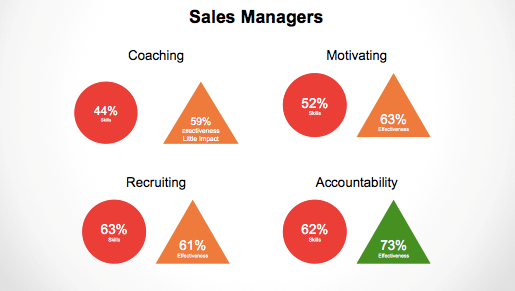
As an example of what we find out, look at the chart below that describes the leadership and sales management skills, tendencies and effectiveness of two sales managers.

skill-chart.png

The names have been changed to protect the innocent, but the data has not been altered.  Here is just one example of one of the findings from the assessment that companies find so useful when attempting to analyze the “why” of productivity and sales outcomes:

#1 – The score tells you how well Gene and Paul scored in their skills for the various data points evaluated as sales managers and sales leaders.

#2 – This helps us understand what a manager’s “go-to move” is when there is pressure to drive performance.

#3 – This tells us how effective the manager is when executing to a skill (recruiting, coaching, motivating, performance management, strategic thinking)

Looking only at the sales manager’s skills - performance management, recruiting, coaching and motivating - you can see that there are problems with motivating and recruiting effectiveness for Gene.  Both of these are his strongest tendencies, but he lacks the skill and perhaps has a problem with the make-up of his sales team (not coachable). Therefore, he is not very effective.  You would want to know this prior to implementing any type of sales management coaching program.

Paul, on the other hand, is average at best at 3 of the 4 sales management skills needed to effectively drive sales growth.


KNOWLEDGE IS NOT POWER

I once heard Tony Robbins declare that “Knowledge is NOT power.”  He went on to say that “Knowledge in Action is Power.”  That is the purpose of this post.  Too many companies create budgets for training and development without good intelligence.  Too many companies believe that training salespeople on the latest sales process concept is the way to drive sales.  Suppose you have people that lack desire?  Suppose they are un-coachable?  Suppose you have managers that don’t have the skills to support the dollars and effort you spend on training your salespeople? 

Before investing time, money and effort to train and develop your sales managers or salespeople, strongly consider doing a study - an x-ray, if you will - of the team that you have. Find out why they perform the way they perform, how coachable the team is , what the opportunity for growth is and if you’re going to help them with those contributing factors that support effective execution.

Supporting information:

Root Cause Analysis Training Video

Find out Why Selling is So $#$%! Hard?

Talk to Tony about the Sales Effectiveness and Impact Analysis – 513.226.3913 (Text:  SEIA – provide your name)

How Do I Grow Sales? – An article that answers that question

Request a Free Demo or Sales Assessment Sample

Topics: developing sales talent, how to manage salespeople, effective sales management, predictable sales growth

Is Motivating Salespeople What It Takes To Drive Sales Results?

Posted by Tony Cole on Fri, Apr 28, 2017

tony_boy_run.jpg

I have done many workshops over the years and, normally, in the very beginning, I ask:  What is it that you want to leave here with that would make this a great investment of your time?  One of the top 3 answers in every situation is the question:  How do I motivate or keep my sales team motivated? (Dan Pink – Ted Talk on Motivation – a great 18 minute investment!)

IT HAS TO START INSIDE

My response 100% of the time is this: “You cannot motivate your sales team.  All you can do is recruit motivated people or create an environment where they motivate themselves.”  I then share with them what I heard Mark Victor Hansen say many years ago at the Cincinnati Life Underwriters Annual Meeting: “Motivation is an inside-out job.”  In other words, it’s something that has to start inside of someone; you cannot motivate them from the outside.  I believed that then and I still believe it now.

IT HAS TO BE THERE FROM THE BEGINNING

As some of you know or may recall, I grew up on a blueberry farm in the blueberry capital of the world, Hammonton, NJ.  My dad, Ray, was the foreman on the farm.  I’m sure that if dad hadn’t been a foreman, he would have been a drill sergeant.  Does that give you a picture of the type of guy my dad was?  Dad was a no B.S. ”you want to make more money then work more hours, when all else fails hard work works” kind of guy.

You may also recall that I graduated from the University of Connecticut where I played varsity football on a full scholarship.  Working towards earning my scholarship didn’t start when I entered high school in the 9th grade.  It didn’t start my junior year when I earned the starting position of center.  It didn’t start when I was named co-captain along with Patrick Gazzara my senior year.  No, I started earning the scholarship when I was 9 years old.

That summer of 1963 was uneventful until I made the comment to my dad that I’d like to play football.  He asked me why? I said, “It looks like fun.”  He asked, “Are you sure?” and, without hesitation, I replied, “Sure.”  He pressed on saying, “It’s going to be hard.”  I said, “Okay.”  Finally, he said, “I’ll get you the name of the coach, Matt Gazzara (not related to Patrick). You call him and tell him you want to play.”  I said okay.

[Jumping ahead to the end of my first practice] I came off the field and dad asked me, “What did you think?”  I said, “I loved it - I'm going to go to college someday and play football!”  He asked me, “Are you sure?” He went on to tell me that college football players are in great shape, so I would have to work hard to be in great shape.  I said, “Okay.” 

I took off my helmet. He helped me take off my practice jersey and shoulder pads and then said, “Start running laps around the field.”  I asked, “How many?” He just said, “I’ll tell you when to stop.”

I stopped 13 years later when I finished my career on the field of Holy Cross where we had just lost the game 40 to 41.  I cried like a baby because I knew I’d never again played the game that I loved so much.

That is internal motivation.  I didn’t know about scholarships when I was 9.  I hadn’t thought about the education I would get.  I had no idea that I’d get a chance to fly on an airplane for the first time when I was 18.  I didn’t know I’d get to travel along the Middle Atlantic and New England region visiting places like Bangor, Maine and The Military Academy in Annapolis.  All I knew was I wanted to play football and I was willing to do everything possible to succeed.

DOES YOUR TEAM HAVE WHAT IT TAKES?

  • Do you have that?
  • Do you have people – salespeople - on your team that have that?
  • When you think about all the things you’ve tried to motivate people, has anything REALLY had a long-term impact on changing behavior, improving skills or significantly moving the results needle?
  • When you look at performance, how many people do you have that are just “plug and play” - the few you know you can count on day in and day out to do the things they need to do and you know they will perform?
  • When you look at those that don’t perform, how fatigued are you just thinking about the effort you have to put in just to get them to come to meetings on time, use your CRM, and do the activity to get the results?

IS IT EXTERNAL OR INTERNAL?

What we have learned over the last several years by assessing sales organizations using the Objective Management Group Sales Effectiveness and Impact Analysis is that motivation has changed. There was a time when salespeople were primarily externally motivated, but now there is data that tells us the primary motivation of salespeople is internal!  Let me show you: 

motiv-table1.png
Table 1

This table represents the top ten performers in a recent assessment of 100 sales people in the financial services/banking industry.  These findings are consistent with all assessments done in this space over the last 3 years.  By the numbers:

  • 8 of 10 are motivated by winning
  • 9 of ten are motivated by self-rewarding performance
  • All ten succeed and are motivated when self-pressure is applied
  • 9 of the 10 successfully self-manage
  • Competition against themselves or others is evenly split 50/50
  • Self-satisfaction motivation has a slight edge 60/40

NOW, here are the bottom 10 findings: 

motiv-table2.png
Table 2

SO, IT ALL COMES DOWN TO THIS...

So, after looking at the evidence, let's go back to our original question – Is motivating salespeople what it really takes to drive sales results?

NOPE!

Additional Resources:
How do I get this information for my sales team? LINK

DOWNLOAD FREE eBook -  How to Hire Advisors Who Will Sell More

Topics: close more sales, motivating salespeople, getting consistent sales performance, effective sales management

Ghostbusters I Predicted the End of the Sales Professional

Posted by Tony Cole on Wed, Apr 19, 2017

THE DIGITAL AGE SIGNALS AN END TO TRADITIONAL SELLING

If you’re not worried about losing your job as a salesperson, an investment advisor, an insurance broker or a banker, think again.  It’s already happening and it will continue to happen. 

This is not a bold statement coming from someone trying to create hysteria to create more business for his own business solutions practice (Anthony Cole Training Group). Think of this as someone who is reporting today’s weather and attempting to tell you that the current weather patterns are predicting with some certainty that tomorrow will be cloudy with a 50% chance of severe thunderstorms with hail and rain coming down like cats and dogs.

gbmurray.png

(Click HERE for the MUST watch prediction of the future of salespeople…)

THE LIMITATIONS OF COMPUTER INTELLIGENCE?

Dan Sullivan, co-founder of Strategic Coach and author of The 21st Century Agent, attempted to warn salespeople (agents) about what they needed to do to secure their future. These three keys to professional security were based on the known capabilities of the microchip in 1995.  At the time, Dan stated that the microchip was incapable of:

  1. Finding and creating new relationships
  2. Providing creative solutions
  3. Helping people make the decision to buy

But, how accurate are those comments today?  Not very!  Mobile technology, big data, sophisticated algorthyms and search protocols allow for anyone selling anything to:

  1. Reach out, find and attract potential buyers
  2. Digitally collect the appropriate data and apply that data to provide solutions for the buyer based on the purchase preferences of the buyer (For instance, I now buy most of my shoes on Zappos.)
  3. Provide a “1 click option” (like at Amazon) for people to purchase nearly anything in less than a minute

“So…” you reply, “this technology only applies to shoes, books and low cost items.”

Not so fast. Think about the last time, either at home or while in your car, seeing or hearing Flo from Progressive or the reptile from Geico telling you that you could get insurance from them cheaper and faster.  What about State Farm and Liberty Mutual who also consistently tell you that, not only can you get better coverage, but they will also pay your claims quicker and reward you for safe driving?

The technology and AI of today has replaced sales jobs – make no mistake about it!

HOW AI CHANGES THE GAME

You think that your type of selling is really that sophisticated? Alec Ross recently spoke at the Bank Insurance And Securities Association (BISA) meeting at the beautiful Diplomat Resort and Hotel in Hollywood, Florida.  He provided a harsh look at reality to all of the advisors in the room when he candidly answered the following question:

“Alec, what is the one question that this audience (Presidents, program managers, advisors, sales managers, VPs of sales, Investment Product Companies and Broker Dealers) should be obsessing about?”

Alec:  You should be obsessing over ‘disintermediation’. You should be worried about the question – Will the future need financial advisors to help people with their financial independence and retirement planning? Given the state of artificial intelligence and the speed at which data – big data – is becoming available, you should be worried about the role you currently have.  You should be worried about being replaced by artificial intelligence (AI) that is so sophisticated that it functions as well, if not better than, any human advisor would and it does so at a lower cost and a higher level of productivity and effectiveness.

I have Alec’s book and am reading the first chapter about robots.  Quite clearly, he states that if your job is defined by

  • Collecting data and…
  • Applying that data to known information in a data base and then…
  • Providing information back to your prospect…

Then you CAN BE REPLACED by the microchip (artificial intelligence) that…

  • Doesn’t need a vacation
  • Won’t require medical leave
  • Won’t need health insurance or a 401(k)
  • Will work 24/7/365
  • Will never complain about management, competition or compensation

All companies will need to do is keep the machine in a cool room with fresh air, update the components every 18 months at a fraction of the cost 18 months earlier and you are set to go.

THE CAR BUYING EXPERIENCE

My current Ford explorer has just less than 100,000 miles on it.  I received a notice on my notification band (a wrist accessory that used be called a watch) that 1) it was time for a trade-in to maximize the value of the trade-in and 2) the market conditions were going to be perfect over the next 30 days.  The market was going to be perfect because of these 3 factors:

  1. The anticipation of a new trade agreement was going to provide tax incentives to manufacture more power alternative vehicles domestically
  2. The previous year models were going to be discounted or would have to be shipped overseas – the discount was a better economic alternative for the auto makers
  3. There would be a reduction in price due to the redistribution of labor cost

I’ve always dreaded the buying process when it came to buying a new car.  It’s not that I don’t like getting a new car; my family can tell you how excited I get as my vehicles close in on the 100k range.  I start thinking about and ogling cars for at least 6 months in advance. 

My good friend, JB, just bought the latest Lexus SUV… and I’m jealous.  JB is a habitual car buyer and an easy mark.  He takes his car in for service, they lend him a new one to drive around, he does his errands, gets seduced by the latest technology, fuel efficiency, et cetera… and, the next thing you know, he’s taking his golf clubs out of the old SUV (only 2 years “old”) and putting them in the new one.

AN EXCEPTIONAL EXPERIENCE - BUYING FROM BILL

Every time I search for anything on my laptop, my mobile connection device (MCD or notification band; no longer just a watch, phone or fitness monitor) begins popping up with small ads to notify me about the closet auto distribution center and the “best” deals in a 20-mile radius.  Honestly, I’ve never been one to shop for the best deals.  I’ve purchased cars from Bill for several years now and Bill is the one I will buy from again.

It’s Saturday. I just finished my workout and then headed over to see Bill… but Bill wasn’t there. As a matter of fact, it was hard to find anyone there. The service bays were open so I walked over there and asked to talk to someone about buying a car  - specifically, I was looking for Bill.  Joe, the service manager, told me to head over to the main entrance and I would find “Bill” inside.

I did as I was instructed.

I walked through the sliding glass doors and in front of me were a series of kiosks -   very similar in appearance to what you might see in airports or grocery stores.  They all had names on them and one of them was named “Bill”.  I walk over to Bill and looked at the screen, which welcomed me to the King’s Auto Distribution Center.  As I moved closer, Bill, the kiosk, began speaking to me:

 car dealer kiosks.png

  • “Hello, Tony, welcome back! It is great to see you again.” (I'm amazed that it even sounds like my old friend, Bill). Bill continues, “How have you been?”
  • I stood there, not saying anything. Eventually, Bill asked, “Tony, are you here to talk about buying another car? I got a notice that your Ford was closing in on 100k miles and I know from your history with us that you like to maximize your trade-in value and buy at just the right time in the market.  How can I help you?”
  • The screen instructs me that it’s okay to talk to Bill and that I should put on the headset and talk to Bill.
  • “Bill,” I say with some hesitance, “I'm here to look at some cars, SUV’s specifically. You’re right; I have 97,000 miles on my car, it’s got new tires and up-to-date maintenance.  I’ve been look at some other SUVs.  I still like Ford, but would like to see last year’s Lexus XL26.”
  • “Excellent, Tony. I'm glad you’ve come back here to let us help you with your transportation choices.  The Lexus xl26 also comes in the Lexus xlndr (NDR – No Driver Required) model.  May I ask you a couple of questions?”

 lex-Kiosk.jpg

Bill continued to ask me questions about my driving habits, preferences and skills.  He was very cordial and non-offensive with the delicate questions especially the ones about my ability to navigate now that I’m a bit older.  He knew that I’ve had a few vision problems for some time now and wanted to know how that impacts my driving in poor conditions like evening, rain, fog or snow.  He wanted to know if I always drive alone or if I have someone with me like my wife, Linda, my golfing friends or perhaps grandchildren.  He wanted to know how concerned I am about my own safety and the safety of others.  He wanted know if I'm planning on any long trips and if a sudden rise in traditional fuel prices would have a negative impact on my budget.

Once we got through this discussion, Bill informed me about the cars that match my profile that were available now or in the next 7 days. If I wanted to test drive a couple of the vehicles, then all he needed me to do was confirm my driver’s license number on file and to select a payment option as a security deposit.  I could now test drive each car for up to 12 hours with a limit of 3 cars over 5 days or 5 cars over 7.

I selected 3 cars over 5 days and I received a receipt telling me which parking spaces have the cars I’m interested in and codes had been sent to my MCD so that I can start the cars I choose to test. 

Bill wanted to know if I had any other questions. He sent me a notification that provided me with information on how to contact him while I’m on the road.  I can contact him directly from any vehicle or my MCD.  He thanked me for coming to Kings Auto Distribution Center, told me to give my family his best regards and said that he looked forward to talking to me again soon.  He hopes that I find a car to my liking.

BUYING NO LONGER REQUIRES FACE-TO-FACE

No, this really didn’t happen, but as I prepared for writing this article, I spent a lot of time playing the “what if” game.  Given that today you can actually do a lot of car shopping online AND dealerships already have kiosks that have taken over various duties, it isn’t a far stretch to think that the auto industry will soon have a sales model that won’t need “a salesman on the lot”.

Several years ago, my wife and I bought a houseboat at Lake Cumberland, Kentucky.  We went to the lake, visited several marinas and looked at a dozen boats or more before settling on “Light’n Up”.  What I didn’t have to do is speak to someone about financing. I had already been approved for the boat loan… without even talking to anyone.  That was 12 years ago. 

It’s just a matter of time before someone can get a $1,000,000-dollar loan that way!

HOW TO SECURE YOUR FUTURE IN SELLING

I know this article might seem harsh, but the situation is not hopeless. In summary, here are the things you can do to secure your future in selling. Be good, and I mean really good, at the items on this list:

  • Passion and commitment to success in selling
  • Taking ownership of outcomes
  • Finding high value, sophisticated opportunities in the marketplace
  • Deciding that you will only work with people that have a need and understand the value of what you bring to the table
  • Being masterful at a Discovery and Stewardship based sales approach.
  • Being able to recover from rejection anytime during the process
  • Being able to connect with people via social selling modalities and not be afraid of providing information to help people in their decision-making process.
  • Following a specific sales process and executing it flawlessly
  • Demonstrating that you are a great investment for a company because you know how to express their value proposition. You represent the company to their target market(s) and you drive revenue growth.
  • Being a self-starter
  • Having a great figure-it-out factor
  • Taking risk, failing, learning, growing
  • “Owning the room” when you present solutions

This list represents about ½ of the characteristics and skills demonstrated by elite salespeople as identified by the research done by Objective Management Group. Keep in mind that the top performers today are the ones who will have sales jobs in the future.

Additional resources:

Alec Ross' Book – Industries of the Future

Assessing Your Top Talent – How well will your salespeople perform in the future world of selling?

 Request a Free Demo or Sales Assessment Sample

Topics: closing more sales, buying process, effective sales management


    textunder

    Subscribe Here


    Most Read


    Follow #ACTG


    About our Blog

    Anthony Cole Training Group has been working with financial firms for close to 30 years helping them become more effective in their markets and closing their sales opportunity gap.  ACTG has mastered the art of using science-based data and finely honed coaching strategies to help build effective sales teams.  Don’t miss our weekly sales management blog insights from our team of expert contributors.


    Recent Blogs