
ACTG Sales Management Blog

Sales & Sales Management Expertise Blog  

Tony Cole

Recent Posts

What We Get a Chance to Do

Posted by Tony Cole on Thu, Sep 08, 2016

chalk-haveto-geto.png

My wife and I just came back from Minong, Wisconsin where we visited with our friends, Barb and Gerald O’Dell.  Gerald, Barb and I go back a long way, over 30 years. We all met and worked together at Iowa State University.  We parted ways for awhile until Gerald became the athletic director at the University of Cincinnati.  Later, Gerald, a man of great integrity, decided it was time to leave UC and leave athletics for good. That was over 20 years ago.

After a day of catching up and retelling old stories (Linda, of course, heard many of the stories for the first time), we settled into a routine talking about our current lives.  In one of those conversations Gerald shared with me a practice management approach to his “to do” list.  Gerald told me that, a while ago, he consciously changed his thinking from, “Things I have to do” to “Things I get to do”.

Wow.

If you think about it, there is a huge difference between what I have to do and what I get to do.

  • I have to pay taxes.
    I get to go on vacation.
  • I have to take out the trash.
    I get to eat great meals and live in a cool home.
  • I have to go to work.
    I get to help people fulfill their potential.

The other night, I set the alarm on my iPhone.  If you’ve done this, you know that you have a chance to set the time, a chance to select a sound (the song I wake up to is “Isle of Hope, Isle of Tears” sung by the Irish Tenors – a must hear) and, if you can, an opportunity to title the alarm.  Until then, I had simply titled that alarm, “Wake up.”  It now reads, “What I get to do tomorrow.”

What’s interesting to me, though it might be boring as heck to you, is that when I see the title in the evening, it sets the tone for my night’s rest as well as the entire next day.  Instead of thinking and stressing over what I have to do, I have a smile on my face thinking about the things I get to do.

  • I get to talk to people and find out about their business.
  • I get to work with people in my company that are dedicated to our mission.
  • I get to coach sales managers and observe them improve as their skills change and confidence grows.
  • I get to talk to executives about business solutions for finding sales talent and growing sales.
  • I get to convert really cool ideas into client-focused solutions.

I’m not generally one to put forth challenges in these articles, but today I’m making an exception.  I challenge you to think differently about what you do and what your role is.  I challenge you to take some time to write down the things you have been thinking of as “have” to do.  Then, take the time to translate the “I have to” list to an “I get to” list.

But, don’t just do this as an exercise.  Invest in the process and let yourself get excited about all the things you get to do both professionally and personally.

Topics: time management, performance management, have to versus get to, to do list

What to Trust When Evaluating Sales Performance and Talent

Posted by Tony Cole on Tue, Sep 06, 2016

When evaluating sales performance - past, present and future - it’s difficult to figure out what information or data to trust when making decisions.  Just like investments where past performance is not a guarantee of future results, past sales performance does not guarantee anything for the future.  It gives you some, not all, insight into sales results, but it doesn’t tell you how the result was created.

Pipeline analysis (a great performance management tool) is a lagging indicator that can be used to uncover previous sales activity and give you some indication of future sales, but there are problems with that data point:

  • The sales person might be putting in data just to keep you off their back
  • Unless your pipeline is mapped properly with check points,
    then the probability of opportunities is subjective, not certain.
  • If the CRM being used does not provide reporting on conversion ratios from one sales step to the next, you certainly don’t have information needed for intentional coaching.

gang.jpg

Linda and I went to a “box store” to find appliances for a townhouse we had purchased.  We needed to replace all four major kitchen pieces: dishwasher, refrigerator, range/oven and microwave. We were working with a salesman and we were getting close to making a selection between models.  As Linda and the salesman were talking, Linda asked me to search for the ratings on the appliances.  This is what I found:

  • Refrigerator/freezer – 4.3 – 1,200 ratings
  • Range/oven – 4.2 – 2,000 ratings
  • Dishwasher – 3.2 – 1,600 ratings

I hadn’t looked up the rating yet when Linda asked me what I found out.  I reported the 4.3 and the 4.2; however, as I reported the 3.2 on the dishwasher, the salesman stepped back into the conversation and asked what the 3.2 was.  I told him it was the rating on the dishwasher based on 1,600 customer ratings.  His response was “You cannot rely on those ratings.  Those ratings are based on this model two years ago when it first came out – this is a newer version of the model.”

It was so hard for me to not reply with, “So I should trust the 4.3 and the 4.2, but not the 3.2?”  I didn’t want to go there because I know how I get when I challenge someone trying to sell me something. I'm a pain in the *ss.  I cannot help it when a salesman screws up the opportunity to handle something the right way and fails.  But, that’s not my point here.  My point here in this story for this article is this:

Your salesperson, and any sales candidate you are interviewing, will also refute anything negative you ask about, but will never debate the positives.

And that is a problem if you are not aware of that and deal with it when it happens.  Case in point.  We use Objective Management Group for evaluating both sales teams that exists today and future talent to hire.  The tool has been “tested” hundreds of thousands of times and is the most consistent and reliable sales talent evaluation on the planet.  (check it out)

With this business tool, we find a mix of things that are supportive of successful selling:  Strong desire, commitment, responsibility, and sales DNA.  And there are findings that indicate hindrances to successful selling:  lack of skills in consultative selling, asking questions, hunting, closing, and qualifying skills.

Time and time again, when we review the results with the sales manager or the sales person and we ask, “What did you think?”, most of the time we can count on the following:

  • I thought it was interesting.
  • I’ve taken lots of these in the past and you just have to take the results with a grain of salt.
  • I thought it was dead on.
  • I thought the findings really depend on different situations; some of the questions didn’t fit the way I sell.
  • There were a lot of things I agree with and a couple of things I didn’t understand or agree with.

We ask the sales person to then discuss the finding they want to talk about first.  Almost 100% of the time, they will want to talk about the things they disagree with. Obviously, those are the things that are viewed as “negative”.  Never, not once ever in over 20 years, has someone gone to desire, commitment, responsibility, hunting or closing findings that are positive and said,  “I don’t agree with this.  I’m really not committed, I don't have desire for success in sales, I make excuses when I fail, I suck at prospecting and I can’t even close a door.”

NOT EVER!

What they all want to focus on is the 3.2 rating to try and convince me that the negative findings cannot be true, BUT all those positive things, “Yep, that’s me.”

So, there you go.  Your salespeople, as well as the candidates, will do their best to convince you that all the positive data and outputs are accurate and true, but anything negative can be explained away.

Buyer beware!

Additional Resources:

Topics: Sales Tracking, sales management, sales assessments

In Managing Salespeople, as in Life, Failure is Not an Option

Posted by Tony Cole on Fri, Aug 26, 2016

A year ago this past August, I was released from University Hospital here in Cincinnati.  Doctors Augsburger and Correa had performed radioactive plaque surgery on my right eye.  The plaque stayed attached to my right eye for 5 days with a lead eye patch covering it.  I was confined to a lead-lined room.  On the 25th, they removed the plaque (disc), sutured the eye and then sent me home for recovery. I was back to work the following Monday.

 eye-labeled.png

I share this story in an attempt to relate “life happens” to sales management.

Life happens in sales and sales management.  When attempting to manage a sales team, “life happens.”

  • The economy tanks
  • A top producer leaves
  • A new producer that you thought would set the world on fire is going on a PIP
  • The company has changed its product mix, offerings or pricing
  • A new competitor has come to town
  • A new compensation plan is being implemented
  • A new CRM tool is being implemented
  • The Department of Labor passes new regulations, changing the sales landscape for an entire industry 

Despite all the changes and all the “life happens” events that come your way as a sales manager, you are left with one ultimate objective – meet/exceed the sales targets established by the company.  Despite all the obstacles and challenges, at the end of the day, someone in the company is going to look to you and want to know if your team is going to hit the sales goal.

A month after my departure from University Hospital, I met with an oncologist.  Prior to the meeting, I had a blood test completed and a CT scan.  Both tests are designed to look for cancer cells possibly lurking somewhere in my body.  I am to continue this testing every 6 months for the next three years.  I will see my ophthalmologist once every 6 months.  At the end of each time period, all that matters is this: Did I go another six months and stay cancer free?

So, what do you do to get from diagnosis – life event, business event, etc. – to whatever happens next?  Answer: You do everything possible to improve the odds for success. That is what you do.

I have another doctor.  Dr. Peter Shang practices eastern medicine and is a former practicing oncologist.  When I visited with him the first time, he told me one really important thing:  Cancer hates a healthy body.  He told me that we needed to find out how healthy my blood was and make it healthier so that it could effectively fight any cancer cells.  He also told me that cancer loves sugar.  And he told me that regardless of how healthy I thought I was, I needed to get healthier.  This meant exercising 5 days a week for a minimum of 30 minutes a day.

Here are steps that are similar in personal health related problems and business problems:

  • Pay attention to the symptoms
  • Get a diagnosis to identify the root cause
  • Analyze the root cause and identify solutions
  • Determine if the outcome for doing nothing is acceptable
  • If doing nothing is unacceptable, take action
  • Check your commitment to stick to the plan – you must have a non-negotiable reason to stick to it

I just had the second of my six-month checkups for eye, blood and body scan.  All are good.  Also, I’ve continued to work, play tennis and golf.  I monitor my steps, my workouts, and my food intake.  I’d like to report that I’m completely off of all sugar, but I have my lapses.  I was in a great habit of not eating sugar and then, when I hit a body weight target, I allowed myself to celebrate with my greatest food weakness – ice cream.  (If you see me and we are dining, don’t let me eat dessert!)

I work out consistently, and I am healthier now than I’ve been in at least 30 years.  Every time I work out, I talk to cancer.  I tell it that it had better be ready for a fight because that’s what it’s in for.  I work out and think about others who are fighting the fight.  Doug, Ray, Cherie, Brooke and Jerry all are fighting the fight for health.  But… the major motivation is my wife, Linda. She is my non-negotiable reason to stay the course and fight the fight.

In business, you have to have that non-negotiable reason to fight the fight, to overcome the obstacles, challenges, and setbacks.  You are not always going to win the battle every second, every minute or every hour.  But, win the battle every day. Then your days become weeks and the weeks become months and the months become the first year.

In the words of the flight director of Apollo 13, “Failure is not an option!”

Additional Resources:

10 Uncomfortable Deeds that Will Make You More Successful

Download our free eBook, The Extraordinary Sales Manager

Sign up for a free demo of Hire Better Salespeople

Topics: sales management, sales goals, Sales Strategies

How to Grow Sales: The Never Ending Question Just Found ANSWERS!

Posted by Tony Cole on Wed, Aug 24, 2016

rapid-sales-growth.jpg

Growing sales depends on the ability to know the answers to the right questions.  Often companies make a decision to invest in their people in order to improve performance.  Sometimes the investment pays off: other times, not so much.

When it pays off, it normally is a combination of the right things coming together at the right time:

  • Leadership that thinks sales skill improvement is important to improve sales
  • Sales management that really knows how to manager performance
  • Sales management that understands that coaching is the job
  • Recruiting that works to make sure the right criteria are being used to hire superstar sales people and doesn't settle for less
  • Marketing programs that increase visibility, strengthen the brand and generate interest in the product.
  • An economy built for growth
  • A no-excuses environment
  • Metrics for success that matter
  • Systems and processes that support effective selling
  • Salespeople that are motivated and committed
  • Salespeople that have the right skills to sell to the market the company is attempting sell to
  • Etc., etc., etc.

But… what do you do if sales growth isn’t happening as expected or needed?  Where do you start? 

  • New management
  • New leadership
  • New salespeople
  • New CRM and other sales enablement tools
  • New marketing strategy

And therein is the problem; most companies don't have the answer to the question(s) of…

  • How do we grow sales?
  • Where do we start?

At our company, Anthony Cole Training Group, we have partnered with the #1 sales team assessment company in the world – Objective Management Group.  With this partnership, we answer four critical questions for our clients:

  • Can we be more effective?
  • How much more effective can we be?
  • What will it take to accomplish that?
  • How long will it take to accomplish that?

To answer those four critical questions, our prospective clients work with us in an initial interview to get a “lay of the land”.  We spend time asking questions to find out what work isn’t getting done.  We listen to understand and we uncover the symptoms of the problems.   We discuss the impact on the business and the solutions attempted in the past.  What we know about every company is that they are perfectly designed for the results they are getting today and will get tomorrow.  If those results are not acceptable, then we go to work.

We go to work with them by providing them a series of questions that have to be answered by senior executives, sales leaders and, ultimately, the salespeople.  This thorough process results in a report that answers the 4 questions we’ve already discussed.  The answers to these 19 questions ultimately answer the BIG question – How do we grow sales?

If you’ve been looking for the answer(s) to that question, keep reading and let us know how we could possibly help you or find you the help you need.

  1. How Does Sales Leadership Impact Our Sales Force?
  2. What Are Our Current Sales Capabilities?
  3. How Motivated Are Our Salespeople and How Are They Motivated?
  4. Can We Generate More New Business?
  5. Can We Be Better at Reaching Actual Decision Makers?
  6. Can We Shorten Our Sales Cycle?
  7. Can We Sell More Consultatively?
  8. Are We Selling on Price and Who Can Become a Value Seller?
  9. Is Our Value Proposition Consistent?
  10. Can We Close More Sales?
  11. Do Our Systems and Processes Support a High Performance Sales Organization?
  12. Can We Be More Consistent with Our Sales Process?
  13. How Well Are Our Sales Leadership Strategies Aligned?
  14. Do We Need to Change Our Selection Criteria?
  15. Can We Improve Ramp-Up?
  16. Can We Improve Our Pipeline and Forecasting Accuracy?
  17. Can We Improve Our Sales Culture?
  18. Who Can Become More Effective in Their Roles?
  19. What Are the Short-Term Priorities for Accelerated Growth?

Contact Tony Cole Directly:  513-226-3913 (call or text).  If text, use subject line: “I need answers!” along with your name. Or email: tony@anthonycoletraining.com

Additional Resources:


Topics: sales evaluation, OMG, managing sales teams, evaluating sales teams

What the Numbers Tell Us about Salesperson Readiness

Posted by Tony Cole on Mon, Aug 22, 2016

We recently delivered a webinar specifically for one of our clients – BISA (Bank Insurance and Securities Association).  The topic was The Customer-First Advisor: How to Help Your Salespeople Survive and Sell in the Coming DOL Environment – regarding the recent Department of Labor ruling outlining the fiduciary responsibilities of financial advisors giving advice to prospects or clients. (Click here to listen to recording.)

NOTE:  This post doesn't just apply to investment advisor salespeople.  Salespeople in all industries continue to face changes in economic, competitive and company climates.  As a sales leader, it is important to recognize that those salespeople that got you where you are today probably won’t be the same ones that will get you through the other side of change unless you get them ready.

Up until this year, advisors had to satisfy a “suitability” standard when providing advice.  The problem is that sometimes “suitability” also was conflicted advice. It was “conflicted” apparently because some of the products that were “suitable” were also the ones that paid the advisors the most commission.  I have strong feelings about this and why the DoL would stick its nose in this… but that discussion is for another day and time!

As a result, one of the issues at hand is how advisors actually conduct themselves now that there are new regs in place.  During our webinar (click here to listen to recording),we asked a couple of poll questions.  Here are those questions and responses:

Survey-responses.png

What does this tell us – you?

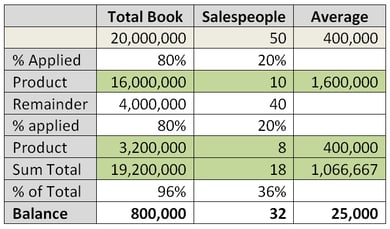
  • Skills to be successful – If you look at your sales results in a 80/20 power curve, you always see that about 36% of your team represents close to 90% of the sales results. What does that tell you about the rest of the team?  Answer: They either fail in effort or execution of the process, or they lack skills.  Question: Did you hire them that way or make them that way?
  • Pipeline – The question applies to anyone selling anything but ESPECIALLY if you are selling products and services of higher dollar amounts and selling B2B. Not everyone that fogs a mirror is a prospect.  Yes, people may call you out of the blue, walk into your office and ask to buy. Sell them!  But, day in and day out, your salespeople need to be looking for and talking to Zebras. (click here for book)
  • Depending on how your salespeople go to the market, the first contact has to be compelling. One of our rules is this: “Don’t look, act or sound like a salesperson.”  If your people open up with how good the company is, great pricing and unbelievable service, then they are bringing nothing to the conversation that is compelling.  REMEMBER THIS from Verne Harnish in Scaling UP – People are distracted.  Prospects have lots of other people looking to take their time.  You must have a compelling message in order to get people to keep listening.
  • Tracking is the name of the game when it comes to performance management. Lots of companies talk about performance management, but normally all that means is that there is an arbitrary line that someone has to cross before they go on a PIP – Performance Improvement Program.  By then, it’s normally too late. The key to performance management is to have systems and processes in place so that you can “catch them early”.

What does this mean?  It means the following:

  • Regardless of the levels of success in your organization, you should constantly invest in your people so that they continue to improve important skills and learn new ones.
  • Make sure that your salespeople clearly understand the ideal client in your organization and make sure that you have a process to “inspect what you expect” in terms of what segment of the market you are capturing.
  • Review your go-to-market messaging and ask yourself – “Does this really differentiate us from the market or are we trying to sell the same message everyone else is?”
  • Identify your sales steps. Have a process in place to calculate exactly how many of each step each salesperson has to execute in order to succeed.  Make sure that you have assumptions about the conversion ratios from one step to the next step.  These ratios will vary from person to person. Collect actual performance results.  Compare actual activity and effectiveness to target activity and effectiveness.

Additional Resources:

Building a Sales Formula for Success – Link to success formula

Tracking – Sample output of data collected

Topics: sales competencies, sales management, building successful sales teams, DoL regulations


    textunder

    Subscribe Here


    Most Read


    Follow #ACTG


    About our Blog

    Anthony Cole Training Group has been working with financial firms for close to 30 years helping them become more effective in their markets and closing their sales opportunity gap.  ACTG has mastered the art of using science-based data and finely honed coaching strategies to help build effective sales teams.  Don’t miss our weekly sales management blog insights from our team of expert contributors.


    Recent Blogs