ACTG Sales Management Blog

Sales & Sales Management Expertise Blog  

Why Perception and Consistency Drive Sales Performance

Posted by Tony Cole on Fri, Jan 03, 2025

I’d like to blame my poor visual perception for my subpar golf game, but the real culprit is my lack of consistency in practice. I’m inconsistent. As a result, my performance on the golf course is erratic, with scores ranging anywhere from 92 to 102.

I can shoot a 44 on the front nine and a 54 on the back. Don’t get me wrong—being virtually blind in one eye doesn’t help with depth perception. It’s a significant disadvantage when trying to gauge the distance from my ball to the pin. Sure, I have a distance-measuring app on my phone, but it doesn’t seem to help much. On the bright side, my depth perception struggles make for good laughs—just ask my daughter Alex about me trying to light candles on a birthday cake.

Let’s explore how these two factors—perception and consistency—impact sales performance.

Perception

Over the last 30 years, I’ve observed that salespeople tend to categorize all sales calls based on their products or services:

  • Lenders often start sales calls by discussing whether the client needs a loan or how they can access capital.
  • Employee benefits consultants focus on improving coverage and pricing.
  • Property and casualty agents zero in on risk vulnerabilities, assessments, and price.
  • Investment advisors prioritize discussions about maximizing returns, minimizing taxes, or reducing financial risk.

These approaches stem from our perception of what the client wants or needs. This perception typically arises from two factors:

  1. Years of experience in the business.
  2. The prospect's initial words during the setup of the meeting.

However, this perception can be flawed for two reasons:

  1. Years of experience don’t reflect the current reality.
    Golf provides a great analogy. Every round is different—weather, fairway conditions, green rolls, and pin placements constantly change. Similarly, sales situations are dynamic, and relying solely on past experiences can lead to missteps.
  2. What the prospect tells you initially is rarely the whole truth.
    It’s not that they’re lying, but they often describe symptoms rather than the root problem. Or they may present a problem that’s a byproduct of a larger issue.

To overcome these limitations, we must broaden our thinking and question our initial perceptions. By doing so, we can better identify the actual problems we need to solve.

Consistency

Top-performing salespeople demonstrate the importance of consistency. Research shows that 80% of the top 25% of salespeople follow a consistent sales process. What does this entail?

  • Milestone-centric processes: Their approach is systematic, ensuring each step leads to a decision. This eliminates indecision and delays.
  • Documentation: They record what happens at each step to track progress and identify gaps.
  • Data analysis: They evaluate data to pinpoint choke points that hinder faster, higher-margin sales.
  • Modeling success: They use data to replicate success consistently.

This mirrors the habits of a good golfer. Great golfers approach each shot systematically: they position their hands consistently, align correctly for putts, and maintain focus. Their methodical approach leads to lower scores and better performance compared to inconsistent players like me.

Commitment Matters

I’d love to improve my golf game, but I know it takes a deeper commitment than what I’m currently giving. Similarly, if you’re looking to improve your approach to selling—selling more, faster, and at better margins—it might be worth reflecting on how your level of commitment aligns with your goals.

Read & Share our Top 25 Sales Tips of 2025


Topics: sales performance, Sales Management Training, Sales Coaching, sales advice

Build a Sustainable Sales Goal Plan for 2025

Posted by Alex Cole-Murphy on Fri, Dec 27, 2024

We know that salespeople who accomplish their goals do these things consistently:

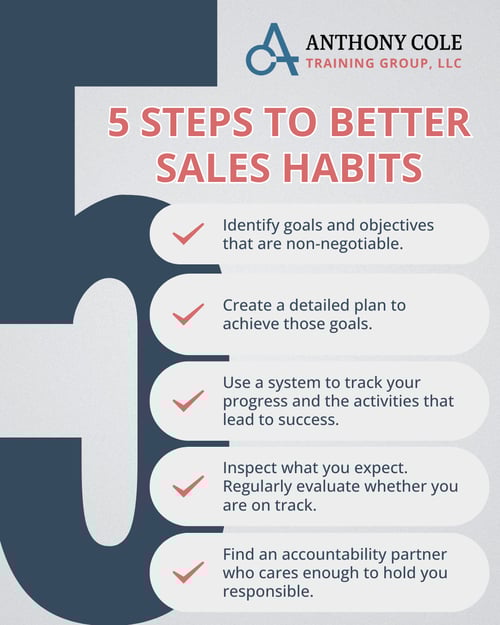
  1. Their goals are written down and they have a plan to achieve them.

  2. They have a timeframe that they stick to and their goals are defined and measurable.

  3. Lastly, they have an accountability partner or a coach to keep them on track.

A sustainable sales goal plan is more than just thinking about and writing down goals. Goals without actions and a strategic plan are just thoughts you have about what might happen. Writing goals with action items is a waste of time if you don’t commit to time frames. And ultimately, you have to inspect what you expect. The joy of accomplishing goals is what will keep you moving forward.

But keep in mind this one very important idea – your sales goal plan has to be tied to YOUR personal goals. It must be a number or objective driven by your needs and not the needs of the company. For example, maybe you want to pay off your credit card debt, a significant portion of the mortgage on that new house you bought, or pay for an upcoming vacation in full. When your work plan is directly tied to one of your personal motivators and objectives, you are much more likely to see the success you want.

Get started by downloading our Personal & Business Workplan template!

The Manager’s Role in Sales Goal Planning

When asked, most sales managers say that one of their greatest challenges is their ability to motivate their salespeople. If a sales manager can figure out what makes their team “tick,” they can better help them hit their goal numbers. Motivation seems like hard work because salespeople often value different things. There are, however, several steps a sales manager can take to establish a motivating environment.

The first step is to recognize that motivation is an “inside-out job.” When the topic of motivation is discussed, we typically think about incentive compensation, sales contests, and recognition programs. All of these certainly encourage your sales teams to focus on generating new business because these are rewards. However, you will gain true engagement and enthusiasm if you create an everyday environment that encourages each individual to identify and visualize their own internal motivation.

Do you remember Maslow’s Hierarchy of Needs pyramid? The bottom two tiers, Physiological and Safety, are the most basic needs of every individual. This same concept holds true for new salespeople. Hopefully, they will make their way up to self-actualization at some point, but they must first have income for food, shelter, safety, etc. Only once they realize they have attained all of these basic necessities and have established a cushion, can they turn attention to the higher tiers of Self-Actualization and the bigger dreams and goals to which they might aspire.

To put it another way, salespeople do not care about corporate shareholder value unless they are shareholders themselves. What they care about is food, shelter, clothing, recognition, paying for a college education or a wedding, buying a vacation home, etc. These are personal desires and make up the vast majority of things that are important to people. So, the solution is to create an environment where this internal motivation can take place. Refer to The Dream Manager by Michael Kelly for more insights.

This means that it is up to you to help your salespeople identify what is important to them. Make the effort to set up time off-site that is dedicated to planning and spend time developing each individual’s dreams and sales goal plan. This is time that you and they will spend ON your business instead of in it. Take a day or two that will help you and your team take a giant step forward to plan for the future.

Create a process where people can establish personal goals because this is where true motivation, passion, and desire are born. Hence, it is from this process that each salesperson’s business plan must evolve.

Create an environment where people get a chance to unplug, sit down, and outline their goals and dreams; a time when both of you can establish timeframes and attach financial values to these items. Once you have attached financial values, you will know what level of prospecting and selling activity is necessary for each salesperson.

Reward yourself and your people when they have a success. As your people go through this process and identify their sales goal plan; as you sit down, and establish your own personal goals, be sure to specify how you will reward yourself and your people as each of you achieve these goals. Make sure that you take time to find and celebrate the joy of this wonderful world of selling and helping customers make sound decisions, as that might just be the most rewarding goal of all.

Don’t wait to get started—download our Personal & Business Workplan template!


Topics: goal setting, Sales Plan, Sales Management Training, Sales Coaching, sales advice

2024's Top Sales Training & Management Content

Posted by Tony Cole on Thu, Dec 19, 2024

As 2024 comes to a close, we’re sharing our most read and favorite sales training and management content that helped sales teams thrive this year. Whether you’re focused on leadership, skill development, or strategic planning, you can use these resources to help drive sales success in 2025. Don't miss our top videos and free downloads at the end!

Top Sales Management Content of 2024: 

From Tony's Blog

Gain leadership insights and strategies for driving sales team success with these management-focused articles.

  1. Leading a Sales Team: 10 Keys to Success (Part 1)
  2. 7 Steps to Improve Your Outbound Sales Strategy
  3. Leading a Sales Team: 10 Keys to Success (Part 2)
  4. Using Sales Enablement Tools and Technology to Add Value to Relationships
  5. Sales Prospecting Tactics

Top Sales Training Content of 2024: 

From our Sales Brew

Share these links with your team to help them enhance their sales skills with expert tips and actionable strategies from top-performing salespeople.

  1. 24 Sales Tips for 2024 – From Our Sales Experts
  2. The Most Common Sales Objections | Part 1
  3. 5 Habits of the Best Salespeople
  4. 5 Tips for Asking Your Prospect Better Questions
  5. The Importance of a Quarterly Review

Top Sales Videos of 2024:

Watch these engaging videos from our sales experts to learn practical sales techniques that close deals and build relationships. Subtitles included!

  1. The Most Common Sales Objections | Part 1
  2. Conversations to Avoid on the Initial Sales Call
  3. The Most Common Sales Objections | Part 2
  4. Referral-Based Selling: How to Ask
  5. The Art of Closing a Sale

Top Free Resources of 2024:

We work hard to provide a large amount free resources for sales execs and salespeople. See our most popular resources of 2024 below! 

  1. eBook: Better than the Best Prospecting Book Ever Written
  2. eBook: Achieve Sales Team Excellence
  3. Recorded Webinar: Cultivate Profitable Customers using Sales Technology
  4. Weekly Email Subscription: Sales Brew
  5. Worksheet: Personal & Business Work Plan

Thank you for being a part of our community in 2024. We’re excited to continue providing quality sales training and management content to help you grow your business in 2025. Here's to another year of growth and success!

- The Team at Anthony Cole Training Group

Topics: Sales Management Training, Sales Coaching, sales advice

Sales Prospecting Tactics

Posted by Jeni Wehrmeyer on Fri, Dec 13, 2024

'Tis the season for prospecting, right? Actually, 'tis the season for every sales leader and company to wonder: Are my people reaching out to enough prospects and customers so that we can begin the year strong? The runway is shortening, and this can be a challenging time to reach decision-makers because they, too, may be out of the office or otherwise busy.

As business leaders, we have to accept some of this as the reality of the time of year. Certainly, we don’t want to come off as the Grinch who stole the spirit of the holidays. But does it make sense to put certain sales prospecting tactics in place and inspect them so that you can celebrate both the magic of the season and a robust start to 2025?

Here is a list of sales prospecting tactics that you can find in our eBook, Better Than the Best Prospecting Book Ever. This eBook includes 14 articles written by the Sales Experts at Anthony Cole Training Group to help you and your team stay on track this holiday season:

  1. Why Prospects Do the Things They Do: Understanding the Customer Buying Motives
  2. Prospects Do the Darndest Things: Handling Stalls, Objections, Questions, and Embellishments of the Truth
  3. Do You Speak Prospect? The Importance of Question-Based Selling
  4. Gone Fishin': Sales Prospecting Plan
  5. The 4 Keys to Great Introductions
  6. Identifying Your Ideal Prospect Persona | Selling to Zebras
  7. The 3 Things Keeping You From Connecting With Your Prospects
  8. 5 Tips for Asking Your Prospect Better Questions
  9. The 8-Step Compelling Prospect Phone Call
  10. Develop Your Sales Pipeline to Increase Sales
  11. Leaving Great Voicemails: The Key to Outbound Lead Generation
  12. The 7 Habits of Successful Salespeople
  13. Relationship Selling is the Key to Your Sales Challenges
  14. 4 Rules to Help Salespeople Maximize Initial Prospect Meetings

Download the eBook Better Than the Best Prospecting Book Ever and share it with your team. We wish you the happiest of holidays and the start of a great 2025! Let us know how we can help.

Do You Need More Leads? –  Free Sales Prospecting eBook Download


Topics: prospecting skills, Sales Coaching, Sales Prospecting Tactics

Expert Closing Techniques

Posted by Alex Cole-Murphy on Thu, Dec 05, 2024

In the old days of selling, closing was about what happens at the end of a client or prospect meeting – did we get them to sign something, give us the green light, or seal the deal? The activity was about applying pressure on the buyer to make a decision NOW.

Let’s pause and think about how we, as buyers, feel when a person is “pressuring” us to make a buying decision now. It seems there is only one agenda happening – and it’s all about the seller. That may contribute to why, over the years, salespeople have gotten a bad reputation.

Think about your own salespeople. There are many reasons they fail to close business. Too often, they fail simply because they don’t muster the courage required at the beginning of the sales process. When they are prospecting, they are not prepared to ask the right questions, and they aren’t ready when their prospect asks them unexpected questions.

Closing should refer to the whole sales process, not just the end. Closing is about asking questions versus pushing a client in a certain direction. “The sale should close itself” – the process should be natural, not forced. If you’re a good negotiator and influencer, the close should happen on its own. According to Objective Management Group, the pioneer and leader in the sales evaluation arena, there are 13 specific skills that lead to success. In essence, closing is not about expert closing techniques; it is about having excellent qualifying skills.

Picture1-Dec-06-2024-12-31-49-6880-AM

Let’s focus on the top two attributes that are essential for closing:

      1. Gets prospect to agree to make a decision: In your sales process, do your salespeople even ask the prospect if they are willing and able to make the decision? It is not uncommon for salespeople to deliver a proposal or a quote only to find that their “person” is not the ultimate decision-maker. Is that because they did not ask about the decision-making process? Or did they fail, in general, to communicate that they would deliver the proposal with the agreement that a decision would be made, Yes or No? Or did they even fail to clarify if the problems uncovered were compelling or costly enough to make a decision now or soon?

      2. Not Likely to take “Think it Overs”: We call these TIOs, and they are the death of most unclosed deals. They can come in the form of “I really like your proposal and will get back to you,” or “Let me think about it and talk to the team.” These are all understandable responses, right? Not if you have utilized this expert closing technique: “When I deliver the proposal that addresses all of the issues you have shared, within the budget we discussed, I ask one thing – and that is for you to make a decision, yes or no. I would prefer to hear yes, but no is okay.” Think about your own pipeline and deals lost. How many of them are attributable to the dreaded “Think it overs”? When faced with this response, skilled salespeople know how to go back to the pain and the cost of not fixing the problem. They are able to remind the prospect of the urgency they shared, why it is a priority, and balance that with the right amount of patience.

Closing is not about the close. It is about understanding and helping the client solve their problems and take advantage of opportunities, acting in the role of a valued business partner.

by Alex Cole-Murphy with contributions from Objective Management Group and distributors


Topics: closing more sales, Sales Coaching, Expert Closing Techniques


    textunder

    Subscribe Here


    Most Read


    Follow #ACTG


    About our Blog

    Anthony Cole Training Group has been working with financial firms for close to 30 years helping them become more effective in their markets and closing their sales opportunity gap.  ACTG has mastered the art of using science-based data and finely honed coaching strategies to help build effective sales teams.  Don’t miss our weekly sales management blog insights from our team of expert contributors.


    Recent Blogs