ACTG Sales Management Blog

Sales & Sales Management Expertise Blog  

The Real Power of Predictive Sales Assessments: Seeing What Others Can’t

Posted by Objective Management Group on Fri, Jul 18, 2025

This article was originally published by Objective Management Group and written by Ben Tagoe, CEO of OMG. It is shared here with permission. Anthony Cole Training Group is a Certified OMG Partner, helping organizations hire and develop high-performing sales teams using OMG’s industry-leading assessments and insights.

Why the strength of any model lies in its ability to separate success from struggle.

At OMG, we believe in empowering sales organizations through clarity. And clarity starts with knowing who will thrive—and who may need support.

In sales, not all assessments are created equal. The true value of any predictive model—whether you’re measuring creditworthiness, ad targeting, or sales skills—is in how well it can forecast real-world outcomes.

In our case, the outcome we care most about is success in sales.

At Objective Management Group (OMG), we use data to predict whether a salesperson is likely to succeed. But we don’t stop at theory—we track how well our model actually works by comparing assessment scores to real-world sales performance.

So, how do we know it’s working?

We look at two groups:

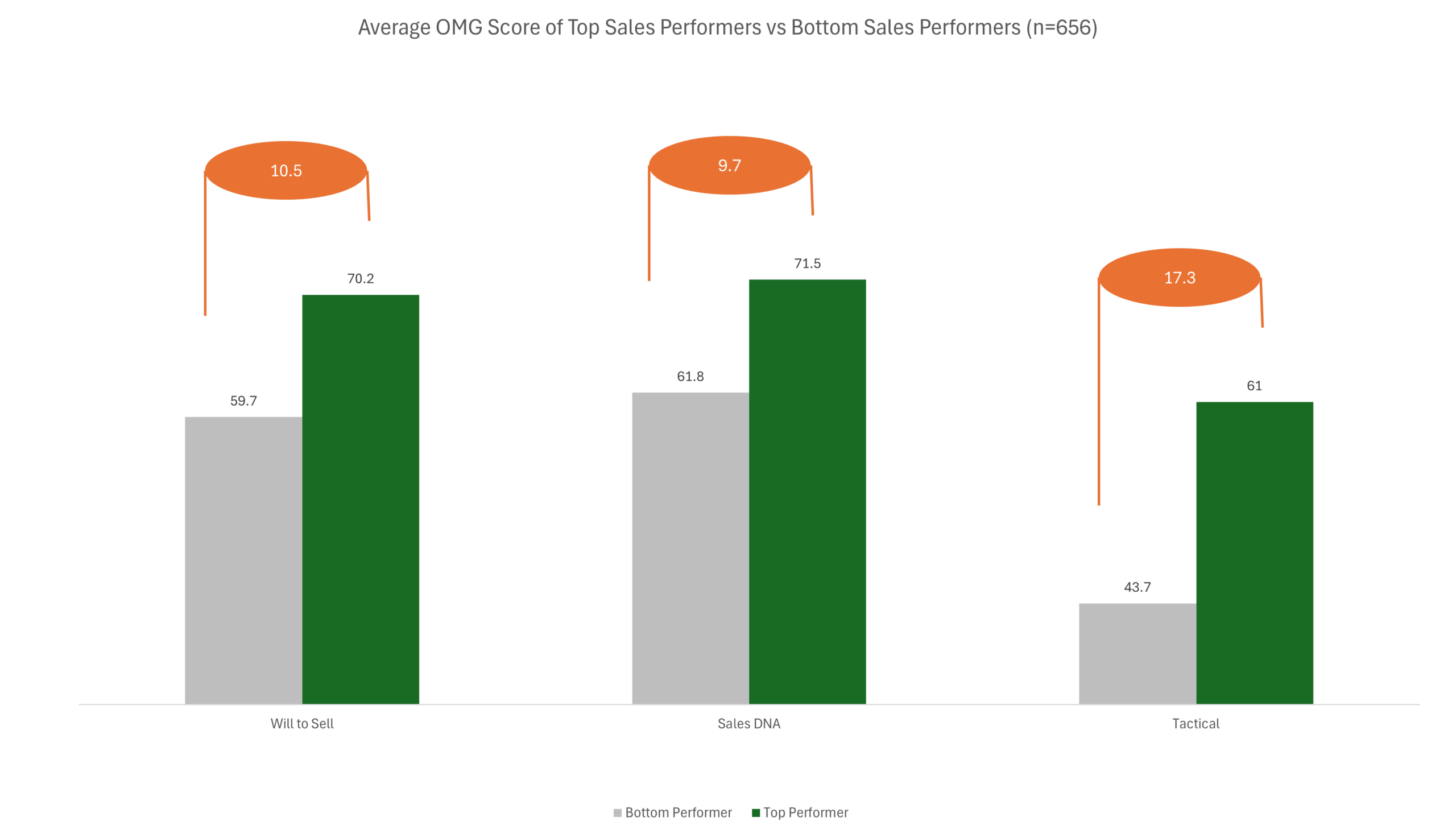
Top performers—those with above-average win rates and high-performance ratings from their companies.

Low performers—those who fall short on both.

And the difference between these two groups? It’s not just noticeable – it’s statistically significant. Our top performers consistently score higher on OMG assessments, with results separating out by a margin of three standard deviations. That means the model isn’t just accurate—it’s highly predictive.


Getting Stronger with Time

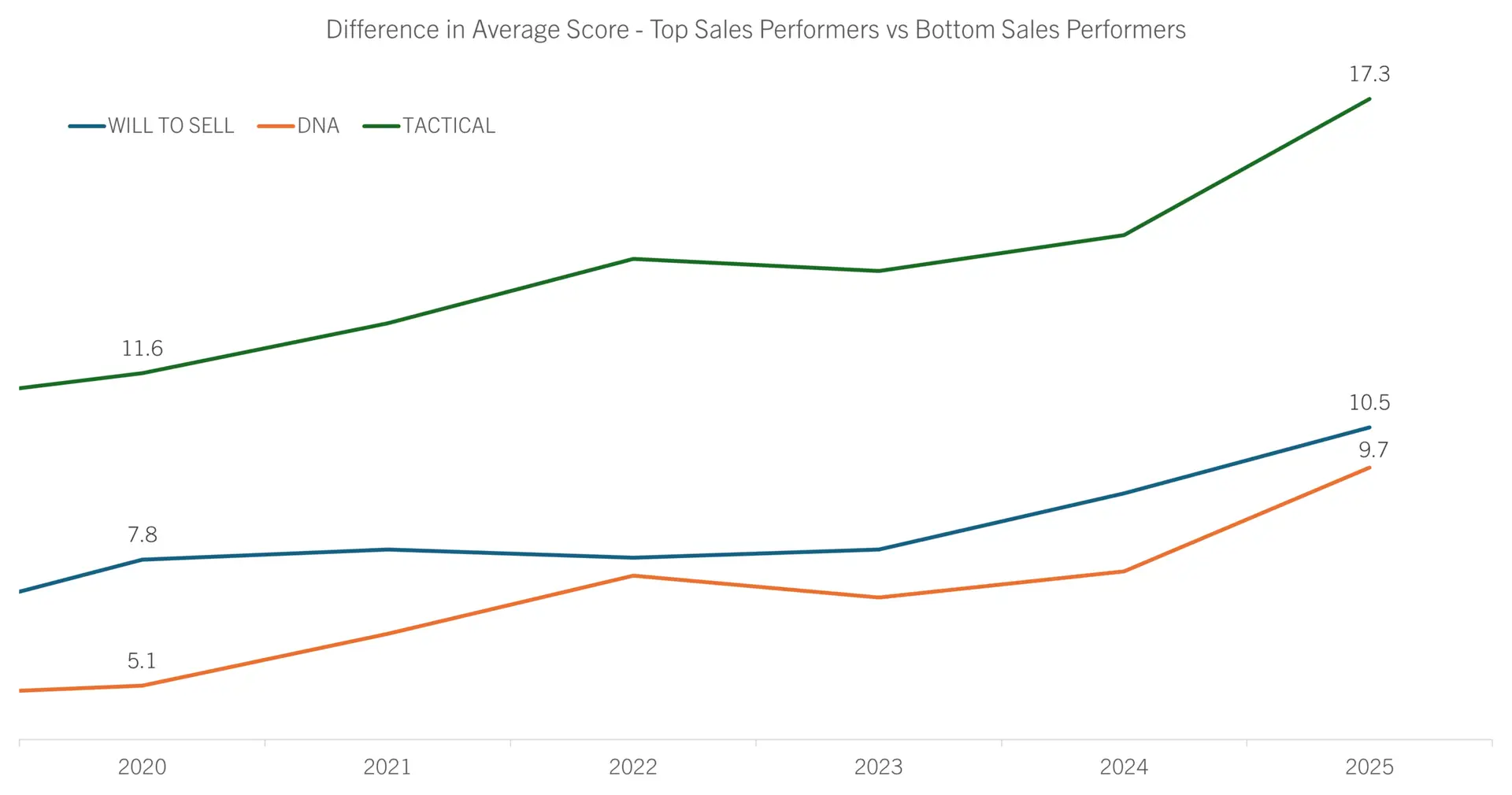
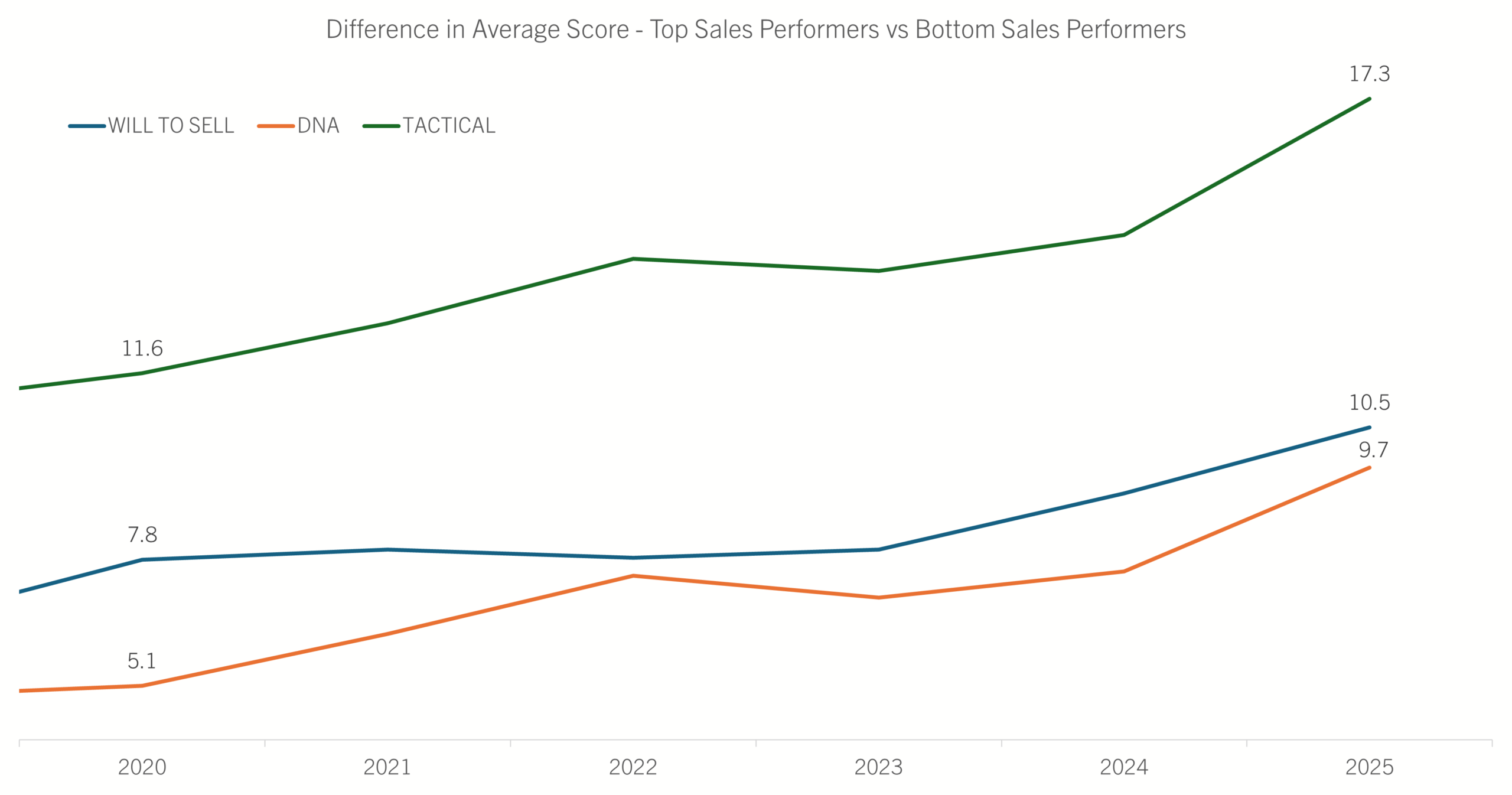
What excites us even more is this: the gap between high and low performers is growing.

Over time, our model has become even better at identifying the attributes of successful salespeople. That’s because we’re constantly learning. As more data flows in, our understanding sharpens—and so does the assessment’s predictive power.

This matters, because it helps sales organizations make better hiring decisions, build stronger teams, and provide the right coaching where it’s needed most.


Why it matters: It’s not just about predicting performance – it’s about unlocking potential.

Our goal isn’t just to sort people into “good” or “bad” buckets. It’s to give sales leaders clarity. To help them recognize top talent, support those on the rise, and invest in the kind of coaching that changes careers.

That’s what predictive modeling should do.

It should see what others can’t—and help people grow because of it.

Request Free  Sales Force Performance  Evaluation Samples


Topics: Sales Training, sales assessment

A Smarter Way to Generate Leads

Posted by Tony Cole on Thu, Jul 10, 2025

Selling to Zebras is a focused and effective lead generation strategy. There is no mistaking a zebra when you see one. If you book a safari to see the great African elephant and all you see is zebras, you're going to be disappointed. Maybe not the first couple days, because zebras are pretty cool—they’ve got those stripes. But eventually, you want to see that elephant. And when you do, there will be no mistaking the elephant for the zebra.

So it is with effective lead generation. Generating leads for new business isn't just a combination of behaviors and skills. As a sales leader, make sure that your salespeople are growing their business using the solid practice management strategy called Selling to Zebras. This concept came from Chad Kozier, the author of the book Selling to Zebras, and here are a few key concepts to implement with your team:

Three Simple Lead Generation Steps to Selling to Zebras

1. Segment your book into thirds.
Take a look at the top third of your business. If your business is like most, that top third represents over 90% of your revenue. These are your best clients. The idea behind Selling to Zebras is to ensure your lead generation strategy focuses on attracting more active buyers who resemble those top-tier clients.

2. Identify common traits and demographics.
What do your top clients have in common? Consider factors like industry, point of contact, how you made the connection, volume of sales or size of the organization, and key trigger points that signal they’re ready to buy.

3. Focus your time wisely.
Commit at least two-thirds of your lead generation time to looking for or attracting only those companies or individuals who resemble your top third. Avoid wasting time on unqualified or mismatched leads.

Bonus Tip for Your Salespeople

Chances are, the top third of each salesperson’s clients know at least five other companies like them. They should ask them for introductions. It’s a powerful way to leverage their existing network for growth.

Of equal importance is for every salesperson to know and be able to clearly articulate what isn’t a Zebra for them. This helps to bring clarity to their network and prospecting efforts. Here are some reasons why knowing what isn’t a Zebra is so important for salespeople:

It Eliminates Ambiguity

  • If you aren’t specific about who you serve best, it’s hard to get introductions. If you are vague in your prospect description, it will be more difficult to ask your advocates for introductions. Introductions have been proven to be the #1 lead generation strategy for top producers to grow their business. You must be specific and clear about what type of Zebra you serve best.

It Reduces Your Opportunity Cost

  • Every salesperson’s opportunity cost is simply this: if you called on Company ABC, that means you aren’t working on Company XYZ. Your opportunity cost is what you aren’t working on that might be more viable for you and your organization.

If you know what you don’t want and the reasons why, it might reduce the quantity of opportunities in your pipeline, but the quality will increase dramatically. As a sales leader, take some time in your next team meeting to help your sales team improve their lead generation efforts and success with Selling to Zebras.

Free eBook Download: Find Out if Your  Salespeople Can and Will SELL


Topics: Sales Training, generate leads, lead generation

Improving the Customer Experience in Banking

Posted by Mark Trinkle on Thu, Jul 03, 2025

Focus on the customer experience is not new. Secret shoppers and client surveys with NPS (net promoter scores) have helped build an entire industry because all banks, like all companies, want to continually improve the customer experience and ratings. Research validates that high ratings on the customer experience in banking correlate to more repeat business, more profitable and longer-lasting relationships, as well as recommendations to others. In most cases, it is also true that it costs more to replace a relationship than to grow existing clients, and of course, a strong experience is the best way for most bankers to earn additional relationships.

The Experience – Are Your Clients Satisfied or Engaged in the Customer Experience in Banking?

Many companies have a team of people that are held accountable for measuring and ensuring a positive client experience. For example, have you talked to a service company recently that didn’t ask you to take a 3-question survey at the end of the call? In the past, the focus was on gauging customer satisfaction. But in recent years, in light of direct and non-bank competitors, the focus has evolved to discovering clients’ engagement levels as a score for the customer experience in banking.

In fact, a recent Gallup survey discovered that:

  • 48% of consumers who were satisfied with their banking relationship also said they would consider their institution for their next product or service.

  • When they said they were both “satisfied and fully engaged,” the ratio rose to 83%.

Engagement can occur across all the various channels in banking: online, chat, customer service, in-branch, and social media. At times, these impersonal, multi-step digital avenues can work against the bank as well. So how does a bank turn a satisfied banking client into a more engaged client?

Meaningful Engagement Involves People-Powered Conversations

Equipping and training your customer-facing people is the silver bullet to creating and increasing customer engagement in banking. Consumers and business managers alike have been emailed, texted, pinged, and surveyed to the point of apathy. But when a need arises or a financial goal must be attained, there is no greater opportunity to drive engagement than when the phone rings or the customer walks into the bank.

When that happens, are your people prepared to ask enough of the right questions to truly understand and consult with the client? Are they capable of creating a conversation so impactful that the client is not only satisfied but wowed — ready to tell their family and friends about the experience and looking forward to the next one? That’s engagement. And when clients are that engaged, they have no interest in talking to other financial providers because their needs have been met and exceeded. Only adept, people-powered conversations can achieve that.

Helping Your Team Have More Powerful Conversations

Our sales evaluation partner, Objective Management Group (OMG), has identified 21 Core Sales Competencies that are critical for success in sales, business development, and relationship building. These competencies fall into three categories:

  1. Tactical Competencies

  2. Mindset Competencies (Sales DNA)

  3. Grit Competencies (Will to Sell)

Want to improve conversations? Evaluating your bankers’ competencies is fundamental to predicting a team’s overall success. In fact, bankers with high competency scores on the 21 Core skills are 50% more likely to be top performers. Bankers and sellers with higher competency scores perform better on win rate, new opportunity finding, and relationship building. By identifying and training the right competencies, bank leaders can give their teams the tools and training they need to succeed in their specific roles and to drive more engaged and enduring relationships.

Find out how you can evaluate  your team's Competencies!


Topics: Sales Training, customer experience in banking

Stories & Villains: Storytelling in Sales

Posted by Mark Trinkle on Fri, Jun 27, 2025

This week I was rewatching the Steve Jobs presentation from 2007 where Apple released a piece of technology that perhaps you have heard of. They called it the iPhone. Maybe you are like me and wonder how it is possible that 18 years have passed since then. I still remember having dinner in Philadelphia with a work colleague who had just bought the first version of the iPhone. I remember looking at it and saying, “I don’t think this is something that people are going to buy.” I might have been off base with that prediction.

Steve Jobs was a masterful storyteller. Just go back and watch any of his presentations where Apple was releasing a new product. Storytelling in sales is a trait great salespeople have mastered. Peter Guber said this in his book Tell to Win: “stories provide emotional transportation.” The key takeaway from that quote is that stories are capable of moving people. Stories are capable of inspiring people. If you are good at storytelling, you can move people from where they are today (presumably dealing with a problem or a villain) to where they might be in the future after they have overcome that problem or villain. And when that happens, your prospect becomes their own hero.

The Power of Emotion in Storytelling in Sales

The key to storytelling in sales is to harness the power of emotion. At Anthony Cole Training Group, we have known for quite some time that people buy emotionally and justify with logic. I completely agree that your technical skills need to be excellent and that you need to be a subject matter expert. But that is not what moves people to the point of taking action to solve their problems. What makes that happen is when emotion enters the equation and your prospect self-discovers that they must act. Fear, disappointment, and frustration are examples of just a few of the more powerful emotions that your prospect might be facing.

Probably the most powerful emotion in life (after the emotion of love) is the emotion of hate. And to be clear, there is too much hate in the world. For my money, I believe there are only three things that are okay to hate:

  1. Cancer

  2. Racism

  3. Alzheimer’s

These are villains that everyone is against and for good reasons. Steve Jobs was a believer that the best storytellers always give their prospect a villain to root against or a problem to hate so much that the prospect feels compelled to fight for a better future.

Stop talking about things your prospects don’t care about. Give them a villain to conquer. Some prospects are just waiting to become a hero. They just need something to root against. That is a conversation worth having.

Can we help you find the right  approach for your company?


Topics: Sales Training, Storytelling in Sales

Elevate Your Team’s Skills with Sales Practice

Posted by Alex Cole-Murphy on Fri, Jun 20, 2025

Every sales leader understands intellectually that practice is an essential contributing factor to the success of their salespeople in the field. Any skill, every skill, whether it is playing an instrument, competing in tennis or basketball or soccer, requires hours and hours of practice. So does becoming a champion in selling. It requires hours and hours of sales practice to refine a successful prospecting approach with a unique and compelling value proposition. It takes hours of practicing the right questions and listening to uncover if there is a real problem that must be fixed. And of course, discovering if there is time, budget, and resources to make a change is an elite skill that only comes naturally if a salesperson is comfortable asking some tough questions. In fact, they must think it is their job to do so.

What makes sales practice difficult is that many salespeople just don’t like it. Here is our advice for the sales leaders: they don’t have to like it, they just have to do it. Once that is made clear, and leaders initiate structured time and scenarios to incorporate into their sales practice plan, salespeople will begin to get more comfortable with practicing sales techniques.

Here are just a few unedited comments made by salespeople about sales practice and role play in our sales training this year:

      • "Allowing us the practice, although uncomfortable really allows me to get a feel for the layout of the conversation and dig deeper to have more successful conversations."
      • "As uncomfortable as roll playing can be, practice makes perfect."
      • "Discussing the different sales bases, what information needs to be collected in order to move forward. The role play & seeing it in action helped me a lot."
      • "Drilling down within my real-life scenarios made be better prepared for my meeting tomorrow than I would have otherwise."
      • "Makes you be prepared. Role play gets to the pain. Am I a commodity or do I bring something valuable to the table other than save you $. Listen, drill down. Lots of good stuff, even for those like me who have been doing this for a long time."

Much like salespeople, sales leaders might not like to run sales practices, but they too just need to do them! It can be difficult for managers because they may feel on the spot to demonstrate how the sales conversation should sound and may not be that comfortable themselves. Yes, to some degree, sales leaders should understand and be able to role play an effective sales conversation. However, here is an effective tip: rely on others. One of the effective approaches for sales practice with a team is to gain the insights from other producers.

Here are some other good guidelines for sales practice and how to role play:

  • Leaders, have regularly scheduled time and topics to role play on your team’s calendar

  • Don’t get too fancy, just dive in!

  • Determine roles: prospect and producer

  • Salesperson should share the opportunity’s background in 5 minutes or less

  • Remember, this is not a strategy discussion; the conversation must be in the role

  • Begin and continue the conversation as you would with your real prospect, making sure the prospect uses typical objections

  • If you need to step out of role play to make a point or gain feedback, state “out of role play”

  • After sales practice, gain feedback and insights from the team

    Screenshot 2025-06-20 at 9.09.39 AM

What should the team sales practice?

If a company is operating without a defined, stage-based sales system, it will be more difficult to create productive sales practice sessions, so start there. Using the ACTG sales approach, here are areas that salespeople should practice to become proficient, along with some tools sales leaders can use in practice sessions:

  1. Making the initial prospecting call: 8-Step Compelling Phone Process Worksheet

  2. Uncovering problems and pain that must be fixed, asking consultative questions to discover if this is a real prospect or just a shopper: Drill Down Questions Worksheet

  3. Asking real questions about time, budget, and resources: Are They Really a Prospect Sales Brew

  4. Overcoming objections and asking about the incumbent are always tough areas and must be role-played!: Winning Sales Pitch Sales Brew

  5. If a prospect is fully qualified, in a sense, they should “close” themselves, but here is an effective approach to sales practice for closing: Critical Closing Questions Sales Brew

Every sales leader would agree, it is important that salespeople practice their sales techniques with co-workers so that they do not practice on their prospects. Improving skills, practicing the game plan, and getting feedback from the practice sessions are crucial for success. Sales leaders, just get started and don’t get caught up in making it perfect. Practice is never perfect.


Topics: Sales Training, sales skills, sales practice


    textunder

    Subscribe Here


    Most Read


    Follow #ACTG


    About our Blog

    Anthony Cole Training Group has been working with financial firms for close to 30 years helping them become more effective in their markets and closing their sales opportunity gap.  ACTG has mastered the art of using science-based data and finely honed coaching strategies to help build effective sales teams.  Don’t miss our weekly sales management blog insights from our team of expert contributors.


    Recent Blogs