ACTG Sales Management Blog

Sales & Sales Management Expertise Blog  

Client Centered Selling: What It Is and Why It Works

Posted by Mark Trinkle on Thu, May 01, 2025

Here is the definition of client centered selling given by AI:

Client centered selling is a sales approach that prioritizes understanding and addressing the unique needs and goals of each customer, rather than simply promoting a product or service. It focuses on building long-term relationships and providing solutions that empower customers to achieve their desired outcomes. This approach involves 1) active listening, 2) asking insightful questions, and 3) tailoring the sales process to meet the specific circumstances of each customer.

Active Listening in Client Centered Selling

There are usually two problems:

  • Salespeople don’t spend enough time listening during their sales conversations.

  • When they do decide to listen, many salespeople don’t do a good job of listening.

Many salespeople think that listening means not talking, but that is not the whole truth. Being an active listener means you are listening to understand and not waiting for the opportunity to bring up your next point. Stephen Covey once said, “Seek first to understand before being understood.”

Active listening means you pick your spots to ask the other person to clarify what they just said. Be willing to tell your prospect if you see an issue differently. Ask them if it would be OK to talk about that different perspective. After an upcoming sales call, reflect on how much time you spent listening vs. talking.

Client Centered Selling Requires Asking Insightful Questions

The worst thing you can do on a sales call is try to convince or persuade. The best thing you can do on a sales call is to walk your prospect through a process we call the art of gradual self-discovery. This process is centered on asking great questions that allow the prospect to self-reflect and contemplate the problems they are having either as a consumer or as a business owner.

The best salespeople in the world don’t really sell anything. They create an environment where prospects make the decision to solve problems. They create an environment where prospects simply buy.

Think about using these insightful questions in your next sales conversation:

  • Tell me more about that.

  • How long has this been going on?

  • What have you done to address the problem?

  • When you spoke to your current provider, what did they recommend?

  • What happens if you don’t fix it?

  • How much will it cost you?

  • Is that a problem?

  • Do you have to fix it?

Tailoring Your Sales Process in Client Centered Selling

All elite salespeople follow a stage-based sales process, but what makes them great is their ability to tailor it to their clients. That’s what adding value in the sales process is all about.

Borrowing from the wonderful book Go-Givers Sell More by Bob Burg and John David Mann, they identify The Five Laws of Stratospheric Success:

  1. The Law of Value

  2. The Law of Compensation

  3. The Law of Influence

  4. The Law of Authenticity

  5. The Law of Receptivity

Let’s look at the Law of Value first. Here’s what they say:
Your true worth is determined by how much more you give in value than you take in payment.

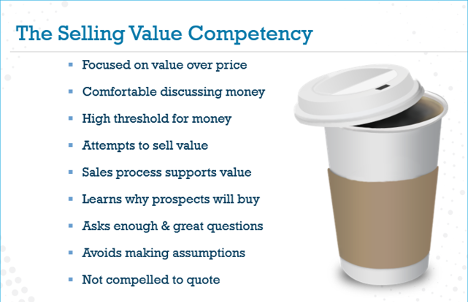
In addition, we know from our sales data source, Objective Management Group, that there are specific traits that skilled salespeople demonstrate when they build value for a prospect or client:

  • Focused on value over price

  • Know & believe in their value

  • Comfortable discussing money

  • Learn why prospects will buy

  • Ask enough & great questions

  • Avoid making assumptions

  • Not compelled to provide a proposal

As a salesperson, how skilled are you at tailoring your approach by doing your research in advance, asking enough of the right great questions, and adding value to every conversation? Do you make sure not to assume anything? Selling your value is something you need to focus on and develop in your sales toolkit.

Let’s look at one more of Bob and John David’s Five Laws – The Law of Influence, which they describe as:
Your influence is determined by how abundantly you place other people’s interests first.

All salespeople recognize that the days of showing up with your box of products are over, in large part because the buying process is now in the hands of the prospect. So, if everything can be found online, how do you differentiate yourself?

Consultative sellers put other people’s interests first. In other words, they tailor their approach with their core selling skills and behaviors.

Think about how your skills at listening, asking insightful questions, and tailoring your sales process contribute to your client centered selling. Remember, according to Bob and John David,
“Selling is not at its core a business transaction; it is first and foremost the forging of a human connection.”


Topics: Sales Training, client centered selling

Coaching Your Sales Team Starts with the Numbers

Posted by Tony Cole on Fri, Apr 25, 2025

Coaching of sales teams is usually done as needs arise. If a salesperson has a deal he needs to close, he may talk it through with his sales manager. Or if a salesperson has a specific problem submitting paperwork or with technology, coaching may take place. Of course, these items must be addressed. But ultimately, we must coach for sales success. We must coach bankers and advisors to go out and win more business.

Create a Success Formula for Coaching Your Sales Team

Coaching your sales team for success starts with the math. The details in the numbers will help you help your people succeed. Ask yourself, "What numbers must my team submit?" and then break it down per advisor.

Start with the end in mind. Figure out how much each salesperson must sell so that your team reaches its annual goal. Making the math easy, see the following example: Assuming you need $500,000 annual new business sales and you have 5 salespeople, you know that you need $100,000 of new business sales per sales professional. If you know the average size sale is $10,000, then you know each sales producer must make approximately 10 sales. These are their Smart Numbers.

But we must continue this analysis. These Smart Numbers are supported by activities that also have Critical Ratios that must be calculated and tracked. In other words, how good are they at each step of the sales process? So now you must calculate the activity ratios per salesperson.

What is Jane's ratio of presentations to closes? What is her ratio of sales opportunities to presentations? What is her ratio of appointments to sales opportunities? What is her ratio of contacts to appointments? And what is her ratio of dials or attempts to contacts? These are called Critical Ratios. In order to coach your sales team, you must know these.

Perform a Math Analysis to Set Benchmarks

Perform this math analysis with each individual on your sales team. Then establish a benchmark.

If you know that each salesperson's annual sales goal is $100,000 and you know the current ratios needed, per the analysis above, you will then be able to extrapolate to get the specific behaviors necessary per individual to reach his or her annual sales goal.

In other words, if the current ratio of a salesperson's dials to contacts is 10:1 and you know that his ratio of contacts to appointments is 4:1 and his ratio of appointments to sales opportunities is 3:1 and his ratio of sales opportunities to presentation is 1.25:1 and you know that his ratio of presentation to close is 4:1, then you can approximate that he will need to make 40 presentations, 50 sales opportunities, 150 appointments, 600 contacts, and 6000 dials annually (120 dials weekly or 24 dials daily) in order to reach his annual goal of 10 sales.

Breaking it down:

  • 100,000 / $10,000 average sales = 10 Sales

  • 10 Sales / .25 (4:1 ratio) = 40 Presentations

  • 40 Presentations / .80 (1.25:1 ratio) = 50 Sales Opportunities

  • 50 Sales Opportunities / .33 (3:1 ratio) = 150 Appointments

  • 150 Appointments / .25 (4:1 ratio) = 600 Contacts

  • 600 Contacts / .10 (10:1 ratio) = 6000 Dials or Attempts

If these numbers are annual numbers, each of these behaviors should be reduced to weekly and daily activity numbers so that you have the data necessary to coach your people in real time.

In other words:

  • 6000 Dials or Attempts / 50 Weeks = 120 Dials or Attempts per week

  • 120 Dials or Attempts per week / 5 Days per week = 24 Dials or Attempts per day

This is an example of a Success Formula—the daily and weekly numbers that must be identified so that you can hold your people accountable. You will coach your advisors to perform to these numbers. Each week you will remind each of the number of calls they must make.

Track Performance Against the Success Formula

Once these numbers are identified and communicated to each of your salespeople, you must evaluate individual performance against their Success Formula. Every week, you must compare actual activity against these benchmarks to see if each salesperson has completed the behaviors identified in his Critical Ratio analysis.

Once the activity numbers have been identified, communicated, and tracked for a time, you will begin to see who is making the effort—the dials, the contacts, the appointments, etc.

Is John making the effort? Is he making the dials and contacts? There is absolutely no excuse for lack of effort. If you have a salesperson who is not making the effort, you have a new set of problems and the solutions are few. John can either make the effort, resign, or be put on performance probation. If he does not improve, he should be reassigned or terminated within a specific time period.

If someone on your team is not making the effort—the dials, the contacts, the presentations—your sales figures will reflect it. If an individual is not meeting a conversion ratio level identified in the Critical Ratios, you will know what area you must focus your efforts on. This is how coaching your sales team begins with the numbers.

Focus Coaching Beyond "Run Harder" Techniques

When I was coaching at Iowa State University as a strength and conditioning coordinator, my first task was to evaluate each player's fitness level. As a result, we knew, when George and other defensive linemen ran less-than-acceptable times in the 40-yard dash, that we would get crushed by Oklahoma and Nebraska because their players were bigger and faster. At the time, our coaching technique sounded something like "George, you must run faster." At the beginning of fall practices, when players were out of shape, this may have been adequate coaching. However, as the season wore on and players were better conditioned, this type of coaching was ineffective.

I was subject to this same typical but-less-than-additive coaching when I was in the life insurance business. My manager, Bob, would look at my numbers and tell me that I needed to see more people. How many of us are guilty of coaching people that way? How many of us have been coached that way? This "run harder" coaching technique might be effective with a salesperson who is not making any effort or with a new hire. But if he is working hard and doing the behaviors, you must uncover his choke points and adopt more constructive coaching techniques.


Get more help with coaching your sales team in our eBook The Extraordinary Sales Manager below!

Download Free eBook:  The Extraordinary Sales Manager


Topics: Sales Training, Sales Coaching, coaching your sales team

4 Keys to Hiring Better Salespeople

Posted by Tony Cole on Fri, Apr 18, 2025

As you take stock of your team’s performance, what concerns you most? Is it the challenge of maintaining your company’s market share? Are you worried that your salespeople are not selling? Are you concerned that they even have what it takes to sell?

Hiring better salespeople is one of the biggest problems identified by the companies participating in our programs. The question is always, “How do I hire better salespeople?” Unfortunately, there is no simple answer to this question. But one thing you must recognize is that you and your process are responsible for the quality of the salespeople on your staff today. In other words, your recruiting process is perfectly designed for the team you have. So, if you need to hire better salespeople, you will need to change your recruiting process.

Recruiting is like sales. A salesperson must have a system. They must have a pipeline. Their activity must be consistent. Like the salesperson, you must have a system and you must execute the recruiting process exactly like you wish your salespeople to execute their sales process. Recruiting, like selling, is not a “sometime” thing — it must be a consistently planned and implemented activity.

Build a Recruiting Pipeline to Start Hiring Better Salespeople

You must have a Recruiting Pipeline, like your salesperson has a Prospecting Pipeline. Individual salespeople are required to fill their Prospecting Pipeline. Sales managers and sales leaders must be required to fill their Recruiting Pipeline. After all, if you had salespeople who didn’t have sufficient Prospecting Pipelines, you would be concerned about their future and the future of your company. As the person responsible for hiring better salespeople and driving sales production, the same should hold true for you and your Recruiting Pipeline.

To implement a Recruiting Pipeline, ask your sales team to let you know if they run across someone at the networking opportunities they attend. Ask them who they know. “Who should we be talking to? Do you know a salesperson who might be looking to make a change?” You must make your own efforts as well. Sometimes salespeople will not wish to offer up names, thinking that these people might present competition.

Meet with other employees to find out who they know who might be a good fit. Put together a Recruiting Team and ask these people to submit candidate names once per week. Implement a Recruiting Huddle and hold yourself and everyone accountable. Talk to your neighbors, your tennis partner, your golf friends. Ask them who they know who might be looking for a new opportunity in sales. You never know where you will find your next producer, and your goal is to fill your Recruiting Pipeline with prospective hires.

You must also determine your Pipeline Success Formula — how many names must you have in your pipeline to hire one good salesperson? How many names must you acquire to find one candidate that you will hire, contract and on-board? If you don’t already have a Recruiting Pipeline and have not done this consistently, you will have to guess until you get enough experience.

Hiring better salespeople requires you to be proactive. Have a consistent process, do the behaviors and inspect your activity just like you do your sales team’s activities.

Identify the Ideal Salesperson Candidate

Last but not least, you must identify the Ideal Salesperson Candidate. What are the skills and strengths most necessary for success in your company, industry and marketplace? It is imperative that you determine a profile for the ideal salesperson because otherwise you might hire just to fill an opening, thinking a warm body is better than none. In this process you must identify the type of salesperson you need and how your current sales staff measures up to the ideal salesperson.

I recommend an objective assessment that screens for sales skills, weaknesses and compatibility like the OMG Sales Candidate Screen. The Sales Candidate Screen gives you a succinct and accurate glance at a recruit. Will they take responsibility for their successes and failures? Will they get referrals? Can they handle prospects? Will their desire to be liked get in the way of selling? Do they take put-offs? Will they make presentations to unqualified prospects? Are they a hunter who will go out and find business, or a farmer who cultivates current business?

So, you must know what you are looking for in a candidate and you should know in advance the problems that a candidate is bringing to the table. Clearly resumes are not the answer because they typically present a stellar candidate. Face-to-face interviews are often misleading and can take you off track if you particularly like or dislike a candidate.

Next, you must implement a 5-Minute Prescreen Telephone Interview with the goal of initial discovery. Is the resume accurate? How does the candidate handle the phone call? In this case, you are the prospect, and your candidate needs to sell you on themselves.

The idea is to create an environment on the phone just like the salesperson will face when they are prospecting. Thus, it should be a bit uncomfortable. You must find out how the sales candidate will act under pressure.

A good sales candidate will try to engage you by asking questions. This means that they will likely attempt to do the same in a sales situation with a prospect who is rejecting them. Perhaps they will even try to close for an interview. This means that they will likely attempt to do this with a prospect. If they do one or the other, they pass the 5-Minute Interview and are on to the next step.

Remember, your current recruiting process is perfectly designed for the team you have. Are you ready to make changes in your recruiting process so that you can hire better salespeople?

Click Here for Additional Hiring Tools!

Topics: Sales Training, hiring better sales people, hiring better salespeople

Building Trust in Selling

Posted by Tony Cole on Thu, Apr 10, 2025

There are entire books written about building trust in selling, but for today, we will focus on one key element that may seem quite ordinary and obvious but is actually a well-honed skill of highly successful salespeople. And that skill is: Find out what your client or prospect wants. How is that done? Here is our recipe for building trust in selling:

• Ask questions.
• Listen to what they say.
• Understand what they say.
• Listen for what they don’t say.
• Ask questions about what they didn’t share.

What seems so simple is quite complex. To build trust, salespeople must be very skilled at asking questions so that when they dig a little deeper than normal, it does not seem like an interrogation. How do they do that? With a conversation in which they are engaged and genuinely interested in the prospect or client and NOT thinking about the next sale or product to offer.

The right time will come to provide solutions, but trust will be built along the way if the right questions are asked and answers are “heard.” A very common problem with many salespeople is that when they hear a cue such as, “Our payment process is just not working efficiently,” they will jump too fast to offer solutions. To truly understand that problem, more questions need to be asked, such as: “What have you done to address that?” “How long has that been going on?” and “How is this problem impacting you?”

Now how does a salesperson go about finding out what a prospect or client is NOT saying? Using the example above, if a client or prospect has had a problem that has been going on for a while, to find out what they are NOT saying, you could ask them: “Why do you think the company continues to just live with the problem?” They might bring up systems limitations or budget allocations — any number of things — but it’s all good information for determining next steps, if any.

Another idea to find out what a client may not be saying is to ask them: “If another agent called and asked to meet with you, would you say yes? And if so, why is that?” This should be a genuine, inquiring conversation and cannot come off as being defensive.

Another way to find out what customers want and to better meet their expectations is by asking them: “What one or two things could I do more or better that would help you?” Then, listen closely to what they say and keep your antenna up for their safe words: ok, reasonable, fine, pretty good, happy. If you are shooting to build trust and grow advocates, you will need to exceed expectations and look for words that indicate you have outpaced others in your efforts and delivery to serve. Words such as best yet, irreplaceable, always deliver.

Five Capabilities That Support Building Trust in Selling

Here are five practical sales capabilities that successful salespeople master to help them in their quest to building trust in selling:

  1. Ask the right question, the right way, at the right time. Asking questions is the key to great selling, but only if the questions are the right ones and they are asked in a way that builds trust and helps the prospect to further disclose details around their SMA (Severe Mental Anguish).

  2. Listen closely to the answer. Salespeople must really listen. Most of the time the initial problem a prospect identifies isn’t the real problem. Salespeople must uncover the real problem by listening intently and asking probing questions, digging ever deeper with each follow-up query. Resist the urge to pitch the product!

  3. Dig deeper with the following techniques. Salespeople must master questions and statements like the following: “Tell me more about that.” and “Why is that so important to you?” They must be comfortable asking questions like: “Is that problem compelling enough to make you take action?” and “How will you find the budget?”

  4. Reject rejection. Salespeople need to understand that selling isn’t personal. So, if they don't move forward with a particular opportunity, they must be able to recover, reset, focus on other opportunities, and continue to prospect.

  5. Be prepared. Scheduled prep time is essential. Salespeople who are well-prepared are better able to utilize their sales capabilities when they need them most. If they are practiced and comfortable going into a sales meeting, they will be able to operate under pressure.

In a highly commoditized industry such as financial sales, building trust in selling efforts is the superpower of differentiators. Salespeople should take a minute to review their top 20 clients, for example, to think about how deeply the trust factor is present and create a focus to turn more customers into trusting clients.


Topics: Sales Training, building trust in selling

How AI is Changing Sales & What That Means for Salespeople

Posted by Alex Cole-Murphy on Thu, Apr 03, 2025

AI is a leading topic in almost every industry publication these days — from Forbes to Insurance Journal to the American Bankers Association. As it should be, since it is revolutionizing most job functions, including sales and business development.

AI is another tool that offers many benefits for salespeople, and staying informed as AI is evolving will be important. A comparison would be the introduction of the internet and the impact it had on selling. The information that consumers and businesses used to call or visit companies to attain became readily available at the prospect’s desk and fingertips.

Yet salespeople still exist — and thrive — even after the internet changed everything. The key here is that salespeople must stay current with how AI can help them in their role of finding and cultivating clients.

This blog article will cover how AI is changing sales, how it can become a tool for salespeople, where it can help identify opportunities, and why sales skills matter more than ever to compete and be successful.

How AI is Changing Sales: Real-Life Tools Making a Difference

We recently met with the CEO of a small tech firm who has developed software to help target and focus a salesperson’s daily outreach activity. Using AI to evaluate current client data, they serve up a daily lead list of prospects with similar qualities in priority order — with complete contact information — helping salespeople stay focused on prospecting activities that will have the most impact in reaching their goals.

Salespeople no longer need to search around for who they should call, saving considerable time and effort. This tool also minimizes distractions. Think about how easy it is to get on LinkedIn for a purpose and suddenly you're reading posts and looking at connections. All good activities — but not as targeted as a custom-built daily calling list. This is one example of how AI is changing sales.

The role of Customer Relationship Management Systems (CRMs) has evolved over the years, and in today’s world, AI is playing a large part in providing predictive insights from client and industry data. Many CRMs are connected to email automation tools with some level of conversation intelligence — meaning they can read actual customer conversations to predict deal outcomes and forecast projections with unprecedented accuracy.

This is how AI is changing sales: allowing a company to provide data that helps salespeople get smarter and more focused in their business development efforts.

Where AI Helps in the Sales Process

Let’s break down where AI can help salespeople in their daily job. First and foremost, in prospecting with lead scoring and prioritization that identifies warmer leads more apt to respond and engage.

AI can also help in follow-up with automated reminders for appointments and emailing of information, as well as email sequences. These email sequences can be set up to send relevant information to targeted prospects.

We recommend being selective with the use of these automated emails, as those on the other end may be inclined to unsubscribe, causing a future inability for outreach. Relevancy and trustworthiness are the factors determining cold email success in 2025, as just published in a recent Hunter.io study. So, it is important to make certain that in outreach — whether automated or customized (preferred by most) — your messaging is relevant to the end user.

AI can also help the sales process by analyzing calls for coaching purposes and in forecasting, helping companies manage their pipelines with more accuracy and effectiveness.

Why Sales Skills Still Matter

Referencing once again the Hunter.io article: relevancy and trust are the two most important factors when a new salesperson comes calling.

AI cannot build trust, develop relationships, or strategize with a business owner on solutions. AI also does not handle objections like a salesperson can: asking the right questions, uncovering real reasons, and helping prospects navigate the mental roadblocks involved in making a decision.

The power and the value of the sales role is to apply emotional intelligence and relationship-building skills alongside appropriate AI intelligence.

According to the #1 sales evaluation company in the world, and our partner, Objective Management Group, one of the 21 Core Sales Competencies is relationship building, which includes quickly developing rapport and building relationships over time. It is these qualities that drive customers to stay at a company — or follow many salespeople to new companies if they move. As of today, this cannot be replicated by AI.

To illustrate: when a business owner must make a pivotal decision about the business that will alter strategy, revenue, and profit for future years, will they turn to AI or the right consultative salesperson for resources?

Most salespeople have heard about and explored ChatGPT and other similar AI tools that can help them improve their own communication and self-marketing. Salespeople will benefit by embracing these tools, finding time to understand them, and learning how they can help improve their calling efforts and conversations with prospects and clients.

AI is changing sales and is doing so in a positive manner for those salespeople and companies who stay informed and embrace these resources to improve results.


Topics: Sales Training, ai is changing sales


    textunder

    Subscribe Here


    Most Read


    Follow #ACTG


    About our Blog

    Anthony Cole Training Group has been working with financial firms for close to 30 years helping them become more effective in their markets and closing their sales opportunity gap.  ACTG has mastered the art of using science-based data and finely honed coaching strategies to help build effective sales teams.  Don’t miss our weekly sales management blog insights from our team of expert contributors.


    Recent Blogs