ACTG Sales Management Blog

Sales & Sales Management Expertise Blog  

4 Steps to Create Client Advocates

Posted by Walt Gerano on Tue, Jan 17, 2017

A guest post by Walt Gerano, Sales Development Expert, Anthony Cole Training Group

advocate_checklist.jpg

Today's question is this: “What are you doing to keep your clients coming back... and telling their friends?”

Can you think of a place where you go, wait in a long line, spend a lot of money and yet can’t wait to tell others how great it was and go back again?  Well, that could describe a number of places, but the frame of reference I want to use today is the Disney experience.

No one would argue with the success that Disney has in exceeding expectations and creating advocates. When you go there your first time, it is more beautiful than you ever imagined.  You have such a magical time that you forget about how much things cost or how long the lines are for almost everything.  In his book, Inside the Magic Kingdom, author Tom Connellan shows us (in story form) the seven keys to Disney’s success and how they work to create a dazzling experience for all of their guests.  As you read the book, you can only imagine what would go into building and sustaining that kind of relationship with your customers.

In order to achieve “dazzling”, you must have a process that is consistent and predictable.  People need to know what they can depend on when they trust you with their business.  In other words, it’s not a once-in-a-while thing; it is just the way you do things.

Keep in mind that it does not have to be the same thing for all of your clients.  The way you support your top 20% needs to be different from how you support your bottom 20%. But, at the heart of it all, everyone gets the basics.

So, how DO you create advocates?

  1. You have to find out what they want.How do you do this?  Ask!  Give them a list of things to choose from with the option to add things that might not be on the list.
  2. Next, prioritize critical areas. The key here is to find out what they won’t tell you.  How many times have you left a restaurant after you told your server everything was fine when they asked… then you  get back to your car and vow to never go back?  Some of your clients may do the same thing.
  3. Identify performance levelsand find out where they are setting the bar; don’t assume you know.
  4. Negotiate expectations. Now is the time to deal with anything you are not willing to agree to. Sometimes we say “yes” because we think it’s a deal breaker; just ask and then decide.  If it is outside your process, then you are better served to move on because, unfortunately, it will always be a struggle and they will never become an advocate anyway.

The only way to exceed your customer’s expectations is to know what they actually are, not what you think they are.  Start by having that conversation first and soon you will have them coming back for more and telling their friends.

Additional Resources:

Solving Problems for Prospects

Topics: exceeding customer expectations, creating advocates, solving sales issues

Developing Rapport Quickly with Sales Prospects

Posted by Jack Kasel on Fri, Jan 06, 2017

sales-rapport.gifA guest post by Jack Kasel, Sales Development Expert, Anthony Cole Training Group

Rapport can be the fertilizer to help develop relationships quicker and with deeper roots.  However, most salespeople confuse rapport with having things in common.  Hello, everyone, this is Jack Kasel bringing you the latest Anthony Cole Training Sales Brew—Developing Rapport.

Most salespeople, upon entering a prospect’s office for the first time, become Robo-Salesperson – scanning the room for something to make a witty and insightful comment about.  When they hone in on a picture on the desk, they ask, “Is that your family?”   The prospect may answer differently, but is thinking “No, that’s the family of the person who had this office before me.  I liked his family better, so I kept the picture.” (Pause) “Of course, it’s my family, Captain Obvious.”

Don’t get me wrong; making those observations are helpful, but needing to be mentioned at the right time and mentioning it “right off the bat” isn’t the right time.  Why?  Because 10 out of the 12 previous salespeople who called on your prospect did the same thing.  You don’t want to be like all the other sales people; be different, be memorable.

Our definition of building rapport is this:  Prove you belong at the table.   You prove you belong at the table by the way you conduct yourself, the questions you ask and how you manage the interaction with the prospect.  That includes how you open the call.

We suggest two things when opening the call:

  • Don’t thank them for the meeting
  • Ask a great opening question

The opening statement could sound something like this: “I’m glad we could coordinate our schedules; I’m looking forward to our conversation.”   If we give the impression we are just a lowly salesperson, it doesn’t create “Equal Business Stature.”  They are professionals, we are professionals; we are going to have a professional business discussion.  IF we give the impression we are so grateful they could fit us in to their busy schedule, that doesn’t get the conversation started correctly.  Remember: our time is just as valuable as theirs, so act like it.

Asking a great opening question may sound like this, “Mr./Ms. Prospect, What do we need to discuss over the next 40-45 minutes that would make you say, ‘I’m glad we scheduled this meeting’  OR  ‘This was a good use of my time today’?   That forces them to talk about things important to them and gets the meeting started correctly.

As I mentioned earlier, discussing things on a personal level (sports, interests, hobbies, etc.) is best saved for when you are closing up the meeting.   That can bring a personal touch to the conversation; just make sure it’s done at the proper time – which is the end of the meeting, not the beginning.

Additional Resources:

4 Steps for Creating a Dazzling Client Experience by Walt Gerano

subscribe-to-blog.png

Topics: Sales Strategies, close more sales, rapport with sales prospects, asking sales questions, initial sales meeting

5 Sales Activities that Lead to Success: Are Your Salespeople Assertive Enough?

Posted by Tony Cole on Fri, Dec 30, 2016

success_work.gif


Assertive (not aggressive) salespeople win more business than others.  They care so much about doing the right thing for their clients that they are willing to risk the relationship and the deal in order to make sure the prospect or client makes the right decisions.  Does that describe your people?  Are they assertive?

When we say assertive, what do we mean?  What sales habits do assertive and successful people do day in and day out?  In 2010, I wrote a blog entitled 5 Direct Sales Activities That Lead to Sales Success that has been one of my highest readership blogs.  I went back and reviewed and here are the five steps:

  1. Activities that lead to getting names - networking, speaking engagements, sponsored seminars, meeting with centers of influence and/or asking for introductions
  2. Calling a suspect on the phone for an appointment
  3. Conversations and meetings to qualify a suspect
  4. Gathering additional information that leads to a presentation meeting
  5. Presentations/pitch meetings that lead to decisions

Steps 1 and 2 have changed dramatically in the last 6 years.  Social selling and the evolution of the buyer’s process utilizing all of the multiple channels of information has completely changed the process of prospecting for business.  Step 2 - getting a suspect on the phone - is virtually impossible with voicemails and phone trees.

Our Own Prospecting Case Study

Earlier this year, we decided to test the waters for our hiring business solution, www.hirebettersalespeople.com.  We had some initial success right off the bat with our launch in January of 2016, but then activity seemed to cool down.  We purchased a local lead list based on company size and title and I began calling.  Here are the calling results:

  • 66% of the dials took me directly into a recorded phone tree
  • 25% of the calls took me to a receptionist who was very helpful and informative but transferred me to voicemail
  • Of the remaining 9%, I had in depth conversations with 3 people, met with one and generated one sale from that contact

3 people fit our profile; I met with 1 and sold that one… but not to help them hire better salespeople, but rather to help them test, train and track some of the salespeople that were not “hitting their weight”.  The second was not interested at the time and the 3rd introduced me to someone in the home office. That contact has put us in the middle of negotiations for a 5-figure initial engagement.

I tell you that story to make the following points about step #2:

  • Calling prospects on the phone doesn’t work like it used to.  
  • It requires more attempts and effort than ever before - you have to have a different tactic and message to differentiate yourself.
  • Once you make contact, you have to be extremely good at what you do and have a compelling reason for people to listen and stay on the phone. THAT is where being more assertive makes a difference.

Steps 3, 4, 5:  How to be More Assertive at Qualifying, Presenting and Getting Decisions

In our primary markets of financial institutions, investment services and insurance brokerage, we ARE the resource for sales growth solutions.  We coach our clients on the fact that the reason for either their sales growth or loss is due to their peoples’  1) effort or 2) execution.  But what does assertiveness have to do with Effort and Execution of steps 3,4 and 5?  In a word, EVERYTHING.

Steps 3,4, and 5:

  1. Conversations and meetings to qualify a suspect
  2. Gathering additional information that leads to a presentation meeting
  3. Presentations/pitch meetings that lead to decisions

In each one of these steps, the skill of asking the right questions, the right way, at the right time is critical.  In our selling system, we explain that -  in order for a prospect to qualify - they must:

  1. Have compelling reasons to buy, make a change, do something different
  2. Have the capability and willingness to invest the right time, money and effort required for the purchase/change
  3. Be in a position of decision making and be able to make the decision to find a solution to the compelling (have to fix) issue,  can make the money decision, can leave a current or add to a current relationship, and say yes or no.

There are lots of questions that need to be asked in order to find out if the prospect qualifies in these three areas.  Some of these questions require a sales person to be assertive.  Questions such as:

  • How will you go about telling your current broker/banker/relationship that you are no longer going to do business with them?
  • If you don’t have the money, how will you solve the problem?
  • The budget you have won’t be enough to get you the outcome you want. What part of the solution do you want to eliminate?
  • What will you tell your partner when they say they don’t want to make the change?

Additionally, sometimes statements are required that would be considered counter-intuitive to selling, gutsy and risky.

  • Based on our experience and deep domain knowledge about your business, your best action to take would be this: ________.  If that doesn’t seem to work for you, then there’s a possibility that we won’t be a good match.
  • If I treated my clients the way you’ve been treated, then I would expect to be fired.
  • When we finish our presentation, solve all of the problems you’ve asked us to address within your budget and answered all your questions, I’ll need for you to be in a position to make a decision on whether we’ll do business together or not.
  • Maybe the most important thing for you to consider is “fit”.  If there isn’t a fit between our two companies, then our products and pricing really don’t matter.

Imagine for a second that you had salespeople that were gutsy enough to have these types of conversations. What would happen?  You might fear that you would lose more business. But… suppose that wasn’t the case.  Suppose by being more assertive and gutsy, your salespeople eliminated tire kickers earlier.  Suppose this lead to the elimination of “think it overs” and actually got people to decide.  Imagine for a second that your salespeople stopped making presentations to people who could only say “no” and never had the authority or intention of saying “yes”.  What would happen?

Your people would sell more, more quickly, at higher margins.  They would stop wasting time, stop getting delays, stop being shopped by a prospect that was just trying to keep a current provider honest.  

Here’s How Sales Managers Can Get Their Salespeople to be More Assertive

Sales managers must hold their salespeople accountable to the right level of sales activity.  To do this, you must have a success formula and a well-defined sales process so that you can identify where the choke points are for individuals when they fail to close “sure thing” opportunities.  You must also have a pipeline tool that actually helps you predict the possibility of an opportunity closing rather than a tool that just reports that there is activity in the pipeline.  And, finally, you must have a full pipeline – an anemic pipeline makes cowards out of salespeople. These are the tools you will need to help your salespeople be more assertive and close more business, more quickly, at higher margins.

subscribe-to-blog.png

Topics: sales competencies, sales management, sales prospecting, Sales Strategies, asking sales questions

7 Effective Sales Management Steps to Take NOW

Posted by Tony Cole on Wed, Dec 14, 2016

Luck-not-strategy.png

Sales management, sales leadership and sales presidency require special diligence this time of year. Actions taken now will assure successful sales results in the coming year. In order to transition smoothly, here are 7 sales management steps that should be completed before the end of the year.  

By now, you should have:

  1. Evaluated the individuals on your team for the year. Unless you have anomalies at the end of the year, your team’s individual outcomes and results are pretty much set.
  2. (Based on the evaluation) Begun to have meetings with all your people. The meetings are similar to performance reviews, but they’re not the corporate type of review that gets put in the HR file.  These reviews put your team members in 1 of four groups. You then have a discussion about what group they are in.
    1. Met or exceeded sales goal and sales activity requirements group
    2. Met or exceeded sales goal but currently not at sales activity targets group
    3. Met or exceeded sales activity targets but failed  to hit sales targets (below 100% is failing)
    4. Has not met sales or sales activity targets

(If you would like information on what the conversation should sound like for people in each of these groups, call me or text me at 513-226-3913.  If I don’t answer, just leave a message with your name, mobile number and email requesting, “Where’s Walter?” information.  You can also email me at tony@anthonycoletraining.com.)

  1. Reviewed performance, actual effort and execution effectiveness results against targets for the year.
  2. Assessed where the choke points are for people on the team who are not succeeding. To do this, you look at the conversion ratios in your sales success formula that was built last year and reviewed every quarter.  (Don’t have a success formula?  Click here –> Success formula download)
  3. Revised the success formula for 2017 based on each person’s commitment to performance via the “extraordinary discussion”. (Haven’t had that discussion? Ask Jeni at Jeni@anthonycoletraining.com to send you that information.)
  4. Conducted an offsite where your salespeople identify personal goals, translate the personal goals into a personal income requirement and translate that into a work plan that you will follow up with every quarter. (Yes, we have information on what that offsite should look like.  Even though it’s late to be doing that now, conducting the session in January would be better than not conducting one at all.  Let us know if we can help: 513-791-3458)
  5. Talked to your HR department about additional FTEs for the coming year to grow your sales team and replace the people that are not performing. Think about this: Suppose you had to hire better salespeople (3) but can only grow your sales team by 2 – who would you let go?

These 7 things are the minimum functions for sales management at this time of year.  Failure to execute on these 7 steps will pretty much guarantee that your next 12 months will look like the past 12 months:

  • Only a few people will meet or exceed the goal
  • Most of the people will miss the goal by at least 10% and some as much as 20%
  • The bottom 33% of your sales force will represent less than 5% of your new business revenue
  • Salespeople that fail will continue to make excuses
  • The salespeople that had a “one-off” great year will coast in the next year and live off the laurels of this year.
  • Your top performers will continue to be frustrated by lack of attention, support and recognition for their outstanding contributions.

subscribe-to-blog.png

Topics: success formula, managing sales teams, effective sales management

28 Sales Traits to Identify When Hiring Better Salespeople

Posted by Tony Cole on Thu, Dec 08, 2016

So, what are you looking for in your next great sales person?  I guess the most important question is this: Are you really looking for the next great sales person or are you looking for a sales person that will fill the FTE allocation?  Will you settle for someone that is “at least as good as” your average sales person?

No one in their right mind would say “yes” to those questions, but if your sales organization is large enough, the data would support that your hiring practices are getting you exactly that.  According to Geoff Smart (Topgrading), 75% of the hires made are not as good as or only as good as the person they are replacing.

If we were to look at the 80/20 power curve in your organization, we would probably find out what we normally do – that about 36% of the sales force is responsible for over 90% of your sales results.  So, what is the other 64% doing?  How did they end up on your sales team?

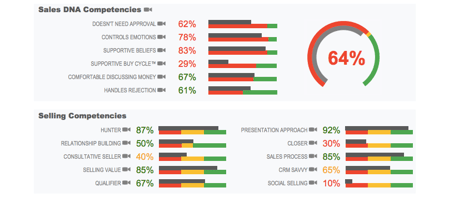
In order to get the right people, you have to know what you should be looking for.  In conjunction with Objective Management Group, we have studied our clients.  We have evaluated their top performers and non-performers.  Looking at over 100 data points, we know what separates those who will sell from those who won’t sell.  Do you?

quality-chart.png

Ignore the words and numbers.  Just look at the sea of green which is representative of performers and compare that with the sea of red representing non-performers.

Here is the list we’ve come up with after analyzing the sales teams of 5 of our clients in the financial services/banking business:

  1. Strong desire for success in selling
  2. Strong commitment/motivated to do everything possible to succeed in selling
  3. Trainable
  4. Has a strong figure-it-out factor
  5. Possesses Sales DNA Competencies
  6. Has no need for approval
  7. Controls emotions
  8. Has supportive beliefs
  9. Comfortable discussing money
  10. Handles rejection
  11. Hunter
  12. Sales posturing
  13. Consultative seller
  14. Qualifier
  15. Closer
  16. Follows consistent sales process
  17. Compatibility with top performer profile
  18. Prospects consistently
  19. Schedules meetings
  20. Reaches decision makers
  21. Recovers from rejection
  22. Does not need to be liked
  23. Comfortable talking about money
  24. Has a strong self-image
  25. Loves to win
  26. Motivated by recognition
  27. Loves competing with others
  28. Rejection proof

What I find interesting about some of the items is that there are a few that have a significant variance between the performers and non-performers:

  1. Commitment – The commitment to succeed in selling is 77% GREATER in performers than in non-performers.
  2. The trainability in performers is 34% HIGHER.
  3. The hunter skill in performers is 112% HIGHER.
  4. Performers have a 48% HIGHER figure-it-out factor.
  5. Performers score 119% HIGHER in handling rejection.
  6. Those that hit sales goals score 87% HIGHER in sales posturing
  7. This one blows me away – neither group is particularly strong in closing: non-performers have only 13% of the closing skills required.  Even though top performers OUTSCORE their counter-parts by 150%, they still only have 33% of the required closing skills.

How do you explain that last item?  Look at the others strengths:  Desire, commitment, trainability, hunter, figure-it-out qualifier, consultative, posturing… they are REJECTION proof! 

The purpose of this post is to get you to think more seriously about what it is that you really know about the candidates you are looking to hire as well as what you really need to know before proceeding with the interview and hiring steps.

Any questions? Please call or write:
513.226.3913 tony@anthonycoletraining.com

subscribe-to-blog.png

Topics: Sales DNA, managing sales teams, managing salespeople, top sales performers


    textunder

    Subscribe Here


    Most Read


    Follow #ACTG


    About our Blog

    Anthony Cole Training Group has been working with financial firms for close to 30 years helping them become more effective in their markets and closing their sales opportunity gap.  ACTG has mastered the art of using science-based data and finely honed coaching strategies to help build effective sales teams.  Don’t miss our weekly sales management blog insights from our team of expert contributors.


    Recent Blogs