ACTG Sales Management Blog

Sales & Sales Management Expertise Blog  

Hitting Your Sales Goals – 3 Challenges to Overcome

Posted by Tony Cole on Wed, Sep 06, 2017

In the last 30 days, I’ve talked to more than a dozen company executives, sales people and sales managers.  I’ve asked them “What is the #1 constrictor to hitting your sales goals?”  The answer every time was: getting more qualified leads.  I know this is not a large sampling and I would be concerned about the validity of this finding if only 25% of them said that getting more qualified leads was the main problem. But that isn’t the case.  The consistency of answer in this survey indicates a trend to focus on.

There is further validation of the current finding:

During training discussions over the course of more than 20 years, I’ve asked sales executives, presidents and sales teams to complete the following statement:  I (we) would sell more, be more productive, more effective if only I (we) …  The #1 most common answer consistently over the years has been “If I had more / better prospects to call on.”

In order to address the problem of gettin more qualified leads, sales leaders and salespeople need to first understand these three challenges:

  1. Will to Sell
  2. Sales DNA
  3. Sales Skills

Let me use an example to explain.  We are currently working with a financial institution that is hiring a new private banker in an expanded market.  Using the pre-hire assessment from our partner Objective Management Group, we created a ‘tailored fit model’ based on the performance of the top and bottom current private bankers and then assessed the 5 candidates they were still considering.

Take a look at these findings:
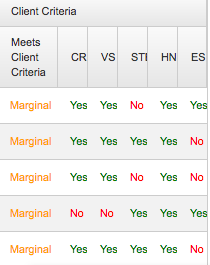
Figure 1 – How well did the candidates match the clients’ work history criteria for success?  The client created a profile that indicated that the non-negotiable sale success criteria where: 1) must be competition resistant (successfully sold in a competitive environment), 2) Successfully sold value rather than price, 3) Sold to executives, 4) Has successfully hunted and sold new business (this addresses challenge #3 sales skills – specifically skills for hunting/ prospecting), 5) Is an entrepreneurial seller.  As you can see all the candidates being considered marginally met the client criteria for success with 3 of the 5 having an 80% match.

But when we look at the other findings, we find the 3 challenges most common to organizations that are trying to consistently hit / exceed their sales goals.
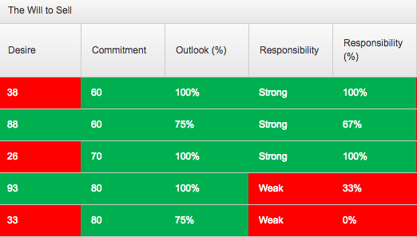
Figure #2 -When we look at Challenge #1 – ‘Will to Sell’ we find the following:

Only 1 candidate meets all the criteria for Will To Sell. The question becomes:  How important is the will to sell when attempting to overcome the challenges of finding qualified prospects to talk to? If 1/3 of your current team lacks the will to sell what is the likelihood  - despite all the ‘prospecting’ training you provide them – that they will actually execute?  Also note that one of the candidates with strong desire, commitment and outlook will still be prone to making excuses for not prospecting, asking for introductions and networking. (Desire for Sales Success)

Figure #3 – Sales DNA (Sales DNA Audio) findings for the 5 candidates looked like this:
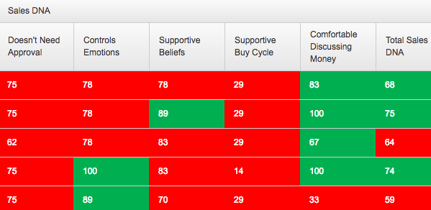
This post won’t go into the definitions of all the criteria you see here but understand that green is good and red is not so good.  If you look to the right of the graph and look at the Total Sales DNA the scores in green and red told our client what they needed to know.  If everything else is equal in the equation then your people with strong sales DNA are more likely to do the activity of prospecting and will be more successful.

*Candidate #2 meets the criteria of the client, has a very strong will to sell and has the highest sales DNA score.  How many of the people on your sales team measure up to this ‘elite’ candidate?

The world of selling is certainly different today than it was just 5 years ago.  Your prospects in the market place have more ways to find more information about you, your products and services. They have more ways to compare you against your competition and all of this happens without you or your sales people even making contact.  (See ZMOT – Google Research – Zero Moment of Truth).

To meet the challenges of today, you need a sales team with the right stuff.

 Find Out More about our Fall Sales Workshops

Topics: Prospecting, sales goals, sales prospects, qualified leads, sales leads, generating leads

How Do You Turn “Old Farts” Into Sales Legends?  Not So Easy 1, 2, 3

Posted by Tony Cole on Tue, Aug 29, 2017

I doubt that you, in public, have a group of producers that you call ‘old farts’ or some other term of endearment.  But what I really wonder is this; Do you have a group that you consider ‘Sales Legends’.  My guess is that the answer is no.  There are reasons for this.

producers, sales legends, sales strategy, top producers

Before I provide suggestions for a solution, let me explain the title:  I recently played in a member guest golf tournament at Triple Crown Country Club with my good friend Jerry Barron.  I’ve known for a long time that since his retirement Jerry plays a lot of golf with his buddies on a regular schedule throughout the golf season. What I didn’t know is that for many years this group was known as the “Old Farts’ gang.  Apparently some people thought that this was a bit insensitive so the pro decided that the group would become known as “The Legends”.

This got me thinking about many of the sales teams we work with and the problems associated with growing revenue when a segment of the sales population isn’t motivated to or can’t grow their book.

The problem associated with the ‘old fart’ team really isn’t about age but rather about three very distinct phases in a sales person’s career.  These phases include but are not limited to those that have been with you a long time and are survivors. Those that do manage a large book of revenue and spend a great deal of time ‘managing the book’ and either cannot or will not grow the book.  And finally you have some people that really are ready to retire but haven’t told anyone yet. Let me clarify these 3:

  • The Survivor: Those who have been with your organization for a long time and who have survived the ups and downs of economic swings and changes in your (re-engineered / right sized) company. These people have stayed just off the radar and when ever talent discussions come up they survive the discussion:  “What do we do with…?”
  • Large Account Managers: The next challenge is with those in the sales population who handle a couple of key accounts or control a large book of revenue that you really don’t want to lose. These people hold you “hostage”.  Your rationalization is that you are afraid that the business will go with them if they leave or you justify keeping them while saying ‘They cover their compensation so they really aren’t costing me anything.”
  • Retired On The Job: Finally you have people who are in fact in the later years of their careers and don’t have the same ‘fire in the belly’ that they did when they first started.  They are empty nesters, have a solid retirement plan, generate a comfortable income from the incentive comp plan and also conveniently may hold the opinion that you can’t teach an old dog new tricks.

Find Out More about our Fall Sales Workshops

Case Study:  Why Retiring on the job is a problem for sales companies.  An insurance agency had a group of mature producers who controlled a revenue block of 5,000,000 dollars in revenue.  The holding company of this agency set a growth goal for this market as well as it’s other markets around the country at 20% gross growth per year  (The company made assumptions of 5% unknown losses in revenue and 10% known loses – non-recurring revenue streams.)  This group of mature producers had stopped producing new business and had no motivation to do so.  That meant that the 1,000,000 dollars of growth on the 5,000,000 dollars had to be produced by the rest of the group who struggled to grow their own book!).

Let’s look at some outside-the-box ideas to build a plan to have a team of legends who leaves a legacy of desire and commitment to excellence and a team of rookies who has the right stuff to grow your sales.

Do This 1 Thing: Eliminate sales goals for them and in exchange, change their comp model to one that is appropriate for managing accounts plus an incentive. 

Do These 2 Things:

  • Take the top 1/3 of their book and make it clear that in order to qualify for the maximize incentive comp as an account manager they will be responsible for maintaining their newly assigned book of business at 100%. (1/3 of their book, 33% will equal approximately 90% of their revenue.). 
  • To maintain the book at 100% they will have to engage organizational partners, look for opportunities to discuss other product offerings AND ask these BEST of the BEST for introductions.

This is something that institutions and agencies have attempted to do for years but have failed.  (See data and resources below.)

Do These 3 Things: 

  • Hire a ‘junior’ producer, officer, or advisor and assign the remaining two thirds of the original book to them. The balance of their compensation comes from an incentive formula associated with new sales and cross selling. This person has the responsibility for growing the remaining book and supporting the “Legend”.
  • Establish metrics and ‘high’ standards of performance that will be used to determine success for both parties (entire organization).
  • Implement a performance management culture where mediocrity is not accepted, excuses for lack of effort will not be tolerated and data will be used to gain business insights so your sales manager can conduct 1-on-1 intentional coaching sessions.

I recognize the potential fatal flaw in these steps:  Your high producer might be tempted to take an offer from a competitor that is poaching top talent by offering attractive financial packages to lure them.  The questions you have to ask are:

  • How well has that strategy worked for you in the past?
  • What problems do you inherit when you’ve hired a high priced producer?
  • Does the book of business and list of clients they promise ever show up?
  • How well have you treated your top people all along?
  • When people have left you for greener pastures have you ever heard stories that the promises made to them didn’t come true?

Extra Help – From HBRGiving Top Performers Feedback – A Key to Keeping That Talent With YOU!

Find Out More about our Fall Sales Workshops

Topics: Effective Coaching, sales tips, getting better sales results, sales producers

The Power of Sales Stories

Posted by Mark Trinkle on Fri, Aug 25, 2017

Guest Post by Mark Trinkle, President & CSO

Now that my daughter has reached her teens, our daughter-dad relationship has changed quite dramatically.  Yes, I knew it was coming.  Yes, I wish I could go back and get back some of that time again when she thought I was more of a superhero than today when at times she thinks I can be a super dork.  And yes, I was not prepared for the drama that surrounds teenage girls.

But I digress. One of my fondest memories of her toddler years was her request at bedtime that I tell her a story.  Some of them I read to her; but the ones that she loved the most were the ones that I made up.  Those stories captivated her attention…and, on occasion, actually made her fall off to sleep.

The same thing happens with salespeople…and with prospects…when sales stories are told.  One of the most powerful advantages to storytelling is that stories provide what Peter Guber described as emotional transportation.  Stories captivate attention.  Stories, when properly told, are capable of moving prospects from their current state to a preferred state down the road.  Perhaps you have heard it said that if you are telling, then you ain’t selling.  But, of course, we know at Anthony Cole Training Group that telling is the default mode for most salespeople.

I still remember the immortal words of Walt Gerano, one of our sales coaches in our organization.  Walt once said, “Weak salespeople prefer to tell what strong salespeople prefer to ask.”  He was speaking of the supreme importance of asking questions. Not just any question, but fierce questions – questions that are courageous and direct…questions that help the salesperson paint a story instead of data dumping a bunch of facts.

So, think about that next time you go on a sales call.  What kind of sales story could you tell?

Remember, if you huff and you puff, you can blow the house down.

Thanks for listening…now go sell like a champion today.  And let us know if we can help your team with an upcoming workshop.  We will go deep on the subject of how important sales stories are in selling.

Find Out More about our Fall Sales Workshops

Topics: sales stories

Motivating Salespeople Involves Knowing Them

Posted by Alex Cole on Fri, Aug 11, 2017

How well can you relate to the following situations: producers not meeting sales expectations, there aren't enough opportunities in the pipeline, too few of the people are carrying the sales production load for the entire team? In almost every sales organization, these three situations exist no matter how many sales meetings are held, what CRM system is used or how closely the sales team is managed- these problems persist.

Now, why does this happen? Is it because your salespeople aren’t armed with the right tools to go out, find and close business? Nope. Maybe it’s because they don’t have the required skills? Possibly yes. Maybe they just don’t care about their own success? Or maybe it's because YOU don't care enough about their success.

32080638_l-2.jpg

That seems harsh, I know, but let me explain. According to an article "You Can't Lead People You Don't Know, written by Jim Bouchard, creator of Black Belt Mindset Productions, less than half of the leaders they work with report knowing the people who report to them. They obviously know the role that they play and the features of their job, but they admit to not knowing them on a personal level. So, my question is this: how can you expect to motivate someone to meet sales expectations, generate opportunities and produce results when you don’t know them? You don’t know what drives them, what gets them out of bed in the morning. Your salespeople don’t care about shareholder value and year over year growth of the division or the department. They care about their kids in school, paying off college debt, building a deck on the back of the house, saving for the wedding, the vacation home and the retirement years. That is their sales motivation. 

Our partners at Objective Management Group believe that there are three ways people are motivated- altruistically, intrinsically and extrinsically. Salespeople who have altruistic motivation are those who care more about the success and well-being of those around them. They are more relationship focused and they thrive off of doing great work for the benefit of others. Intrinsically motivated salespeople find motivation in the praise that they receive for a job well-done. And those that are extrinsically motivated are considered the “original salesperson”- they’re motivated by making money. The point is you obviously need to know your salespeople personally in order to understand what motivates them to succeed.

So, what do you do now?

First, watch this short video featuring Tony Cole on the importance of motivation and personal goals. Next, create an environment where your salespeople believe their dreams can come true. You foster the ability to pursue those things that are near and dear to their heart. You create a recognition program (or incentive process) that recognizes the things that are important to them. You find a way to mesh what they want, with want you want (more sales) and what is required in their role. Motivating your salespeople is crucial for the success of your organization, so go out and meet your team. Learn what is important to them. Discover what drives them so you know how to drive their success.

DOWNLOAD our FREE EBOOK -  The 9 Keys to Coaching Sales Success

Download this free e-book "9 Keys to Coaching Sales Success" to enhance the management skills required to run a successful sales team.

Topics: motivating sales people, sales motivation

How to Improve Sales:  5 Keys to Coaching Sales Improvement

Posted by Tony Cole on Wed, Aug 09, 2017

Companies are constantly trying to figure out how to drive organic growth by:

  • Acquiring a revenue stream by buying a business or lifting out talent from a competitor
  • Developing current talent

raise.jpg

If you are not in the acquisition business, then you must develop your talent.  One of the keys to doing that is to understand how to drive sales improvement.  You must determine what is really happening with your salespeople when they fail to acquire a new piece of business.  (See LinkedIn Article: What You Don’t Know Can Kill Sales Growth) Are your people just making excuses for failure or do they have deficits in the required sales competencies or will to sell?


For a free pre-hire assessment for a potential sales candidate,

CLICK HERE for a  Free Sales Candidate Assessment!

You will receive instant results that are easy to understand and immediately actionable. Find out if they are recommended or not recommended for hire and how long it will take for them to get up to speed. Discover the strengths that will support or weakness that will sabotage their sales success and what you must do to help them achieve their potential.


To be successful in determining the real issues with your salespeople, you must have a system

I read a blog the other day by Dave Kurlan.  We’ve had a strong business partnership with Dave and his company OMG (Objective Management Group) for most of our 24 years in business.  With OMG, we have the ability to determine the answer to the question – is it excuses or is it a talent issue?

Dave’s post  - 12 Reasons They Didn’t Like You Enough To Buy From You – helps address some of the issues associated with “not getting the business”.  It primarily focuses on the area of matching styles.

This got me thinking about the issue of “style” as it relates to talent, which relates to sales competencies and excuse making.  The challenge for the sales manager is determining if the reason a salesperson did not get the sale was really a talent issue or if they are just making excuses for failing to execute the skills or sales process of the organization.

To determine the root cause of the results, a sales manager must work more closely with the relationship managers and implement a process that Bill Eckstom calls “intentional coaching”.  This process of working closing with your RMs is addressed in our Sales Management Certification Program in the Coaching for Success Module.


Here are the 5 steps you must take to help you determine if your people have skill issues or an excuse-making issue:

  1. You must gain insight. You gain insight by using various data points. The data points you MUST use are: 
    1. Observational joint sales calls – You do not run the sales call; you observe your RM
    2. Data from your CRM or SAT program (SAT – Sales Activity Tracking)
    3. Sales meetings – In all your sales meetings, you need to include a segment on skill development where you drill for skill, role play and conduct strategy development discussions
    4. 1-on-1 coaching – Each week, you should have time set aside for 1-on-1 coaching with those people that are NOT in the 1st quadrant of the “Where’s Walter?” matrix
  2. Provide feedback. In advance of the discussion about lost opportunities, you want to provide your RM with the data you have – no ambushing.
    1. You discuss – ask the RM questions about what they see in the data
    2. You provide them feedback based on what you see and where the problems might be
    3. You discuss what the future might look like if the current trends continue
    4. You agree that there is a problem
  3. Demonstrate – Once you identify the problem as either an excuse or a skill issue, you demonstrate to the RM what you expect them to execute.
    1. If they are making excuses – ‘They didn’t understand the value of our offering” – You ask, “If I didn’t let you use that as an excuse what would you have done differently?”
    2. If it’s a skill problem – “I asked them if they had a budget and they said yes.” “When you asked them what it was, what did they say?”  “They said they didn’t want to tell me.”  “When you asked, ‘why not?’, what did they say?”  “I didn’t ask that question.”
  4. Role play – The scenario above allows you to now role play with you playing the prospect. You need to start with Drill for Skill and then graduate to the full role play.  Getting them to practice what you expect them to do takes patience and repetition.  Do not believe for a minute that one role play will be enough.  You need to start your RM on a weekly coaching session repeating the required skills over and over again.  (Note: At this time, you will also want to review their OMG results to uncover a real root cause for the failure to ask.  In this case, it might be a problem with need for approval or buy cycle issues.)
  5. Action steps – each coaching session must end with action
    1. Bill, so what I want you to do is call Mary and have this conversation we just role played.
    2. I want you to report back to me by end of business today what happened as a result of that conversation.


Implementing a process of gaining insight, providing feedback, demonstrating, role playing and establishing action items will go a long way in helping your team discern the difference between making excuses for failure and the need for skill development.

DOWNLOAD our FREE EBOOK -  The 9 Keys to Coaching Sales Success


Topics: 5 keys to coaching sales improvement, how to improve sales


    textunder

    Subscribe Here


    Most Read


    Follow #ACTG


    About our Blog

    Anthony Cole Training Group has been working with financial firms for close to 30 years helping them become more effective in their markets and closing their sales opportunity gap.  ACTG has mastered the art of using science-based data and finely honed coaching strategies to help build effective sales teams.  Don’t miss our weekly sales management blog insights from our team of expert contributors.


    Recent Blogs