ACTG Sales Management Blog

Sales & Sales Management Expertise Blog  

Tony Cole

Recent Posts

Successful Salespeople Understand that the Small Stuff Does Matter

Posted by Tony Cole on Fri, Aug 19, 2022

I will have to agree to disagree with Richard Carlson, Author of Don’t Sweat the Small Stuff. My view is that the little and or small things do matter and often they matter a great deal.

We have a newborn in our family. Born July 1st 2022, she came into the world just over 7 pounds. The parents knew in advance that their child would be born with Cystic Fibrosis (CF). With that came the understanding of the complications at birth and the lifelong disease associated with CF. You see, they already have 1 child with CF.

The baby was in the hospital for 5 weeks due to complications with her digestive tract issue, not uncommon with CF patients as they often don’t produce the enzymes to process protein and fat and as a result don’t ‘poop’. That is a problem.

The baby had to gain a defined amount of weight a day for a rolling number of consecutive days before they would release her to go home. That amount is 30 grams a day. I don’t convert easily from the metric system to the decimal system, so I had to look it up.  28.3495 grams equals 1 ounce. 1 ounce is .0003125% of my total body weight (200 lbs). A very small amount I think we would all agree.

So how important is the small stuff? Ask the parents, and they will tell you that day in and day out that while they waited to bring her home from the hospital, it was not such a small thing.

Another example to consider: The diameter of the moon is approximately 2,158 miles.  If the NASA scientist missed the calculation to moon landing site by just 1 degree, the Apollo 11 moon landing would have missed the landing site by: 

Screen Shot 2022-08-19 at 3.36.35 PM

What does this have to do with selling? Everything. Understand I am a salesperson that happens to sell sales growth training and development programs to community banks, insurance brokerage agencies and investment advisory firms. I came from a background of recruiting and selling young athletes to come to our campuses at UConn, the University of Cincinnati, and Iowa State University. I sold Nautilus exercise equipment and life insurance.

The lessons of small stuff didn’t hit me until I got into the insurance business and had to track my weekly sales activity in my success manual. I didn’t think it was that important, it was a pain in my backside to report this every week to my manager Bob and when I didn’t hit my numbers, I just made them up to keep Bob off my back. 

If you are reading this and you are an experienced and successful banker, insurance agent or advisor you can relate to this especially if you are one of our clients and have been introduced to the manager’s extraordinary discussion, the success formula, and huddles (video). You probably think it’s a waste of time and why does missing my call number, or my conversion number really matter? The graphic below shows you how much it matters.

chart

The quarterly plan called for approximately 3.38 calls per day over the period of 1 quarter / 65 working days. If you miss that mark by just 10%, assumed conversion rate of outreaches is 18% instead of 20% and, your average size loan is 2,025,000 and finally you don’t renew all of your current 20,000,000 portfolio you end up at 88% of your goal!

So, the little things do matter and if you end up with a couple of little things not adding up, you miss the Big thing. Your personal goal!

(Personal Note: As of this writing the baby continues to grow, their oldest is almost 2 going on 5, you would never know she has CF. Mom and Dad are juggling what life has sent their way. They really do appreciate the small things.)

Do You Need More Leads? –  Free Sales Prospecting eBook Download

Topics: Sales Growth, Sales Leadership, Sales Activities

What Making Assumptions in Sales Does to Your Success

Posted by Tony Cole on Thu, Jun 16, 2022

Doing research and preparing for a prospect meeting so that you know what questions to ask is important. However, it is even more important to have a healthy level of skepticism and not assume anything about what they may or may not need.

pexels-christina-morillo-1181712

Since Alex and her husband moved just around the corner from me and Linda, twice a week I ride my mower over to their place to mow their yard. I have time to do it, I like doing it, they are busy moving in and chasing their 21-month-old around, so why not.

Not too long ago on the way back to our house, I noticed a neighbor’s yard had not been mowed in a while.

I had a flashback to 24 years ago- Anthony, our son had a cardiac arrest and was in a coma and in Children’s hospital for over 90 days. It was the fall of the year. The grass was still growing and eventually leaves started falling. Our neighbors, without saying a word would occasionally pitch in. We would come home from an almost 24-hour a day and the grass was mowed and/or leaves were gone.

I thought that perhaps the same thing had happened to our neighbor, so I took a few moments to mow their front yard.

The next day I was driving home, drove down our street, and saw a sign that said; “Stop mowing our lawn, Karen!”

I’m not up on the whole “Karen” thing so I didn’t understand what the intended message meant. I just thought that perhaps there was a neighbor-type of dispute going on and one of the participants was named Karen. I come to find out that they were talking about me.

As I thought about it more, there are 2 sales & selling messages here:

Salespeople making assumptions. I assumed that there was a need when there wasn’t one. How often have you gone out on a call assuming that the prospect was compelled to buy something, was willing to spend money, and could fire their current relationship? Oh, you may not have assumed that in the very beginning but when:
    1. The prospects say they are unhappy, thinking about, considering, looking into, and you automatically start thinking they are looking to buy. This happens because you were either taught about “buying signals” or do not have a healthy skepticism of prospects.
    2. They said, “I’m the decision-maker” you took them at their word.
    3. They talked about mistakes made, lousy service, and price increases, you thought they were willing to leave the incumbent.
    4. The prospect said, “This looks great, I really like what you’ve done here” you figured that they were ready to buy, and were surprised when they said they wanted to think it over
Prospects make assumptions. My neighbor assumed that someone mowed their yard because the grass was really getting long, and perhaps was offended because it looked unkempt. How often do prospects make assumptions about you, and how you may go about doing business?
    1. They have been brainwashed by advertising that everything is about price.
    2. They believe that all insurance brokers, bankers, and investment advisors are only out there to make commissions and couldn’t possibly care about them and their needs.
    3. They figure that you are in the business of providing free information and quotes because that is what they experienced from all the other bad salespeople they’ve dealt with.
    4. They assume they can take their time because chances are you didn’t uncover any urgency by what you said and did.
    5. They think you are like all the rest because your pitch sounded like all the rest:
      • We have great service
      • Our products are industry-leading edge
      • We care about our clients
      • Our pricing is competitive

NOTE: No one in the marketplace says; our service sucks, our products are middle of the pack, our clients are secondary, or our prices are incredibly high.

So, the next time you make a call or go out on an appointment, pretend this is the first time ever that you sold to a farmer, doctor, department head, or CEO. Do your homework ahead of time about their industry so that you know the right questions to ask and understand their potential concerns but do not assume anything about what they may or may not need. Have the curiosity of a child BUT have a healthy level of skepticism as well.

Download your Personal & Business Work Plan for Free

Topics: sales succes, think it overs

Terminating “Think it Over”

Posted by Tony Cole on Thu, Jun 09, 2022

In the profession of selling there is a response or an answer we are often confronted with that causes great distress, delays in decision-making, or loss of opportunities. That response is: “I need to think it over”.

There are three major areas that "think it over" typically appear- the initial phone call, the first appointment, and the presentation. 

pexels-skitterphoto-633881

In the profession of selling there is a response or an answer we are often confronted with that causes great distress, delays in decision-making, or loss of opportunities. The response is: “I need to think it over”, or what we at Anthony Cole Training refer to as “TIOs”. Today I am going to do my best to help you minimize and or eliminate TIOs in your professional selling career.

Keep in mind that TIOs don’t just show up after you’ve presented a product or business solution. TIOs can and do occur when you first call someone in an attempt to convince them to meet with you. TIOs also show up after you’ve met the first time, delivered a bit of a pitch, and asked the prospect what they think. They may respond with, “let me think about it and I’ll get back to you”. Or, “let me run this past my team and I’ll get back to you”.

So, let’s take the three major areas: The phone call, the first appointment, and the presentation, and help you TERMINATE TIOs!

The phone call: You’ve made contact with your intended target, had a discussion about your offerings, benefits, or products, and the prospect has expressed some interest. But when you ask for the appointment or get invited to meet, they tell you they want to think it over or they ask you to give them a call next week. Here are your options:

  • Ask the prospect if you can make the decision easy for them, they will say yes and then say, “Why don’t you just tell me no”.
  • Tell the prospect that you hear that a lot and what most people are trying to do is just get you off of the phone without hurting your feelings and ask if that is what is happening here.
  • Suggest to the prospect that you’ve had others make this request, and when you follow up as requested, the prospect never takes your call or answers your email. Ask the question, “how do we keep that from happening here?”

The appointment: The best way to avoid TIO at the end of your first appointment is to do the following:

  • When you attempt to close for the appointment, your close should sound something like this: “Can I make a suggestion? Why don’t you invite me out to see you and we will ask each other a lot of questions. I will find out more about your current situation/challenges and ask you for more detail about some of the things we discussed today. You will be able to ask me lots of questions about what we do, how we do it, and some possible solutions. When we are finished talking, we will both know if it makes sense to go any further. If we should take the next step we will, if it doesn’t make sense, you can just tell me no and we won’t worry about meeting again. What objections do you have to that process?”
  • When you start the meeting, review what you discussed on the phone and the agreement to decide at the end of the meeting if you will move forward or not.

285674466_528764215615045_4341107855843860753_n

At time of presentation: Let me make this perfectly clear. It is unreasonable for me to think that you will completely terminate think it overs at this stage. The idea of asking to eliminate think-it-overs is really a strategy to help you more clearly understand the decision-making process of the prospect and possibly terminate think-it-overs. At the very least, you will get more clarity on a timeframe for a decision. Here are the steps:

  • In the meeting prior to the presentation review everything you’ve covered with regards to:
    • Compelling reasons to act, make a change, purchase
    • The monetized value of not taking action, changing, or making the purchase
    • The capacity to invest time, money, and/or resources to fund the purchase, gather, and deliver additional information to proceed to the proposal, and willingness to invest the time required
    • The ability and willingness to undo any current relationships
    • The timeframe for action
    • The decision-making process within the organization
  • Once you’ve completed the review, you share with your prospect what you are prepared to do:
    • Provide a solution to eliminate their problem or help them leverage the opportunity they have
    • You will provide a solution within their budget
    • You will be able to answer ALL of their questions at time of presentation
    • IF you can’t solve the problem within their parameters, you will not need to meet again
  • Share with them how you will finish the meeting:
    • When I finish, I will ask you three questions;
      • Do you believe we understand what you are trying to accomplish?
      • Given how we’ve presented our solution and our company, do you feel we can help?
      • Do you want our help?
    • When I ask the third question you can tell me yes or no, I’d rather hear yes but no is okay. What objections do you have to that process?

So again, you will not completely eliminate all TIOs but think about the very last question. What objections do you have? That question will help you uncover anything you missed especially about money, decision-making, and the ability to leave their current relationship!

Last bit of advice: These suggested solutions will help you get started. I will warn you though that to execute this kind of out of the comfort zone response you will need to have: 

So why am I in the hazmat suit you might be asking. Simple answer: I’m trying to terminate the squirrels in my attic!

Topics: increase sales, think it overs

Relationship Selling is the Key to Your Sales Challenges

Posted by Tony Cole on Thu, Jun 02, 2022

Most organizations and advisors have been working long term to be more customer-focused. The challenge is for advisors to be productive and assertive without coming across to customers as sales-driven.

One of the key sales challenges is to stay focused on adding value and leading with relationship selling.

pexels-fauxels-3184465-1

In today’s volatile markets, one of the key sales challenges is to stay focused on adding value and leading with relationship selling. This is not new news to those of us who work in sales. In fact, most organizations and advisors have been working long term to be more customer-focused. The challenge is for advisors to be productive and assertive without coming across to customers as sales-driven.

Assertive (not aggressive) salespeople win more business than others. These people care so much about doing the right thing for their clients that they are willing to risk the relationship and the sale to ensure the prospect or customer makes good decisions. Does this describe you? This is the essence of relationship selling.

What does assertiveness have to do with relationship selling?  In a word, EVERYTHING. If done properly, the early conversations and meetings will help to qualify or eliminate a suspect. This will save time for those prospects who are really not prospects as well as streamline your efforts and pipeline, giving you more time and energy to focus on finding more and better prospects for whom you can solve problems. One of the biggest sales challenges for many salespeople is spending time on unqualified prospects who will never buy.

In initial “assertive” conversations, you must be gathering information that leads to a full understanding of what pain or problems your prospect has to solve, what they have done to address those, and what their current provider has done to help. It is only through the intelligence that is gained and utilized in these conversations that will lead to long-term mutually beneficial relationships.

In this discovery process, the skill of asking the right questions, the right way, at the right time is critical.  In our selling system, for a prospect to qualify, they must:

  1. Have compelling reasons to buy, make a change, or do something different
  2. Have the capability and willingness to invest the necessary time, money, and effort
  3. Be willing and able to make the decision to fix the problem, AND be able and willing to make the money decision

There are lots of questions that need to be asked to find out if the prospect qualifies in these three areas.  Some of these questions require a salesperson to be assertive.  Questions such as:

  • “How will you go about telling your current broker/banker/relationship that you are no longer going to do business with them?”
  • “If you don’t have the money, how will you solve the problem?”
  • “The budget you have won’t be enough to get you the outcome you want. What part of the solution do you want to eliminate?”
  • “What will you tell your partner when they say they don’t want to make the change?”

Imagine if you were gutsy enough to have these types of conversations. What would happen?  You might fear that you would lose more business. But suppose that wasn’t the case.  Suppose by being more assertive, you are actually helping the prospect by discovering what is in the way of them reaching their objectives.  Suppose this leads to the elimination of think-it-overs and actually helped people to make decisions.  Imagine that you stopped making presentations to people who could only say “no” and never had the authority or intention of saying “yes”.  What would happen?

You would sell more and build stronger relationships.

Download your Personal & Business Work Plan for Free

Topics: relationship selling, sales challenges

Data Driven Sales: Proven Concepts, Proven Results (Full Article)

Posted by Tony Cole on Thu, May 26, 2022

If you and your organization don't have a data-driven sales approach and process, you could be missing out on some key information that would help increase sales success.


person-writing-on-notebook-669615

As I thought about this article, I figured it would only be fair to present separate information important to the three primary sales roles in a company. These include; the president, the VP of sales or leading sales manager, and the actual producer in the field responsible for generating sales revenue.


However, I encourage you to read all three sections as there is critical and useful information that will benefit you regardless of your role or responsibilities.


Presidential Data: Top-level data tells you the story of who is and who isn’t

President DataIf you are the president of a company with a sales force of over 30 or so people, you should pay attention to the chart above which reflects 183 salespeople. The findings here will probably be pretty close to what you would find in your organization.  

What stands out to you vs. what should stand out are two different things. What should stand out for you as a president are the following:

  • The 80 / 20 rule isn’t applying here. Not even close. It’s not a good thing or a bad thing. But if I were you, I would check my team to see if we are hitting our numbers on the backs of a few. If so, that makes you vulnerable to a key loss by design or by default. It also makes you vulnerable to creating a “just enough is good enough” culture.
  • The middle 20% is being outperformed by the top group 2 to 1. If you are president, you should be asking why that is the case. All of these people have been hired to do the same job, are all in similar markets, and are all paid the same. Most companies think it’s a longevity thing. It is not. Notice that the average Years of Service (YOS) are only marginally different.
  • The bottom 20% is being slammed by a 3.39 to 1 margin on total and about the same for average production. So, what is going on there? Again, no major difference in YOS. Ask yourself what is that bottom 20% costing you in salary, benefits, lost opportunities, additional coaching and managing, and recruiting turnover?

Sales Manager Data: What does it take to be successful?

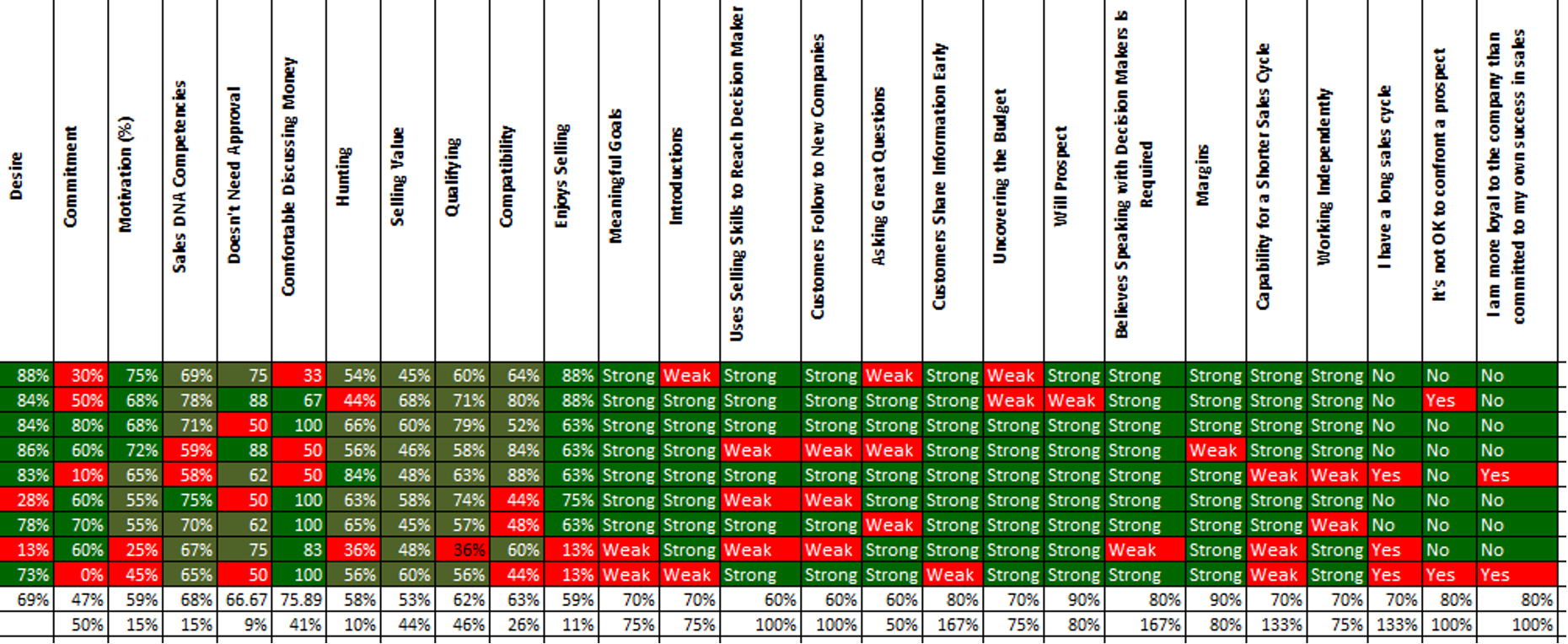
VP DataFor the VPs of sales and sales managers, this tells you why there is a difference between your top performers and bottom performers. In this graphic, evaluated salespeople from all industries and over 25,000 companies are on the left, and the non-performers are on the right. 

As you consider your training, coaching, and recruiting, how much time do you spend making sure that your salespeople have what it takes based on data vs. gut, instinct, or feel?

When you consider the training dollars spent on technique, approaches, pitches, and presentation skills, do you wonder why:

  • Your people don’t change their behavior
  • Skills don’t improve
  • You constantly work on the same "choke points" in the sales process with the same people
  • Prospecting is a never-ending problem
  • The pipeline continues to be anemic or constipated
  • New hires that cost you a fortune take too long to ramp up or fail out of the company

Salesperson Data: Target your top 36% average account

SP Data

For years, salespeople have tried to figure out how to get to the next level of success. Certainly, it takes the Will to Sell, the Sales DNA, and the sales competencies identified in the Objective Management Group Sales Evaluation that has 92% predictive validity. But in addition to that, it requires that you have a business model that is built to help you sell more business, more quickly, at better margins.

The model represented here is not new. If you’ve read any sales books in your, career you have probably heard of the Pareto principle or the 80/20 rule. I’ve taken it one step further.

Focus on the cells in green and plug in your own numbers:

  • This book of revenue represents 30,000,000 in loans. Yours could be premium, units, revenue, or renewals. It doesn’t matter. Take that number and multiply it by 80%.
  • There are 75 clients in the portfolio and we’ve multiplied that number by 20% to get to 15.
  • In short 15 clients represent 80% of the entire book of business.
  • Go 1 step further and do the math again. You’ll find that 96% of the entire $30,000,000 is;
    • Represented by 36% percent of the clients = 27
    • The average loan represented by this group is 1,066,667

Here is what takes you over the top:

  • Compare the average loan from the top 36% to the loan average of the bottom 64%.
  • Who would you rather be selling to?
  • Assume that your top 36% of clients know at least 5 other people like them
  • Ask your top 36% of clients for an introduction.
  • Assume you get 50% to say yes, half of those people qualify, and half of those that qualify do business with you.
  • Using the numbers above, that would be 6 new clients at over $1,000,000 in loans.

The closing question is this: How many sales would you have to make from your bottom 64% of clients to equal one from your best client group? The answer: 40.

STOP selling those that look like your bottom 64%.

Don’t believe me? Look at these results from our clients who have implemented this process:

Banking Case Study


Insurance Case Study

Need a Sales Training  Workshop?

Topics: data driven sales, data driven sales approach


    textunder

    Subscribe Here


    Most Read


    Follow #ACTG


    About our Blog

    Anthony Cole Training Group has been working with financial firms for close to 30 years helping them become more effective in their markets and closing their sales opportunity gap.  ACTG has mastered the art of using science-based data and finely honed coaching strategies to help build effective sales teams.  Don’t miss our weekly sales management blog insights from our team of expert contributors.


    Recent Blogs