ACTG Sales Management Blog

Sales & Sales Management Expertise Blog  

Tony Cole

Recent Posts

Why is It So #%&@ Hard to Solve the Sales Growth Problem? – The 5 Constraints to Growing Sales – Part III

Posted by Tony Cole on Thu, Jan 26, 2017

obstacles-money.jpg

In my series (see previous posts) regarding the constraints to growing sales, the two remaining topics are:

  • Ineffective motivation of the sales team
  • The “just enough is good enough” approach to hitting setting and hitting goals

THE POWER OF THE “RIGHT” MOTIVATION

Ineffective motivation of the sales team is not uncommon and it is the subject of one of the more frequent questions people ask me: “Tony, how do I keep my sales people motivated?”  My first response is normally a question in return:  “Do you know what motivates your people?”  The most common answer: “Well, uh, yeah, I think so.”  I cannot help myself when I ask, “Do you know or do you think you know?”  Their most common answer: “I think I know.”

With that in mind, how do you possibly motivate people when you just think you know what motivates them?

What we know about motivating salespeople is that it has changed over the years.  When we first started evaluating sales teams using the #1 Sales Evaluation Assessment – Objective Management Group Sales Evaluation and Impact Analysis – the findings told us that people were externally motivated.  Motivation was money and the things money can provide.  Today, however, we see a different set of results (Read this HBR article on motivating salespeople).

The current findings tell us that sales teams are highly motivated to succeed, but the source of motivation is internal rather than external.  They are motivated by a job well done. They want to be recognized for success and they are motivated by achieving their own personal standards for success and achievement.

I was 9 years old when I walked off the football field the very first time.  I had just finished practice and my dad was waiting on the sideline for me.  He asked me what I thought and I told him I loved it.  “Someday I’m going to go to college to play football.”  Dad asked me if I was sure and I said “yes.”  He then told me, “College football players are in great shape so, if you are going to play college football, you’ll have to be in great shape. Take off your helmet and shoulder pads and start running some laps.”  I followed his advice and I ran laps every night after practice to get in shape to play college football.  In February of 1973, I signed my letter of intent to go to the University of Connecticut to play football.

My dad - my manager - knew my goal and used that occasionally to keep me on track.  Occasionally, when I would fall off the training wagon, he would ask me if I still planned on playing college football.  I would always answer, “Sure!”  He would then say, “Well, I wasn’t sure. I haven’t seen you run or lift weights in a while.”  That’s all he needed to say.  Off I went.

When you know what motivates your people, you can then have the appropriate discussions to keep them on track.


“JUST ENOUGH” IS NEVER GOOD ENOUGH

“Just enough is good enough.” THIS MINDSET DRIVES ME CRAZY!  How do you know that this is your culture?

  • Year over year growth is one of the metrics you use to determine if you are getting better
  • Comparing one unit in your organization against another is the way you communicate to the teams about which ones are having success – stack ranking and comparing the rank of one team against the others as a way to explain, “If they can go from #22 to #15, then so can you!”
  • Hitting sales goals on the backs of the few
  • You have people on your sales team who - month after month, quarter after quarter and year over year - fail to hit their sales goal.
    • I don’t mean those that are at 99% one year and 101% the next and then 95% the third
    • I mean those that consistently perform in the low 90’s or high 80’s.
    • Those people that fail to perform still earn incentive comp, are not subject to any disciplined approach to improving skills or changing behaviors
    • There is never a discussion that sounds like, “What happened to the superstar sales person I thought I hired ____ number of years ago?”

I understand how this happens. There is so much pressure to just hit the numbers that, at the end of the day, it really doesn’t matter how you hit the numbers; you just have to hit them.  But what are the long-term consequences of this sales environment?

  • Turn over of really good producers that are tired of carrying the load
  • Producers who are close to being really successful manage themselves downward instead of upward.
    • They witness that there are no consequences for failure
    • They become “at leasters” – “I’m not as good as Julie, but at least I’m not as bad as John.”
  • Recruiting top talent is difficult because, when they talk to your top performers, they tell them that there will be a lot of pressure to perform because nothing happens to the slackers and the company depends on the top producers to make up the difference.
  • When goal setting time comes around, people at the top get more heaped on them and those in the middle to bottom of pack argue that the goal you give them was never one they bought into.


SETTING THE BAR FOR SUCCESS

Bottom line is:

  • Organizations have to have a mind-shift first about what it means to be successful in the organization.
  • There have to be systems and processes in place to catch failure before it happens rather than when it actually happens. Failure never happens all at once. It’s gradual; however, instead of addressing the issues when they appear, managers put salespeople on “double secret probation.”
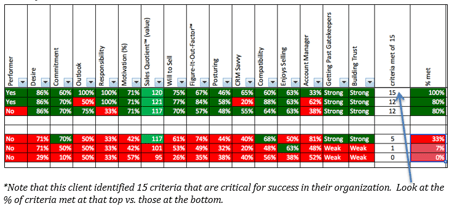
  • The metrics used to determine success have to include diagnostics of the improvement of quintiles year over year. (See chart below for a snapshot of quintile performance.)  The idea is that when you take the snapshot next year, the numbers for each quintile have to be better than the previous quarter, year, etc.
  • A willingness and commitment to set the bar higher for success and then hold people accountable to actually DOING the THINGS required to be successful rather than just looking at training data.

quintile-chart-2017.png

I will continue to explore and discuss these constraints to consistent and predictable sales growth.

Additional Resources:

The 80/20 of the 80/20 - What it means for your company and next steps

Get a FREE TRIAL of the #1 Sales Candidate Assessment


Topics: sales leadership development, sales performance coaching, sales productivity, predictable sales growth, sales management responsibilities, sales motivation

Why is It So #%&@ Hard to Solve the Sales Growth Problem? – The 5 Constraints to Growing Sales – Part II

Posted by Tony Cole on Mon, Jan 23, 2017

In the previous post, I identified 8 clues that would indicate that your sales organization has a sales growth problem (CLICK HERE to read the article and review the 5 clues).  In that article, I identified (in some detail) 2 of the 5 constraints to sales growth:

  • Weak or lacking performance management
  • In-the-moment coaching rather than coaching that changes behavior and improves skill.

I received some feedback that the previous article was tooooo long and so, instead of covering the 3 remaining constraints here, I will present them one at a time (and hope I keep you coming back for “the rest of the story!”).

Constraint #3 - Hiring salespeople based on the wrong criteria with the wrong processes and systems

hbsp logo cut.pngTo Hire Better Salespeople, you have to have a better way to attract better salespeople and a better way to eliminate those 90% that will not do 100% of what you need them to do.

As in the previous article, let’s first determine “IF” there is a problem (check all that apply):

  • You have trouble finding enough candidates to choose from
  • The candidates you interview all look and act the same
  • When you interview candidates, you…
    • Spend time establishing rapport
    • Sell them on the company, the position and the opportunity
  • Your turnover rate of salespeople that don’t work out is at least a 6-figure problem or 2-comma problem (#,000,000)
  • When you evaluate the performance of the current sales team, there are people in the middle of the bell curve that are not performing like you thought they would or expected them to
  • You feel desperate to fill seats
  • Your recruiting is usually reactive

If you answered honestly and have 3 checks or more, then let’s agree there is a problem.

Several years ago, my son, Anthony, and a good friend of mine, Dave Zimmerman, went with me to NYC to watch the Bengals play the Jets.  We were guests of then general manager, Terry Bradway.  We met up with Terry the evening before the game just to catch up and introduce him to Anthony.  While we were in his hotel room, I asked him what was the most difficult part of his job. Without hesitation, he replied, “Player personnel - that’s the most difficult part of the job.”

He went on to discuss how he and the scouting staff spent Thursdays, Fridays and Saturdays all over the country watching college games. Sometimes they attended two games a day just to find the talent they needed to compete and win on Sundays.  Unfortunately, Terry lost his job with the Jets in 2015. Terry is a great guy and a personal friend, but I cannot imagine the pressure and small window for success in drafting NFL players.

In the 2016 NFL draft, there were 256 players drafted.  There are roughly 15,588 student athletes playing on college campuses through out the US.  Two hundred and fifty six is 1.6% of all the college seniors.

I’m not suggesting that your hit percentage should be the same, but Geoff Smart, author of Who and Topgrading, suggests that it be at least 1 out of 20, or in other terms, 5%.

You may or may not notice the intentional use of the phrase “a better way to ELIMINATE those 90%” in the opening paragraph, but one of the keys to hiring better is to get better at disqualifying candidates!

In our approach to helping companies hire better salespeople, we find that it is critical to first change the mindset of the process and then change the process. The mindset that has to change from “find candidates that qualify” to “disqualifying candidates.”  If you work hard at disqualifying, then those that are left are more likely to be successful candidates.  Using this approach to hiring - in conjunction with using a predictive sales success assessment - will help you eliminate hiring mistakes!

I won’t go any further into the details about the process of eliminating mistakes here today except to mention one critical component – scorecards.  You should have in your possession a scorecard to evaluate talent based on the competencies that are required to succeed.  Specifically, that means the competencies, skills and behaviors needed to complete 100% of the job at an extraordinary level. The challenge here, of course, is to sort through the 90% of candidates that are incapable of executing what you need done 100% of the time.

Additional Resource: 

Download our free eBook - How to Hire Bankers Who Will Sell

Topics: hire better salespeople, find salespeople, predictable sales growth, hiring top salespeople, sales management responsibilities

Why is It So #%&@ Hard to Solve the Sales Growth Problem? – The 5 Constraints to Growing Sales – Part I

Posted by Tony Cole on Thu, Jan 19, 2017

I’ve written on this subject, talked about it at workshops/keynotes and presented it to our clients in our Sales Managed Environment® Certification program for over 20 years.  But, here I go again and for good reason – it’s still a problem.  It’s still in the news.  It’s still something that we get asked about when we present at the Community Bank CEO Network and other venues.  It’s a problem that doesn’t seem to have a solution.

Wrong!

Let’s take a minute first to analyze the problem or to help you identify if you have a problem.  (This will be kind of like Jeff Foxworthy’s “You know you're a redneck if” routine.)

foxworth.png

You know you have a sales growth problem if…:

  • You cannot consistently and accurately predict future sales GROWTH
  • You recognize that most of the sales (90% or so) are being generated by 33-45% of the sales team.
  • Less than 10% of the sales are being generated by over 50% of the team
  • You have salespeople in the middle of the sales performance bell curve that are not performing as you expected. (Did you really hire those people to only perform like the average sales person on your team?)
  • Your new hires are not ramping up fast enough
  • Your cost of “ghosts” (people that you hire and are no longer there) is a 2-comma problem
  • You seem to be coaching the same stuff over and over and over again
  • Your people continually make excuses for lack of outcomes, performance results.

I could go on, but why?

I first recognized the sales growth problem in sales organizations many years ago when I was working with Anthem Blue Shield and Blue Cross here in Ohio. I was meeting with Jim Barone, who is currently the National Vice President – Business Development for Lincoln National.  At the time, he held a regional sales management position for Anthem and he and I were scheduled to meet in Cleveland with his sales team for a training session and sales meeting.

In preparation for the meeting, I reviewed the production report year-to-date for the team (about 25 reps). I had not yet read any Perry Marshall material on The 80/20 of Sales and Marketing (The book hadn’t been published yet…) and, though I had heard of the Pareto Principle, I really didn’t understand it like I do today.  When looking at the numbers, I discovered that roughly 20% of the reps were responsible for about 80% of the results.  That was startling. But, not nearly as startling as what I discovered next.

The bottom 20% of the team – about 5 reps – were responsible for less than 1% of the results and the bottom 33% of the team was responsible for less than 10% of the results.  The first question I was going to ask Jim was, “Why are these people still with you?” (CLICK HERE here to get rid of the 80/20 in your organization.)

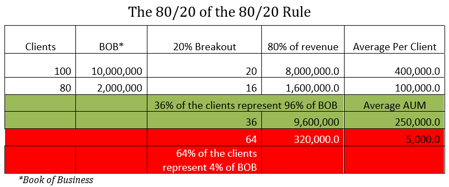
Over a year ago, I did the same type of analysis for a large nationally-based broker dealer specializing in serving the credit union market.  We looked at 100 advisors.  What we were looking for was data to support the position that, in order for a financial advisor to break through the upper limits of their productivity, they had to segment their book. 

As I looked at the collective data, it became very obvious that every advisor in every quintile had a book that had a similarity – 36% of the clients represented in their client base (as many as 1,000 clients) were responsible for 94% of their total AUM (assets under management).  Furthermore, when we analyzed the bottom 36%, that group only represented less than 5% of the total revenue.  Taking one more step, we uncovered that it would take 16 sales from the lower 36% to equal the average AUM from the top 20% of the book.

We thought we knew this, but now we had the data to prove it. 

Just for fun, I looked at the AUM from the 100 advisors for the broker dealer and guess what I found?  You guessed it – 36% of the advisors were responsible for over 90% of the total AUM.  Again, the questions have to be – Why do you have the other 64% of the advisors?  Why do they perform so poorly?  Were they hired this way – to perform at this level?  What was missing in the on-boarding, training and management of those advisors?

One of the easy reactions to the data is this – “Tony, you have to understand that some of the advisors we were looking at don't have the same tenure as those in the top 36%.”  Okay, I will buy that.  But, are you telling me that is the case from #1 all the way to #100?  The answer is no.  In the mix of the top 1/3, there are less tenured advisors, and in the bottom 1/3, there are very senior advisors. 

The tenure argument doesn’t work. The economy argument doesn’t work. The competition argument doesn’t work. The compensation argument doesn’t work and, finally, the DoL regulation or regs of any sort argument doesn’t work.  In every instance, the numbers hold up.

So, what is the problem?  What are the constraints to sales growth? Why is it so $%^&* hard to solve the sales growth problem?  There are five reasons I want to discuss, but first, let’s agree to some assumptions:

  • Your organization has a solid strategic plan to gain market share. (If not, contact Gazelles.  Verne Harnish is a genius and the concepts in his book, Scaling Up, will change your business.)
  • Everyone is either rising or sinking with the economic tide.
  • Your company’s compensation plan fits with in the suggested range of the industry. (Contact Peter Bielen or Scott Stathis to discuss compensation.)
  • You have access to the products and services that the ideal prospects identified in your strategic plan want and need
  • Your support partners provide you the backend client services that you need.

Again, the list can go on – in general, let’s assume that the basics to start and sustain a business are in place.  But, something is missing year in and year out that makes sales growth so difficult.  Here are the 5 constraints to consistent and predictable sales growth:

  1. Weak or lack of Performance Management. Understand what performance management is NOT – setting goals and then telling people that they have to work harder if they are not hitting the goals.  It is NOT using PIPS as a way to get people to perform.  A solid performance management structure and strategy requires a couple of steps, systems, and processes.
    1. Identifies the right metrics to measure success
    2. Creates benchmarks that force salespeople to work harder and better
    3. Holds people accountable to the THINGS they need to do to get sales growth results
    4. In addition to the items listed above, the executor (sales manager, sales coach, sales leader) needs to have the right sales management behaviors and skills
  2. Any coaching is in-the-moment coaching rather than Coaching for Success. Coaching for Success is intentional/planned coaching.  It is based on what the data identifies as choke points in executions or lack of effort.  In-the-moment coaching does not focus on changing behavior and improving skills. It’s kind of like what happens in a time-out in most sports.  There is a situation in the game that requires some additional thought and strategy.  The coach calls a time-out to discuss the strategy and lay out a plan to execute “in the now.”  That type of coaching is designed to solve the in-the-moment problem, but it virtually does nothing to change behavior or improve skill overall.  Coaching for Success requires:
    1. Data points established as a result of the performance management success formula (The metrics that define success identified in your performance management strategy)
    2. Data collection
    3. Reporting that identifies the variance in actual performance from goal performance
    4. Gaining business intelligence from the data report
    5. Effective coaching skills http://c.ymcdn.com/sites/www.bisanet.org/resource/resmgr/onesource/9_skills_to_coaching_success.pdf, systems and processes
    6. A consistent process of disciplined coaching designed to help the advisor get on track and stay on track because behaviors change and skills improve.

The remaining constraints are:

  1. Hiring sales people based on the wrong criteria with the wrong processes and systems. To Hire Better SalesPeople, you have to have a better way to attract better people and a better way to eliminate those 90% that will not do 100% of what you need them to do.
  2. Ineffective motivation via culture, sales meetings and recognition. Most sales managers don’t know what motivates their people.  If you are going to Motivate for Success, it is important to know what motivates them.
  3. Inadequate hiring. When just enough is good enough, the sales organization fails to regularly Upgrade the Sales Force.

Pass this article on! http://bit.ly/2jPOGFO 

Contact us – 513.791.3458

Contact Tony Directly -  tony@anthonycoletrainingcom or text 513.226.3913 with the message “Call me”

Additional Resources:


Topics: Sales Tracking, sales performance coaching, sales productivity, how increase sales, predictable sales growth

5 Sales Activities that Lead to Success: Are Your Salespeople Assertive Enough?

Posted by Tony Cole on Fri, Dec 30, 2016

success_work.gif


Assertive (not aggressive) salespeople win more business than others.  They care so much about doing the right thing for their clients that they are willing to risk the relationship and the deal in order to make sure the prospect or client makes the right decisions.  Does that describe your people?  Are they assertive?

When we say assertive, what do we mean?  What sales habits do assertive and successful people do day in and day out?  In 2010, I wrote a blog entitled 5 Direct Sales Activities That Lead to Sales Success that has been one of my highest readership blogs.  I went back and reviewed and here are the five steps:

  1. Activities that lead to getting names - networking, speaking engagements, sponsored seminars, meeting with centers of influence and/or asking for introductions
  2. Calling a suspect on the phone for an appointment
  3. Conversations and meetings to qualify a suspect
  4. Gathering additional information that leads to a presentation meeting
  5. Presentations/pitch meetings that lead to decisions

Steps 1 and 2 have changed dramatically in the last 6 years.  Social selling and the evolution of the buyer’s process utilizing all of the multiple channels of information has completely changed the process of prospecting for business.  Step 2 - getting a suspect on the phone - is virtually impossible with voicemails and phone trees.

Our Own Prospecting Case Study

Earlier this year, we decided to test the waters for our hiring business solution, www.hirebettersalespeople.com.  We had some initial success right off the bat with our launch in January of 2016, but then activity seemed to cool down.  We purchased a local lead list based on company size and title and I began calling.  Here are the calling results:

  • 66% of the dials took me directly into a recorded phone tree
  • 25% of the calls took me to a receptionist who was very helpful and informative but transferred me to voicemail
  • Of the remaining 9%, I had in depth conversations with 3 people, met with one and generated one sale from that contact

3 people fit our profile; I met with 1 and sold that one… but not to help them hire better salespeople, but rather to help them test, train and track some of the salespeople that were not “hitting their weight”.  The second was not interested at the time and the 3rd introduced me to someone in the home office. That contact has put us in the middle of negotiations for a 5-figure initial engagement.

I tell you that story to make the following points about step #2:

  • Calling prospects on the phone doesn’t work like it used to.  
  • It requires more attempts and effort than ever before - you have to have a different tactic and message to differentiate yourself.
  • Once you make contact, you have to be extremely good at what you do and have a compelling reason for people to listen and stay on the phone. THAT is where being more assertive makes a difference.

Steps 3, 4, 5:  How to be More Assertive at Qualifying, Presenting and Getting Decisions

In our primary markets of financial institutions, investment services and insurance brokerage, we ARE the resource for sales growth solutions.  We coach our clients on the fact that the reason for either their sales growth or loss is due to their peoples’  1) effort or 2) execution.  But what does assertiveness have to do with Effort and Execution of steps 3,4 and 5?  In a word, EVERYTHING.

Steps 3,4, and 5:

  1. Conversations and meetings to qualify a suspect
  2. Gathering additional information that leads to a presentation meeting
  3. Presentations/pitch meetings that lead to decisions

In each one of these steps, the skill of asking the right questions, the right way, at the right time is critical.  In our selling system, we explain that -  in order for a prospect to qualify - they must:

  1. Have compelling reasons to buy, make a change, do something different
  2. Have the capability and willingness to invest the right time, money and effort required for the purchase/change
  3. Be in a position of decision making and be able to make the decision to find a solution to the compelling (have to fix) issue,  can make the money decision, can leave a current or add to a current relationship, and say yes or no.

There are lots of questions that need to be asked in order to find out if the prospect qualifies in these three areas.  Some of these questions require a sales person to be assertive.  Questions such as:

  • How will you go about telling your current broker/banker/relationship that you are no longer going to do business with them?
  • If you don’t have the money, how will you solve the problem?
  • The budget you have won’t be enough to get you the outcome you want. What part of the solution do you want to eliminate?
  • What will you tell your partner when they say they don’t want to make the change?

Additionally, sometimes statements are required that would be considered counter-intuitive to selling, gutsy and risky.

  • Based on our experience and deep domain knowledge about your business, your best action to take would be this: ________.  If that doesn’t seem to work for you, then there’s a possibility that we won’t be a good match.
  • If I treated my clients the way you’ve been treated, then I would expect to be fired.
  • When we finish our presentation, solve all of the problems you’ve asked us to address within your budget and answered all your questions, I’ll need for you to be in a position to make a decision on whether we’ll do business together or not.
  • Maybe the most important thing for you to consider is “fit”.  If there isn’t a fit between our two companies, then our products and pricing really don’t matter.

Imagine for a second that you had salespeople that were gutsy enough to have these types of conversations. What would happen?  You might fear that you would lose more business. But… suppose that wasn’t the case.  Suppose by being more assertive and gutsy, your salespeople eliminated tire kickers earlier.  Suppose this lead to the elimination of “think it overs” and actually got people to decide.  Imagine for a second that your salespeople stopped making presentations to people who could only say “no” and never had the authority or intention of saying “yes”.  What would happen?

Your people would sell more, more quickly, at higher margins.  They would stop wasting time, stop getting delays, stop being shopped by a prospect that was just trying to keep a current provider honest.  

Here’s How Sales Managers Can Get Their Salespeople to be More Assertive

Sales managers must hold their salespeople accountable to the right level of sales activity.  To do this, you must have a success formula and a well-defined sales process so that you can identify where the choke points are for individuals when they fail to close “sure thing” opportunities.  You must also have a pipeline tool that actually helps you predict the possibility of an opportunity closing rather than a tool that just reports that there is activity in the pipeline.  And, finally, you must have a full pipeline – an anemic pipeline makes cowards out of salespeople. These are the tools you will need to help your salespeople be more assertive and close more business, more quickly, at higher margins.

subscribe-to-blog.png

Topics: sales competencies, sales management, sales prospecting, Sales Strategies, asking sales questions

7 Effective Sales Management Steps to Take NOW

Posted by Tony Cole on Wed, Dec 14, 2016

Luck-not-strategy.png

Sales management, sales leadership and sales presidency require special diligence this time of year. Actions taken now will assure successful sales results in the coming year. In order to transition smoothly, here are 7 sales management steps that should be completed before the end of the year.  

By now, you should have:

  1. Evaluated the individuals on your team for the year. Unless you have anomalies at the end of the year, your team’s individual outcomes and results are pretty much set.
  2. (Based on the evaluation) Begun to have meetings with all your people. The meetings are similar to performance reviews, but they’re not the corporate type of review that gets put in the HR file.  These reviews put your team members in 1 of four groups. You then have a discussion about what group they are in.
    1. Met or exceeded sales goal and sales activity requirements group
    2. Met or exceeded sales goal but currently not at sales activity targets group
    3. Met or exceeded sales activity targets but failed  to hit sales targets (below 100% is failing)
    4. Has not met sales or sales activity targets

(If you would like information on what the conversation should sound like for people in each of these groups, call me or text me at 513-226-3913.  If I don’t answer, just leave a message with your name, mobile number and email requesting, “Where’s Walter?” information.  You can also email me at tony@anthonycoletraining.com.)

  1. Reviewed performance, actual effort and execution effectiveness results against targets for the year.
  2. Assessed where the choke points are for people on the team who are not succeeding. To do this, you look at the conversion ratios in your sales success formula that was built last year and reviewed every quarter.  (Don’t have a success formula?  Click here –> Success formula download)
  3. Revised the success formula for 2017 based on each person’s commitment to performance via the “extraordinary discussion”. (Haven’t had that discussion? Ask Jeni at Jeni@anthonycoletraining.com to send you that information.)
  4. Conducted an offsite where your salespeople identify personal goals, translate the personal goals into a personal income requirement and translate that into a work plan that you will follow up with every quarter. (Yes, we have information on what that offsite should look like.  Even though it’s late to be doing that now, conducting the session in January would be better than not conducting one at all.  Let us know if we can help: 513-791-3458)
  5. Talked to your HR department about additional FTEs for the coming year to grow your sales team and replace the people that are not performing. Think about this: Suppose you had to hire better salespeople (3) but can only grow your sales team by 2 – who would you let go?

These 7 things are the minimum functions for sales management at this time of year.  Failure to execute on these 7 steps will pretty much guarantee that your next 12 months will look like the past 12 months:

  • Only a few people will meet or exceed the goal
  • Most of the people will miss the goal by at least 10% and some as much as 20%
  • The bottom 33% of your sales force will represent less than 5% of your new business revenue
  • Salespeople that fail will continue to make excuses
  • The salespeople that had a “one-off” great year will coast in the next year and live off the laurels of this year.
  • Your top performers will continue to be frustrated by lack of attention, support and recognition for their outstanding contributions.

subscribe-to-blog.png

Topics: success formula, managing sales teams, effective sales management


    textunder

    Subscribe Here


    Most Read


    Follow #ACTG


    About our Blog

    Anthony Cole Training Group has been working with financial firms for close to 30 years helping them become more effective in their markets and closing their sales opportunity gap.  ACTG has mastered the art of using science-based data and finely honed coaching strategies to help build effective sales teams.  Don’t miss our weekly sales management blog insights from our team of expert contributors.


    Recent Blogs