ACTG Sales Management Blog

Sales & Sales Management Expertise Blog  

Tony Cole

Recent Posts

28 Sales Traits to Identify When Hiring Better Salespeople

Posted by Tony Cole on Thu, Dec 08, 2016

So, what are you looking for in your next great sales person?  I guess the most important question is this: Are you really looking for the next great sales person or are you looking for a sales person that will fill the FTE allocation?  Will you settle for someone that is “at least as good as” your average sales person?

No one in their right mind would say “yes” to those questions, but if your sales organization is large enough, the data would support that your hiring practices are getting you exactly that.  According to Geoff Smart (Topgrading), 75% of the hires made are not as good as or only as good as the person they are replacing.

If we were to look at the 80/20 power curve in your organization, we would probably find out what we normally do – that about 36% of the sales force is responsible for over 90% of your sales results.  So, what is the other 64% doing?  How did they end up on your sales team?

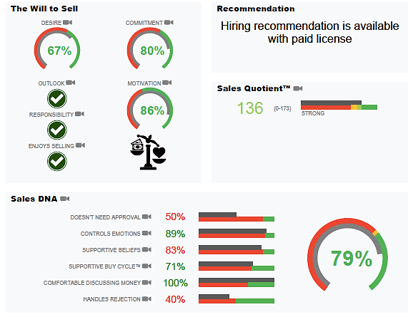
In order to get the right people, you have to know what you should be looking for.  In conjunction with Objective Management Group, we have studied our clients.  We have evaluated their top performers and non-performers.  Looking at over 100 data points, we know what separates those who will sell from those who won’t sell.  Do you?

quality-chart.png

Ignore the words and numbers.  Just look at the sea of green which is representative of performers and compare that with the sea of red representing non-performers.

Here is the list we’ve come up with after analyzing the sales teams of 5 of our clients in the financial services/banking business:

  1. Strong desire for success in selling
  2. Strong commitment/motivated to do everything possible to succeed in selling
  3. Trainable
  4. Has a strong figure-it-out factor
  5. Possesses Sales DNA Competencies
  6. Has no need for approval
  7. Controls emotions
  8. Has supportive beliefs
  9. Comfortable discussing money
  10. Handles rejection
  11. Hunter
  12. Sales posturing
  13. Consultative seller
  14. Qualifier
  15. Closer
  16. Follows consistent sales process
  17. Compatibility with top performer profile
  18. Prospects consistently
  19. Schedules meetings
  20. Reaches decision makers
  21. Recovers from rejection
  22. Does not need to be liked
  23. Comfortable talking about money
  24. Has a strong self-image
  25. Loves to win
  26. Motivated by recognition
  27. Loves competing with others
  28. Rejection proof

What I find interesting about some of the items is that there are a few that have a significant variance between the performers and non-performers:

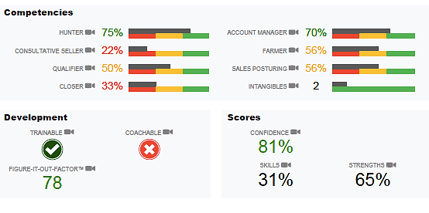
  1. Commitment – The commitment to succeed in selling is 77% GREATER in performers than in non-performers.
  2. The trainability in performers is 34% HIGHER.
  3. The hunter skill in performers is 112% HIGHER.
  4. Performers have a 48% HIGHER figure-it-out factor.
  5. Performers score 119% HIGHER in handling rejection.
  6. Those that hit sales goals score 87% HIGHER in sales posturing
  7. This one blows me away – neither group is particularly strong in closing: non-performers have only 13% of the closing skills required.  Even though top performers OUTSCORE their counter-parts by 150%, they still only have 33% of the required closing skills.

How do you explain that last item?  Look at the others strengths:  Desire, commitment, trainability, hunter, figure-it-out qualifier, consultative, posturing… they are REJECTION proof! 

The purpose of this post is to get you to think more seriously about what it is that you really know about the candidates you are looking to hire as well as what you really need to know before proceeding with the interview and hiring steps.

Any questions? Please call or write:
513.226.3913 tony@anthonycoletraining.com

subscribe-to-blog.png

Topics: Sales DNA, managing sales teams, managing salespeople, top sales performers

Chicken Little and The Impact of Dol (pt.1)

Posted by Tony Cole on Fri, Dec 02, 2016

chickens.jpgAs the story goes, Chicken Little gets hit on the head and declares the sky is falling.

Last spring, the Department of Labor passed new fiduciary regulations on the financial advisory business, and since then, there have been an untold number of articles written about the impact on advisors, the industry and consumers.  Several of these have stated that:

  • Trillions of dollars will saved in investor commissions because advisors will soon be held to a much stricter fiduciary standard that affects transactional incentives.
  • Advisors will lose ½ of their revenue because what was a solid investment recommendation and seen as ‘suitable’ will soon be considered conflicted advice because it paid them commission.
  • The industry is in turmoil as it attempts to figure out how to meet DoL regs, hold on to high-performing advisors and effectively make-up the assumed lost revenue.

The sky is falling?!?

I read Bank Investment Consultant at least 3 times a week.  The publication and its editors/authors do a great job of keeping people connected to the industry in the loop on the latest changes, trends and thought leadership.  Lee Conrad, Editor of Bank Investment Consultant, recently wrote an article titled:  Bank Advisers:  Prepare to Cut Your Book by Half

Here are a couple of excerpts from the article:

The fiduciary rule will require most bank advisors to trim their books of business to a much more manageable level. How much is really a guessing game at this point. But, for many advisors, especially those who have focused on transactional business, it will be significant.

This was just one of the discussions from our last Industry Leadership Forum in Denver. We hold these meetings in conjunction with Stathis Partners as small, invitation-only gatherings for industry execs to discuss the top issues on their radar screens.

So, how many clients can an advisor reasonably manage when they are acting in a fiduciary capacity? The numbers bandied about in our meeting were in the low hundreds: about 200 give or take.

***

REALITY CHECK
How many clients do advisors really have? Consider some research we did earlier this year for our annual Top Program Managers ranking. In addition to asking each nominee how many advisors they had on their teams, we also asked how many households their teams served. We've never used those results until now, but the average was 750 client households per advisor. The median was a bit lower--about 550--but many of the individual programs had well over 1,000 clients per advisor.

***

TEE-UP THE CROSS SELL
Here's one more assumption, on my part, that I feel pretty good about: Advisors don't want to lose too much of their pay. If they generated, say $200,000 in annual production in 2016 and next year they find themselves with a book of business that's been cut by half, the natural move for them will be to get more profit from each client. (Just how to segment a book was another discussion at our forum, which we'll write about in a future installment.)

So, here is the first thing you should keep in mind about Dol and its impact:

It’s easy to get caught in the DoL quicksand.  Two friends of mine who also happen to be well -respected people in the industry, Michael Graham from Midwest Securities Trading Company and Kevin Mummau from CUSO, are not panicking.  Actually, we all seem to agree that this is a great opportunity for advisors:

  • The money hasn’t gone anywhere.
  • Advisors that aren’t very good at really advising clients and struggle with “fiduciary” standards will leave the business.
  • The solutions to the “problems of revenue loss” already exist: financial planning and risk management products.

So, is the sky really falling? We will answer that question in our next post!

subscribe-to-blog.png

Topics: managing sales teams, DoL regulations, managing advisors

Did Your Salespeople Grow Up on the Farm?

Posted by Tony Cole on Mon, Nov 14, 2016

tony-by-maple.png

You and your salespeople are a product of mom and dad, the people met, the experiences had and the education/knowledge acquired:

  • Nature and Nurture
  • Heredity and Environment

Recently, I read a Jack Reacher novel.  Jack is a fictional character in many of Lee Child’s novels.  Jack is a former military police officer and states to himself, “You can leave the army, but the army doesn’t leave you.”  I stopped and thought about that comment and related it to my own life and realized, “You can leave the farm but the farm doesn’t leave you.”

Those that know me and have heard me speak or train know that I reference my youth and growing up on the farm in Hammonton, New Jersey.  Hammonton is the blueberry capital of the world, home of the Hammonton Hawks, the Hammonton Blue Devils and Bruni’s Pizzeria.

I am a product of those experiences as well as the numerous people I’ve met, places I’ve been, books I’ve read, speakers I’ve heard and work/fun experiences I have had since I was 18.  But, I am pretty sure much of what I am today - how I think and how I act - are a result of those first 18 years.  The farm and growing up the son of Ray and Geri Cole laid the foundation that is me today.

The core values and beliefs I learned on the farm that still guide me today:

  • When all else fails, hard work works.
  • Get up early and go to work.
  • Go to bed early and get a good night’s sleep.
  • Learn how to hunt and provide for your family.
  • Working piece meal pays you your true value (i.e. working on commission).
  • Don’t try to control what you cannot control (i.e. Weather and the rate at which blueberries ripen for harvest).
  • There’s no such thing as a free lunch.
  • Someone will always have it better/worse than you.
  • Two things have to happen – death and taxes.
  • God will provide wisdom, strength and courage – you have to do the work.
  • Not everyone gets to play.
  • Winners are rewarded.
  • God provided us with two ears and one mouth, listen twice as much as you talk.
  • You have to be in great shape to play college football.
  • Thank and love Mom, Dad and God.
  • 4th place didn’t get a medal.
  • If you hoe long enough, blisters will become calluses.
  • Trucks run better with all four tires.
  • Hard work can be fun.
  • Make your handshake mean something.
  • All we have is our integrity.
  • Seek and you will find, knock and the door will be answer, ask and it will be given.
  • The only way to get a pretty girl to go out with you is to ask her out for a date.
  • Your heart will be broken and mend.
  • If you plant trees in good soil, take care of them with food and water and shelter them from harm, they will last a long, long time (See my picture of the sugar maple my dad planted over 60 years ago).
  • Love grows best in little houses.
  • Kids taking care of pets learn about responsibility, life and death.
  • Hugs are free.
  • There’s always room for Jello
  • Money doesn’t grow on trees.
  • I’m not a Rockefeller.
  • Practice what you preach.
  • Take care of your equipment and your equipment will take care of you.

Most, if not all, of this list has served me well over the years. There is also a list of things I had to unlearn/undo because it didn't/ doesn't serve me well.

  • Don’t talk to strangers.
  • Life isn’t fair.
  • Rich people are ‘rich bastards’.
  • You want people to like you.
  • Don’t upset the apple cart.
  • Fit in.
  • Play it safe.
  • Don’t trust salespeople.
  • Biases based on gender, religion and color of skin.
  • You can’t be wealthy and happy.

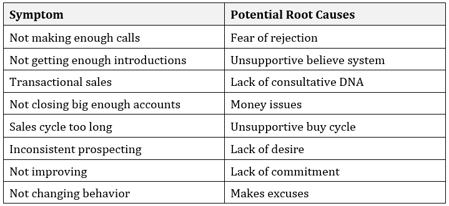
I’m sure I could add more, but I’m also sure that this is getting boring, so I’ll get to the point.  That point is this: you have to do more in your training and development program than just teach tactics and techniques.  There’s lots of stuff in your head -  and in the heads of your people - that influences what you do and won’t do.  To get the most out of any training and development program, you have to understand the “root” cause.

Understanding who your people are is critical in getting them to perform. Understanding who you are will help you help them.

Here is a way to learn more about how your people think when it comes to sales and sales management:  Sales Effectiveness and Improvement Analysis.

subscribe-to-blog.png

Topics: managing sales people, record collection, coaching sales people, sales habits

Is Your Sales Team HUNTING or Hunting?

Posted by Tony Cole on Wed, Nov 09, 2016

When I was a youngster, I used to go hunting with my dad and my older brother, Ray.  I never hunted with my younger brother, Michael, until just a few years ago.  But Ray, Dad and I spent many weekday evenings and weekends in the woods. We were doing two things:

  1. Preparing to hunt
  2. Hunting

deer-stand.png
PREPARING to hunt included:

  1. Going into the woods to scope out the places where deer frequented or could be convinced to frequent
  2. Building tree stands in close proximity to deer paths or food plots
  3. Going to the sweet potato or squash fields to pick up potatoes and squash left from the previous day harvest. Sometimes we would get apples or peaches
  4. Taking basket after basket after basket of deer food (see number 3) into the woods
  5. Practicing our bow skills by shooting targets at 20 yards. Dad was so good he could hit a moving quart milk jug!
  6. Getting a license to hunt
  7. Getting the right clothes for cold weather
  8. Getting the equipment ready
  9. More practice

HUNTING included:

  1. Sitting in a tree stand freezing your baguettes off waiting for a deer to show up
  2. Not moving for 3 hours even if you had to pee
  3. Shooting at a deer
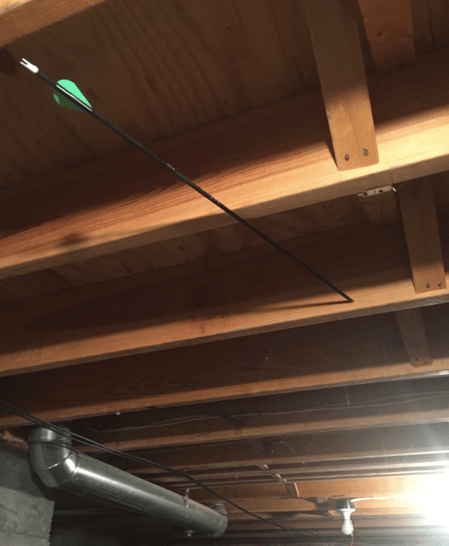
  4. Retrieving arrows that missed the deer
  5. Tracking, finding and field dressing the deer if the arrow hit its mark
  6. Carrying the deer out of the woods – sometimes up to a mile
  7. Skinning and butchering the deer (Actually, I did none of #6 or 7...)
  8. Eating the venison (I did lots of this!)

Everything I just listed (and yes, Ray, I’m sure I missed something…) would be defined as HUNTING.  Even if it appears that sometimes it is waiting and not actually hunting, I assure you it is all hunting.

Then... there is the hunting I’ve done the past week:

  1. I joined a hunting club.
  2. I showed up either early in the morning or early in the afternoon.
  3. Brian, the manager of the club, took me to a tree stand.
  4. Using a buck call, I called for and waited for a deer to show up.
  5. If one showed up, I shot it (I actually got my first dear about a month ago) and sent a text to Brian. If I didn’t see or hit one, I sent a text to Brian and he came to get me.
  6. When I hit a deer, Brian and I tracked the deer.
  7. Brian field dressed the deer.
  8. Brian took the deer to the processor.
  9. I picked up the packaged deer meat.
  10. I prepared venison parmesan.
  11. We ate.

This is hunting in my world today.  Notice the differences?

Yes, I still have to practice.  I still have to get my hunting gear together and make sure my equipment is ready to go.  I still have to get up early and get to the game club.  I still have to sit in the tree quietly and not move.  I still have to have skills to put myself in a position to draw the bow, release the arrow and hit the target.  What I really do not do anymore is sit and shoot… or, rather, just sit.

Now, I want you to think about the similarities in HUNTING for deer and HUNTING for prospects.  And then, I want you to answer some questions:

  • Which hunting is your sales team doing?
  • Which steps are they doing?
  • Which steps are they skipping or failing to do?
  • What impact does this have on their ability to close more business, more quickly, at higher margins?
  • If they are not consistently hunting, then what is the likelihood that they will have consistent sales results?

Brian and I went out last week when the weather was rather warm.  It was too warm to expect a good hunt, really.  I knew that.  He knew that.  But I told him I was going out anyway.  On the way to the stand, we talked about the weather and I made the comment, “It might be too hot, but I certainly won’t even get a chance to shoot a deer unless I go into the woods.”

And… there you have it.  Regardless of how you do it, regardless of the environment, regardless of the difficulties you have to face, the reality is that, in order to get someone to say “yes” to your product or services, you must have salespeople who "go into the woods" and hunt!

deer-hunter.png

Important Resource:

Find out if you have hunters, account managers or farmers – Assess the ability of your current team to grow sales.

subscribe-to-blog.png

Topics: sales competencies, hunting for sales prospects, sales hunting

Habits of Highly Successful Sales Managers

Posted by Tony Cole on Wed, Nov 02, 2016

salesmgrhabits.jpg

The sales management activities that we are performing today are creating the results we are achieving today.  What activities are you doing now that are creating your current unsatisfactory results?  It is up to us as sales leaders to set higher standards for sales behaviors and hold people accountable so that we get better results.

It is a given that successful sales management requires contributions on many levels:  skill, time, effort, effective execution and systems and processes to support coaching, performance management and recruiting.

To help understand what makes a successful sales manager, it is helpful to review the Habits of Highly Successful Salespeople. I recently asked the participants of a workshop to identify and share those habits that they believed contributed to the success of their best salespeople.  Below are some of the common habits identified:

  • Develops great relationships
  • Networks regularly
  • Good time management
  • Gets to decision makers
  • Is selective in prospecting
  • Provides exceptional customer service

Then I asked them to talk about the flip-side of the list – those habits that inhibited or hurt a salesperson’s ability to close more business.  Below are some of the habits they identified:

  • Sells on price
  • Inconsistent prospecting
  • Procrastinates
  • Presents to the wrong people
  • Sells to anyone that fogs a mirror
  • Poor prioritization
  • Is too comfortable

How about you and your habits?  What are those habits that you can point to that you KNOW have a positive impact on your team’s sales behaviors and results?  Here are some that I observe and hear about:

  • Coaches: in-the-moment to get a deal closed
  • Reports sales results
  • Makes joint calls
  • Sets goals
  • Conducts regular sales meetings
  • Reviews and reports pipeline

This is a good list and with some additions, it can become a great list when we identify the skills of a great Coach, one of the most critical roles of an effective sales leader.  To examine what else you might want to consider, take a look at the following list of elements necessary for successful coaching:

  • Debriefs sales calls effectively
  • Asks quality questions
  • Controls emotions
  • Allows salespeople to fail
  • Implements and manages the execution of a consistent sales process
  • Motivates when coaching based on individual/personal goals
  • Coaches to improve skill and change behavior
  • Gets sales people to follow through on commitments

It’s not enough to just have the skill.  In order for managers to be successful at having a sales team built for growth, the manager must be in the habit of using those skills.

Being an extraordinary sales manager is grueling and time-consuming.  It requires attention to detail, the ability to have tough conversations with those who are not meeting their numbers, the desire and commitment to grow yourself and your salespeople, consistent activity and patience.  Like the coach of a winning team or conductor of an extraordinary symphony, you have the ability to positively affect the success and the lives of your salespeople and company. 

subscribe-to-blog.png

Topics: sales management, managing sales teams, sales habits, highly successful salespeople


    textunder

    Subscribe Here


    Most Read


    Follow #ACTG


    About our Blog

    Anthony Cole Training Group has been working with financial firms for close to 30 years helping them become more effective in their markets and closing their sales opportunity gap.  ACTG has mastered the art of using science-based data and finely honed coaching strategies to help build effective sales teams.  Don’t miss our weekly sales management blog insights from our team of expert contributors.


    Recent Blogs