ACTG Sales Management Blog

Sales & Sales Management Expertise Blog  

3 Keys to Developing a Competitive Sales Strategy

Posted by Alex Cole-Murphy on Thu, Aug 01, 2024

To compete in any marketplace, especially the competitive arena of financial services, advisors, producers, lenders, and relationship managers must have a strategy for success. The top 7% of salespeople, the elite producers, certainly follow a sales strategy and can articulate what they do consistently to find and develop client relationships. There are many ways to differentiate and compete but there are 3 key areas to developing a competitive sales strategy.

  1. Must have a USA: This acronym stands for Unique Sales Approach. How are your salespeople distinguishing themselves from the competition? Have you heard and seen their first call approach by phone and in person? The 80/20 Rule applies to most salespeople and proves out that the majority of revenue comes from about 20% of clients. In order to have a USA, producers must spend time defining their profile and determining how to go about finding and reaching more of them.

    Working with clients over the past 30 years, we know that if a salesperson is an expert in a particular area, their ability to open doors, have compelling conversations and serve/sell to a particular segment is more successful. What specific types of clients are your relationship managers best at working with? Focusing on a segment allows salespeople to develop deep domain expertise in an area and that experience provides them with stories and an understanding of the challenges faced by that client type. Credibility grows as prospects and clients recognize that this salesperson is different. In fact, they are advisors with a particular set of skills that can truly help them and their company.

    When your salespeople are experts, their messaging will resonate on first calls and in social selling platforms like LinkedIn, Google, at association meetings.  Top salespeople are always gathering industry information about their target client and building their acumen in their expertise. Spend time with your team listening and helping them refine their Unique Selling Approach to help them develop a truly competitive sales strategy.

  2. Must follow an ESS: This stands for Effective Selling System. According to our partner, Objective Management Group, the pioneer and leader in sales evaluations, an effective sales system measures an individual’s ability to follow a proper sequence of stages and milestones of a structured sales process. An effective sales process evaluates a salesperson on sales-specific attributes such as if their process has key milestones, and if their process yields consistent results. When a salesperson excels at sales process, opportunities will be consistently defined in their pipeline. When a salesperson is weak on Sales Process, their pipeline will have inconsistently defined opportunities, creating longer sales cycles and pipeline bloat.

    To demonstrate just how critical having an ESS is in developing a competitive sales strategy, you can see on the chart below the correlation of Sales Process to Sales Percentile. 87% of elite producers follow a sales process, while only 20% of weak salespeople do so. Which category do you want and need your salespeople to fall into? Make certain that your company has, follows and inspects a consistent and effective sales process.

 Picture1-Aug-01-2024-11-27-10-2892-PM

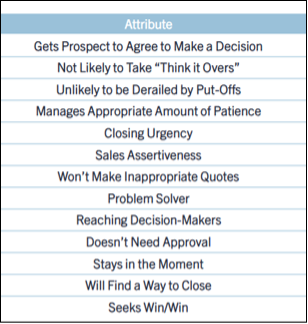
  1. Make sure to ABP: One last acronym for you, this stands for Always Be Prospecting. The skill and habit of prospecting relates directly to your producers’ skills and commitment to hunting. One of the findings on the sales evaluation we utilize includes the specific skills that top prospectors have mastered:
  • Will prospect & prospect consistently
  • Has no need for approval
  • Schedules meetings
  • Recovers from rejection
  • Maintains a full pipeline
  • Not a perfectionist
  • Reaches target clients
  • Gains referrals from clients and networks
  • Uses social selling tools
  • Attends networking events

Your best salespeople schedule time on their calendars to prospect as part of their competitive sales strategy.  And today it is even more important that they do so. Here is a sobering statistic about the world of modern day selling: the average number of attempts to reach a prospect has increased to 16-18, but most salespeople quit after less than 5 attempts. Maybe they think that, “in the good old days,” people used to return calls but the world has changed. Prospects are a hard fish to catch. Make sure that your team has persistence and a commitment to ABP as a key to developing their competitive sales strategy.


Topics: Sales Training, sales training tips, Developing a Competitive Sales Strategy

How Good is Your Team at Prospecting for New Leads?

Posted by Alex Cole-Murphy on Thu, Jul 25, 2024

As sales manager, business line leader, or CEO, is your team finding, qualifying and closing as much business as you think they should? Most say "No" when we ask that question, which means that something in your client outreach and sales process has to change. And that change, we believe, starts at the very beginning. The call or outreach to set up an appointment is key. It is good to remind your people that the prospects they are harvesting today are the ones that were planted some time ago. The goal is to find suspects and build them into prospects by fully uncovering and understanding their needs and goals.

If your team needs to have better initial appointments, they must adopt best practices for prospecting for new leads. They’re going to have to improve the quality of their initial phone call. It takes about 16 attempts to reach a prospect to get them engaged. Most people give up after four attempts. First, your producers and relationship managers and lenders have got to be more persistent and consistent in their outreach and second, they must get better. That first phone call is so critical.

4 Rules for Prospecting for New Leads

Here are some keys to remember to upgrade your team’s prospecting effectiveness. What is the purpose of the first call? Simply, to get the prospect engaged. Not to talk product and definitely, not to sell anything. The first call is to gain their attention, find out what is on their minds and secure a meeting. So here are four rules to help your team improve in that area. Remind them that:

  1. How they say what they say is more important than what they say
  2. Nobody wants to talk to them, really
  3. The first 10 seconds are critical
  4. They must sound like someone the prospect would choose to speak with

All of those can be improved if you require your people to prepare themselves with pre-call planning. They must know what they are going to ask, what the prospect might ask them and be prepared so they can pivot if they need to. If they cannot connect with the prospect in the first 10 seconds, everything from there is uphill. All of this requires practice, practice, practice. That’s where real leadership emerges.  Are you inspecting these behaviors?  Does your company have a consistent sales approach that you or your managers are following and coaching around? All salespeople, including yours, will fall back on what is comfortable, what they learned at a prior company. To implement best practices in prospecting for new leads, you will have to take them out of that comfort zone.

How can leaders get better at improving the sales techniques of their people without processes proven to work? We help many companies with a better first call approach, improving their team’s ability to prospect for new leads. We call this the 8-Step phone approach but that is not important. What IS important is that your people craft this, practice this, refine it and tailor it to who they are calling. First calls that are effective are no whimsical in nature, not off the cuff, they are pre-planned and precise. However, the prospect is not scripted, so your lenders and producers must be flexible and tenacious. Here is a simplified approach for the 8-Step call:

  1. Introduce Yourself then…
  2. STOP​ (let them talk, ask etc.)
  3. Ask Permission​ to continue
  4. Provide short Positioning Statement​ about what other clients in their industry are dealing with (Sample: Bob, in talking with executives like yourself, some of the common challenges that I've been hearing are hiring top talent, and an uncertainty that the people they have can overcome some of the challenges facing them in the coming year. Bob, I'm curious, are either of those having an impact on you and your business?)
  5. Let them answer then ask permission to continue
  6. Give two examples of how you have helped others in similar situations
  7. Discussion & Drill Down ​– ask questions to find out how these issues are affecting them, their company, their success
  8. Close for Appointment​ – no selling, no product talk (Sample: Bob, can I make a suggestion? Why don't you invite me out? Let's find some time to sit down. We can ask each other some questions, and at the end of that, we'll both know if it makes sense to talk further.)

Have your people script this for upcoming calls, then practice over and over. It should not be or sound like a canned approach. They must become familiar with it; they must own it and it must be unique. Have them do that for the next 30 days. Have them record their opening dialogue to their phone call. Listen to it. Have other people listen to it. Coach it. Would you want to talk to them if they called you?

It's important to warn your people about getting happy ears, as we like to call it. They hear one kind of buying comment, such as yes, we really could use a better approach, and bam, they are introducing their product benefits and how they can make it better. Instead, your salespeople will be unique and stand out if they ask questions, better questions and lots of questions to fully understand the prospect’s problem. See how long your salespeople can go without talking about their product or company or solution. At the end of the conversation, their prospect should be thinking: That was different or I can see myself doing business with him or her down the road. I might not have a problem right now, but when I do, I'm going to be thinking of them. They asked good questions, they challenged me, they don’t want to sell me, they want to know me.

So, I will ask you again: How good is your team at prospecting for new leads? And what are you going to do about it?


Topics: Prospecting, Sales Training, sales prospecting, sales training tips

Help Your Team with Cross-Selling & Up-Selling Strategies

Posted by Mark Trinkle on Fri, Jul 19, 2024

The concept of cross-selling tends to evoke skepticism and wariness. Over time, this skepticism has arisen due to some individuals with good intentions although accompanied by undesirable practices. Pushing product is often another term used for cross-selling & up-selling strategies.

Let’s explore why this skepticism about cross-selling exists.

The traditional perspective on cross-selling, if we were in discussion at a training session, would likely involve me asking the participants why we should engage in it. Common responses would revolve around increasing sales, driving market penetration, and enhancing customer loyalty to fend off competition. While these reasons may hold some truth, let’s shift the focus to this question: where is the emphasis placed?

The traditional rationale centers on the benefits to the company – more sales, increased market share, and customer retention. However, there’s a notable absence of consideration for the customer. This observation holds true in our experiences at Anthony Cole Training Group, where, despite our 30 years of engagement in this conversation nationwide, rarely does anyone express that cross-selling and up-selling strategies should occur because they genuinely are in the client’s best interest.

As sales leader, you should lead the charge to adopt an approach that will foster comfort for you and your team and also elevate the quality of the relationships you have built with your customers over time. To achieve this, we must entertain the possibility that the most compelling reason to broach the topic of relationship expansion with a client is the potential benefit to their best interests. It could be that your client is struggling with a problem they need assistance in solving. Here are ten keys to helping your team with client expansion, a much better term for cross-selling or up-selling:

  1. Remember the focus is on the client, not you or your company
  2. Take a consultative approach
  3. Demonstrate empathy
  4. Be curious and ask the right questions (takes practice)
  5. Engage in active listening
  6. Ask if they need your help
  7. Be their guide
  8. Make it your goal to take care of the whole client
  9. Focus on stewardship instead of selling
  10. Guide them to make sound decisions

You will encounter doubt and skepticism, no doubt. Your salespeople will likely think but not share the following:

  • If I ask for other business, they might think I’m greedy
  • I’ll ask for other business after I’ve proven I can do a good job for them
  • I’ve already asked them - they said they aren’t interested
  • I can’t ask for other business because it might jeopardize my current relationship
  • They already have a relationship with someone else that does that for them

If your team truly believes that they are stewards for their clients, many of these objections fall away. After all, by its very definition, stewardship is the job of taking care of something that has been entrusted to you. We will often coach salespeople to “think like the CEO” and ask CEO-like questions. Understanding the bigger picture that the prospect is operating from is always additive. A consultative approach to this will involve asking questions about growth goals of the company or retirement goals for the individual. What is keeping them up at night or getting in their way of reaching their plans? Understanding the environment and industry your prospect or client is operating in is essential. Remember the word “entrusted”.  As you reflect on your team’s success or challenges in the areas of cross-selling and up-selling strategies, have they earned the trust and operated as a steward for their clients? Let’s eradicate the term cross-selling and focus on relationship expansion and serving the whole customer.


Topics: Sales Training, sales training tips, cross selling, up selling

Effective Sales Meeting Strategies

Posted by Jeni Wehrmeyer on Fri, Jul 12, 2024

Every salesperson has attended sales meetings and left thinking “Why do I have to go to these meetings? They are a waste of time and are not helping me get better at selling.” Sales leaders and managers must own and address this problem. Attendees to sales meetings should leave the meeting thinking:

  • I never want to miss these sales meetings
  • I am more motivated to go sell now
  • I learned something today that will help me be more successful

Effective sales meeting strategies begin with understanding what it takes to be a motivational leader. We partner with Objective Management Group, the pioneer and leader in sales evaluations who has identified these 4 strengths in top performing, motivational leaders: they know what motivates their people, they have a strong self-image, they give recognition regularly, and they do not accept mediocrity. Another strength of motivational leaders is the ability to understand how their people are motivated, whether that is intrinsically or extrinsically. Tied very closely to understanding motivation is the ability to drive successful goal setting efforts to uncover both personal and professional goals that will motivate and drive the necessary activities to achieve established goals and results. Too many sales leaders do not understand how and why their salespeople are motivated. While there is no pixie dust to motivating people; if there was, it would be understanding what makes salespeople tick, whether it is college education for their 3 kids or recognition and status of being a top performer. Sales leaders must know this about their people.

All that said, what then specifically can help sales managers be more effective with their sales meetings? Ideally, leaders have two different kinds of meetings regularly with their teams:  Huddles and Sales Meetings. Huddles focus on burning platform issues, they are brief (15 minutes typically) and urgent on a consistent time/day & agenda and involve reporting on smart numbers/predictive indicators that drive success for the organization. Sales Huddles are a communication process that helps managers gain real-time information for real-time coaching and always include an action plan and follow-up.  Huddles help managers identify who needs coaching for future one on one coaching sessions. They also typically include a scorecard that stack ranks their people on the smart numbers, adding transparency and competitiveness to the Huddle. Here is an example of a Huddle Scorecard:

Picture1-Jul-12-2024-11-14-22-8930-AM 

For longer, usually monthly meetings, here are 4 effective sales meeting strategies:

  1. They must have a Purpose: Recognition, important sales information, interaction, learning, skill development
  2. They must have appropriate Frequency & Duration: Driven by the “sales cycle”, monthly recognition for success, long enough to cover sales but short enough to hold attention
  3. They must have a compelling Structure: CEO message (high-level production), results (stack ranking)
  4. They must share Great Content: Sales idea/concept, stories of success and failure, including examples outside of the company including Ted Talks and other motivational resources

If sales leaders deliver these 4 strategies above, they will likely have sales meetings that have their salespeople thinking “I never want to miss these.” Their salespeople will learn something, leave the meeting feeling motivated and with something that will help them TODAY. 

Much like a salesperson who should “never leave home” without a pre-call plan, sales managers must own the responsibility to plan, develop and deliver motivational sales meetings. Put your sales meetings to the test today by implementing these 4 effective sales meeting strategies above.


Topics: Sales Training, motivating sales people, sales training tips, sales meeting strategies

Don’t Leave Home Without It: Pre-Call Planning

Posted by Mark Trinkle on Fri, Jul 05, 2024

Remember the tagline and series of commercials by American Express, “Don't leave home without it?” In this case, we don't want salespeople to leave the office without pre-call planning and pre-call preparation. This is a specific discipline, a hallmark and habit of all great salespeople.

As we work with companies across the country and this topic is introduced, what’s interesting is the resistance that we often receive. The pushback typically comes in a number of different variations. One reason that we will hear is, “Hey I'm a veteran. I've got 20 years of experience. I've been down this road before. I know what I'm doing.” Another excuse we hear is “Listen, I'm really busy. I have a lot going on. I have a lot of calls I need to make. I don't have time for this.”  Other salespeople will say, “I'm just going to wing it. I will rise to the occasion.” And that last one makes me chuckle, and my answer is respectfully, you will not rise to the occasion. Here's what you're going to do. You're going to sink to the level of your preparation, which in your case, might be none or very little.

Sure, there are many things that a salesperson has to do well to be effective and drive consistent results year after year. You have to know your stuff, and you need to be charismatic, and be able to connect with people. You need to build relationships. You need to sell consultatively. You need to be asking all the tough questions. All of that is true. But most importantly, for your prospect or client’s sake, is that you've got to be prepared. It must matter to you enough that you will not think of a sales call as just a sales call. It must matter enough to you that you are at the top of your game every time you roll out into the field and you roll up to a prospect. You're not going to rise to your level of the moment, you're not going to rise to the occasion. That's the athlete in college telling the coach, "Put me in, and I'll show you what I can do." And the coach saying, "Why don't you show me what you can do in practice, and then I will put you in." That's the role of an effective sales leader and coach.

Let's dive right into this best practice of pre-call preparation. Are you or your team doing this or not? And if you're doing it, how well is it going? What is the current status of pre-call planning? Is it something you do all the time? Is it something you do only when you have the time? Is it having the intended effect of increasing your confidence as you go on the call and increasing the effectiveness of your questions while you're on the call?

Let's talk about combustion points. A combustion point, loosely defined, is any opportunity in the delivery of a company's products or services where something can go wrong. There are many things that can go wrong on a sales call. And the purpose of pre-call planning is to engineer out those combustion points. It is designed to not only minimize them, but also to give you a much greater sense of confidence so you can go into that call and get done what you need to get done. We would define that as being very consultative in your approach, asking lots of robust, fierce questions, and being a great listener. And if you don't pre-call plan for that, it is very likely that when the heat's on and it matters the most, you're just going to defer to whatever is known, whatever is comfortable, and whatever is easy. And for most salespeople, what is known and what is comfortable and what is easy, is to talk. They talk way too much.

A good ratio might be 80/20. 80% of the time it should be the prospect talking and 20% of the time it should be you talking. And your 20% of the time talking should be spent asking the questions that then get your prospect to spend 80% of the time talking. That's how it should work. Imagine a sign over your prospect's head that is flashing, wait, wait. And that is an acronym for “Why Am I Talking?”  

If you are convinced that your team needs a structure for pre-call planning, you can download a free worksheet HERE!


Topics: Sales Training, motivating sales people, pre call preparation, sales training tips, pre call planning


    textunder

    Subscribe Here


    Most Read


    Follow #ACTG


    About our Blog

    Anthony Cole Training Group has been working with financial firms for close to 30 years helping them become more effective in their markets and closing their sales opportunity gap.  ACTG has mastered the art of using science-based data and finely honed coaching strategies to help build effective sales teams.  Don’t miss our weekly sales management blog insights from our team of expert contributors.


    Recent Blogs