Are your salespeople following the first commandment of sales success? Our new video series with Mark Trinkle introduces the 10 Commandments of Sales Success. Today we start with number one- Pre-Call Preparation.
Watch all of the Commandments Here


Are your salespeople following the first commandment of sales success? Our new video series with Mark Trinkle introduces the 10 Commandments of Sales Success. Today we start with number one- Pre-Call Preparation.
Watch all of the Commandments Here
Topics: sales skills, pre call sessions, pre call preparation
It is an important distinction in sales – understanding the salesperson who can sell versus the one who will sell. A recent post by Dave Kurlan, on the Difference Between Selling Skills and Effectiveness does a great job of illustrating that difference. Think about your own business and those who consistently produce beyond the expected. There is something more than just their skills that drive their behavior and success. There is the Will to do whatever it takes to achieve their goals.
Why Sales Coaching Matters
This distinction between the can and will is why sales coaching really matters. Sales training can help develop a new producer so that they understand how to prospect, prepare, qualify and close business. But it is often the Coach who helps that salesperson uncover their will and their desire to sell, who stokes the fires by asking the right questions and helps them establish extraordinary goals. Sales coaching matters because it is personal, based on the salesperson’s situation, drive, hopes and dreams.
Sales coaching is also important to every organization because salespeople reporting to a manager with strong Coaching skills tend to have 26% more closeable late-stage opportunities.
But we also know from the data warehouse of Objective Management Group that less than 10% of sales coaches know the personal goals of their salespeople so while they may be well intended, how can a sales manager coach a salesperson until they know why that salesperson comes to work every day or what compels them to pick up the phone and make that next prospecting call.
Most sales coaches moved up through their company because they were good producers and they because of that, they are adept at translating the how to sell effectively, but may not be as skilled in helping to uncover a salesperson’s will to sell. Sales managers need a coaching system so they know when to coach their salespeople and follow an intentional sales coaching process to make it effective.
Here are 9 Skills in our Sales Coaching Skill Development Plan:
Just like salespeople, there are many sales managers who can do the job of coaching – they have the skills, but perhaps are not motivated by achieving success through the development and achievements of others. Those who lead and manage salespeople can lack the will to succeed in sales management. It’s an important distinction for every company to consider as they hire and develop their team.
Find out more about why sales coaching matters: https://blog.anthonycoletraining.com/sales-coaching-skills
Topics: effective sales coaching, Sales Coaching, sales coaching cincinnati
The start of any undertaking is the most important step.
When it comes to building the confident and trusting relationship associated with a strong seller / buyer relationship, the start is especially important. I'm not just talking about the immediate "bonding and rapport" part of selling or a 5-minute segment of chitchat. The start I’m referring to is the entire first contact process whether it is a phone call or an association meeting or the initial meeting after the phone call. The start will often, if not always, determine your finish.
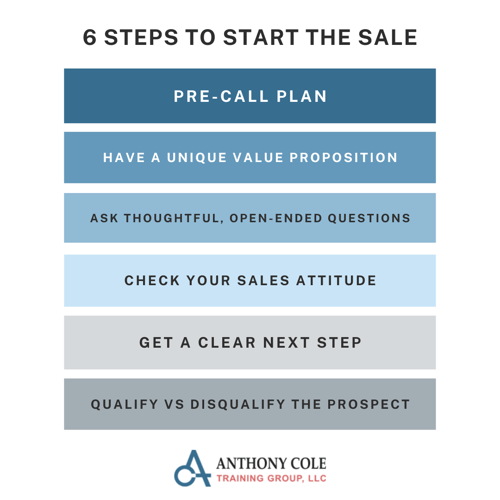
The 6 Steps to Start the Sale:
Master these 6 Steps to Start the Sale and you will close more business, more quickly, at higher margins.
Topics: meeting sales goals, setting sales goals, sales goals
Sometimes that means just go do the work! Early on in our business, I established rules for our sales success. One of my rules was No Cold Calling. Even though there is lots of information on effective cold calling, by having that rule, I was forced to get introductions and network with centers of influence. This has worked well over the years and our entire team follows that path. Occasionally, you need to change your approach to maintain your success. Here is one approach I tried and have adopted to set and reach our sales goals.

Lesson 1 - Have a plan, think through the plan, go do the activity.
Recently I grabbed a business card from a prospect that attended a Cincinnati Chamber session that I delivered earlier this year. I decided to just stop by his office, hand the receptionist his card and my card and ask "Is this guy in?" I was going to be in the area so I decided today would be a good day to just drop in.
The receptionist left with my card in hand and then came back out saying, "Rich will be with you in a minute." Rich came out with a big smile on his face, greeted me and said that it was great that I would stop in. I told him that if I didn't have the guts to stop in and see him, then he shouldn't hire me to begin with.
You see, I'm a bulldog when it comes to prospecting. Once I get a sense that there is something we should be talking about, I just keep calling, writing, and in this case, really get outside of my normal box and drop in. I didn't have on a suit or blazer with a tie. My first meeting was very informal; I was clad in blue jeans, cowboy boots and polo shirt. I was, as Seth Godin would put it, a Purple Cow.
Lesson 2 - Be unique. It is what clients are looking for today.
We spent an hour together and I learned a great deal about their business - what is working and not working, how the business has changed and what is keeping them from performing at a higher level. No sales pitch, no sales talk, just asking questions. I asked them questions that went well beyond areas that I specifically could help them with, because I am interested. And the best way to help anyone is to be sincerely engaged in their business and courageous enough to ask sometimes tough and unusual questions.
Lesson 3 - Have courage. What is the worst that could happen?
Rich took me on a tour and we just happened to go by the VP of sales office where he introduced me to Jim. He told Jim about our history, our conversation that morning and that Anthony Cole Training Group had some really "good stuff" for sales and sales management. Additionally, he suggested that we have a meeting to discuss what they do, what they need to do, and how "maybe" we might be of help. Jim said yes.
Lesson 4 - If you ask enough times and be persistent, sooner or later someone will say yes.
Additionally, given the nature of their business - B2B, with lots of dropping in and cold calling - the VP was very impressed that the President of the company would be out on the road dropping in on prospects. What I did not mention before is that I had dropped by six other businesses and the person I wanted to see at each of those firms was not in. I left my card and perhaps, made an impression. In today’s world of virtual touchpoints, you may just find that an in person drop and stop can set you apart. Can you do that virtually somehow? Are you making full use of Zoom and other video devices? Be creative and look for ways to be different and unique. Be a purple cow.
Lesson 5 – Go Back to Lesson 1 and Go Prospect.
Topics: meeting sales goals, setting sales goals, sales goals
Conversation is much more pleasant than interrogation. This is important for an effective coach to remember because after two or three questions, a salesperson is going to feel like they are being attacked. This is also true for prospects.
Great coaches ask great questions like “Bill, how did that linebacker get past you?” If the coach tells him, “You’ve got to keep that linebacker from getting past you”, does Bill learn anything? Chances are he already knows he shouldn’t have let this happen. By asking the right question and reviewing via the post-call debrief (similar to viewing the game film together), Bill will better analyze his own actions and discover what he failed to do.
Note that the coaching question, “Bill, how did that linebacker get past you?” is an open-ended question. In sales and sales management, it is best to avoid asking “yes” and “no” questions. They are not effective during the sales process or when working with and coaching salespeople. Phrase your questions as open-ended. This will help to engage the salesperson, make him/her think before answering and get him/her involved.
Let’s say that you have a sales person who frequently fails to uncover the competition during the sales process. You could ask him/her, “Did you find out about the competition?” or “When you asked the prospect about those firms being considered, what did he say?”
Can you tell which question is going to get a better answer and provide more insight? Open-ended questions make coaching sessions more conversational and more engaging. Open-ended questions will help the salesperson identify the gaps between what they are doing and what they should be doing. Open-ended questions gather more information.
Let’s parallel this to a conversation with a sales prospect. Your salesperson has secured a first meeting and over the phone, identified a specific issue or pain that is the reason for the meeting. Are they equipped with a meaningful series of open-ended questions that are conversational in nature, so that the prospect does not feel like they are being interrogated? Here are some of the open-ended questions we recommend in a first meeting sales conversation:
While there are several Yes/No questions at the end of that series, for the most part, that questioning technique is conversational and open-ended. The salesperson is genuinely interested in the answers to these questions so that they will understand if they can help the prospect.
Now back to the coaching parallel. Once the gaps between expectation on the call and actual execution during the call are uncovered with your salesperson, you need to gain agreement from the sales person that there is a gap before moving to the next step. Sometimes the salesperson will not see this immediately. Upon agreement, identify specific solutions and objectives to improve performance. The key here is to identify solutions that will help the salesperson learn and grow. Do not just set data or results-based goals.
An example of a learning objective would be to improve the percentage of contacts to appointments. An increase in this percentage would indicate improvement in an initial-call skill. Improving the quality of initial calls would be a measurable objective because there would be a corresponding increase in opportunities created. Be sure to document the identified, agreed-upon objectives and note the specific action items and corresponding necessary behaviors so that you enhance the salesperson’s probability of success.
Topics: open ended sales questions, asking sales questions, asking the right questions