Watch Sales Guy Unplugged: Are Your Sales Questions Courageous Enough?
Mark Trinkle, Chief Growth Officer
Need more information? Download this free SalesTool with the Drill Down Questions.

Watch Sales Guy Unplugged: Are Your Sales Questions Courageous Enough?
Mark Trinkle, Chief Growth Officer
Need more information? Download this free SalesTool with the Drill Down Questions.
Topics: things to do for sales success, how to improve sales, sales leads, create & convert leads

“It’s not you, it’s me!” I love that scene from Seinfeld.
In today's blog, we answer the sales question, "Is it me or is it you?"
Selling has changed a lot in the last 10 years and, if you haven’t noticed, some of the tried and true ways might not be as effective as they once were.
My vote is that the buyer and the buying process have changed the most, so it’s “them”. So, now that we have established who is at fault, let’s talk about why and what to do about it.
So… what is a salesperson to do?
According to Dave Kurlan at the Objective Management Group, you need to sell more consultatively.
What does that mean? Well, here are the 9 attributes for consultative selling from the OMG sales evaluation:
This is a lot of stuff to think about. Could working on some of these 9 help you be more effective and sell more? I think so, but it’s up to you.
Child: "Can I have ice cream for dinner?"
Parent: "No."
Child: "Why?"
Parent: "Because ice cream isn’t good for you."
Child: "Why?"
Parent: "Because it has no nutritional value."
Child: "Why?"
Parent: "Umm … I guess because its makers wanted to make sure it was tasty."
Child: "Why?"
Parent: "So, they could sell more of it."
Child: "Why?"
If you’re a parent, you know this scene all too well. And if you’re an honest parent, you know that at times all those incessant questions can be downright annoying.
But you also know that asking those questions is a critical part of the child’s developmental process. Children have no built-in knowledge base, so asking questions – and getting answers – is the way in which they begin to make sense of the world around them.
It’s similar to great selling, actually – minus the “annoying” part.
Great salespeople always ask the extra question. They know that the more knowledge they can gather about the customer’s situation, the better they can serve him or her.

Ask, Then Listen
It’s not enough, though, to just fire away with question after question. Great salespeople listen – really listen – to the answers their customers give.
That may sound simple, but if you’ve ever watched a locker room interview after a big game, you’ll see how often people who are paid to ask questions – sportswriters – fail to do this.
Locker room interviews don’t always produce thoughtful questions.
Reporter: “Johnny, tell us about your game-winning hit.”
Player: “Well, I was just looking for a pitch to drive. But I really think the key was the week I spent in a sweat lodge before the game. That really cleared my mind.”
Reporter: “Uh huh. So, what are your thoughts about tomorrow’s matchup?”
We exaggerate here to make a point. But often writers are so intent on getting through their list of questions (and getting back to the press box to file a story before deadline) that they fail to listen to answers that, if they followed up on them, would give them a much better story.
What’s the Customer Really Saying?
At PrecisionLender, our software is designed to help bankers have these better conversations with borrowers by supplying them with insights from our virtual insights coach, Andi®. So, consider this hypothetical situation …
Let’s say you’re trying to win a deal with a borrower for a $3,000,000 commercial real estate loan. But the borrower says he’s planning to go with a competitor bank that’s offering a rate that’s 50 basis points lower.
Some bankers throw up their hands right then. The deal doesn’t meet their target so, then, oh well.
But great bankers start asking questions. “What can you tell me about this deal?”
Perhaps then you find out how, exactly, the competitor bank is offering such a low rate. Maybe it’s because part of the loan is guaranteed. That could be the end of the story. But the great banker channels his inner annoying child and asks about the guarantee: Who’s providing it? What are the details?
In this hypothetical scenario, the guarantor is the borrower’s father-in-law. Again, this could be the end of the line. But the great banker – unlike the mediocre sportswriter – is listening to the answer, and he detects that the borrower is less than thrilled at the prospect of “owing one” to his father-in-law. So, the great banker asks more questions and finds out that the borrower would be more than willing to cut a few months off the length of the loan if it means he can get the same low rate and not have to rely on his father-in-law’s guarantee.
By asking questions and listening to the answers, the great banker has gathered enough information to turn the tables and win another deal for his bank.
With this approach, the only people truly annoyed are the bankers working for the competition.
About Tim
As SVP of Enterprise Client Success for PrecisionLender, Tim’s significant career experience in commercial banking makes him uniquely qualified to partner with bank executives to increase revenue and profitability, as well as improve the customer experience and colleague experience. Prior to joining PrecisionLender, Tim spent over 10 years at Citizens Bank (NYSE: CFG) in various line and support roles, including National Sales Director - Franchise Finance, Chief Operating Officer - Commercial Finance, Director of Commercial Banking Strategy and Growth, and Head of Commercial Excellence. In addition, Tim served as Director of Credit Product Management for BMO Harris Bank.
Before the Salk Vaccine:
“Until 1955, when the Salk vaccine was introduced, Polio was considered one of the most frightening public health problems in the world. In the postwar United States, annual epidemics were increasingly devastating. The 1952 U.S. epidemic was the worst outbreak in the nation's history. Of nearly 58,000 cases reported that year, 3,145 people died and 21,269 were left with mild to disabling paralysis, with most of its victims being children. The "public reaction was to a plague", said historian William L. O'Neill. "Citizens of urban areas were to be terrified every summer when this frightful visitor returned." According to a 2009 PBS documentary, "Apart from the atomic bomb, America's greatest fear was Polio.”
Before the Objective Management Pre-hire assessment:
In the late 1980s, David Kurlan founded the Objective Management Group (OMG). The primary focus of his company was to help sales organizations uncover the root causes for the sales opportunity gap – that variance between how a sales team is performing and how it should be performing. Kurlan’s main objective is to answer the question “will they sell?” That's the essential question every sales interview is geared to answer. So why do we so often end up with salespeople that can't or won't sell despite our best efforts and intentions?
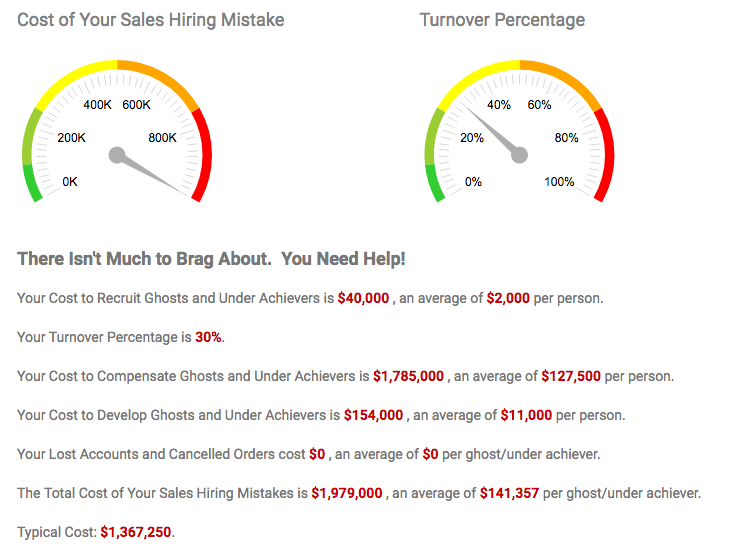
I'm not trying to compare Polio to hiring salespeople-- just trying to make a point that something dramatic had to happen (a significant change in preventative medicine) to eliminate ‘America’s greatest fear’. Hiring the wrong salespeople is happening today constantly and it’s crippling. Bad hires have an impact on:
Several years ago I met with a group of financial advisory managers. As part of our meeting we used the Hiring Mistake Calculator to help them determine their specific cost of bad hires. When we finished, I asked the president of the advisory program what number he came up and he said $2,000,000 a year. Based on best estimates, a bad sales hire is a $100,000 to a $1,000,000 mistake. If you are a hiring manager, an HR director with a recruiting team or a president of a company, this 2-comma problem should cause you to realize that a dramatic change is needed.
Everything that the hiring manager and supporting HR team does when attracting, vetting, assessing and selecting salespeople should be focused on ONE thing! Will they sell? Not: Can they sell? Do they know banking? How well do they understand coverage’s and employee benefits? Can they conduct a financial plan?
Over the years I’ve asked sales managers and presidents this question: How many people that are no longer with you are gone because they didn’t understand insurance, banking or investment advisory. The answer for 25 years has been; Zero! Not a single person was fired or left because they didn’t know the how to of the business. Bad hires are bad hires for 1 primary reason – they can’t or won’t sell. Yes, you will sometimes have cultural, compliance or HR issues but 90% of the time people are exited because they did not perform the basic fundamentals required to be successful in selling.
Click on the links below to learn more about the Objective Management Group assessments and how having a strong recruiting process will help eliminate hiring mistakes!
Eliminate Hiring Mistakes for Outside Salespeople
What Does Your Best Sales Person Look Like
Understanding the Make-Up of Your Current Sales Team
Hire Better Salespeople Recruiting
Topics: OMG assessment, assessing sales talent, #1 sales assessment
In the fast-paced, ever-changing field of sales, it’s no wonder why systematic, repeatable training is important to keep sales reps up-to-date. Since sales reps often need to learn and adapt to the latest sales process, methodology, and messaging, offering timely training is a must. Equally important is the regular distribution of sales training content that is memorable. Without it, learned information will not stay with the seller for long. This kind of meaningful training can come from an effective sales enablement program
The problem is that many sales enablement practitioners typically adopt training methodologies that do not give reps what they actually need. Traditional sales training techniques take the seller away from the buyer, which often prevents them from being as effective as they set out to be. By implementing a more effective sales enablement program, a company can improve the training process by addressing the actual needs of the sales team.
While this task may seem daunting, there are four simple ways that a sales enablement program can actually streamline sales training.
1.) Making Training More Available
One of the biggest problems with sales
2.) Contextualizing the Training to Meet the Reps’ Needs
As with all large-gathering
A more beneficial sales training strategy would give reps information that is relevant to the sales
An effective sales enablement program helps ensure that all the sales content that is given to the rep is significant and relevant to their current engagements.
3.) Training on Simple, Deliverable Language
Since sales reps are the buyer’s primary communication point for the company, it is vital that they are able to communicate the necessary information to the buyer in a simple and concise way. Few buyers will be interested in jargon or technical data statistics, but they will want to know the essential aspects of what they are considering buying. If a sales rep cannot fully explain the product simply and coherently, they may lose the buyer’s interest and ultimately, their business.
Because of this, an effective sales enablement program must support a sales training and communication strategy that gives the rep the necessary information in such a way that they can easily digest and deliver it to the buyer in simple language.
4.) Incorporating Training Into the Regular Workflow
Perhaps the most essential need is for the sales training content to be seamlessly incorporated into the rep and sales manager’s workflows, making room for quick and regular coaching feedback from the manager to the rep. The training process should be ongoing so that sales reps are not losing out on new information or having to remember what they learned months ago.
An effective sales enablement program that incorporates sales training techniques into a company’s workflow will help make training and coaching more efficient in the long run.
Developing an effective sales enablement program that works around the sales team will help the reps with what they actually need, allowing them to be more productive and motivated to sell more. When they are regularly given proper training material that helps them in their specific engagements, they will use what they learn more regularly, making it less likely that they forget what they learn and more likely that they use it in the future. Lastly, the sales enablement program can help ensure a workflow that allows room for regular, practical feedback from managers to the reps. All these together streamline the training process and make the sales team more efficient, productive, and effective.
Shawnna Sumaoang is the Director of Marketing for Highspot, the industry's most advanced sales enablement platform, helping organizations close the loop across marketing, sales, and the customer.
Topics: Sales Training, Sales Enablement