ACTG Sales Management Blog

Sales & Sales Management Expertise Blog  

Desire and Performance Variability

Posted by Tony Cole on Thu, Oct 06, 2016

brain_maze.png

“What you can conceive and believe you can achieve.”  - Napolean Hill

This is so obvious that any meaningful information could probably be expressed simply by stating:

If you have people with various levels of desire for success in sales, you will have variability in performance!

Done. 

Not really, but this isn’t going to take a long time either.

Many years ago, I heard Mark Victor Hansen (author, speaker and all-around good guy) present to the Cincinnati Association of Life Underwriters.  It was at our annual conference and he was our keynote speaker.  His topic was “Visualizing is Realizing.”  During his presentation, he made the comment, “Motivation is an inside-out job.”  I wrote that down in 1990, and I’ve used that phrase over and over again in our 23-year history as a company.

Time and again, sales managers, sales executives and presidents of companies ask me, “Tony, how do I keep my team motivated?”  I tell them that they cannot do that because it’s something their people have to come wired with. That's mostly true. Companies do have to have an environment where it’s possible for people to create reasons for staying motivated.  Compensation, contests, incentives, and recognition all play a part in keeping people motivated.  However, in the end, people have to have a really good answer to the question: “Why do I desire success in selling?”

Success in selling is very specific.  It isn’t just success in a vacuum.  It’s success in a very difficult role with very difficult challenges.  I was once asked why I was in life insurance sales.  I responded that I liked people.  The prospect said, “Bullshit. You’re in sales because you want to make a lot of money.”  I said, “Fair enough; you’re right. I do want to make a lot of money.”

But, money in and of itself is not the root desire.  It’s one of the basics that drive the desire. It’s represented in Maslow’s hierarchy of needs.  Money is just a way to take care of food, shelter, clothing, freedom from harm and security.  Traditionally, people that are very successful in selling have this one thing in common – they have lots of s**t to do that requires money.

Yes, sometimes people have a desire to be recognized as the best.  And they want to have self-satisfaction for a job well-done; but I assure you that none of that matters if there are bills to pay, kids to be fed, a college/mortgage/wedding to pay for or new cars to be driven.

With that as the foundation, let me make this as simple as I can to help answer the question, “So, how do I minimize variability in performance by focusing attention on desire?”

  1. Recognize that it is an inside-out job… so that means you have to recruit people that have huge desire for success in selling.
  2. Traditionally, desire is a result of people establishing goals.
    1. Your manager has to be leader in this. If they are not a goal setter (personal goals), then chances are your salespeople won’t be either.
    2. Your manager also has to set the example of goal achievement.
    3. Your manager has to create an environment/opportunity for personal goal setting.
  3. Your manager has to have the mindset that they must know what motivates their salespeople – why do they desire success in sales?
  4. The sales manager needs to recognize that it is their responsibility to help people raise their self-esteem by recognizing success in all forms when it happens.

As I stated in the beginning, the connection between desire for success and selling and the variability of performance is pretty obvious.  If you want to minimize variability in success, minimize the variability in desire for success.

subscribe-to-blog.png

Topics: managing sales teams, desire for sales success, managing salespeople, variability in sales performance

Variability and the 14-Letter Dirty Word – Accountability

Posted by Tony Cole on Mon, Oct 03, 2016

Several years ago, as part of our sales team evaluation, the skills, tendencies and effectiveness of the sales leadership team was also assessed.  The findings indicated that of the 224 leaders, 23% had at least 60% of the skills required to be an effective performance manger.  Of the 5 sales management skill sets required - coaching, motivating, recruiting, mentoring and performance management – this last one, performance management, is where the team “scored” the best. The skills/tendencies within the skill set are as follows:

  • Doesn’t accept mediocrity
  • Has no need for approval from sales people
  • Takes responsibility
  • Manages behavior
  • Asks Questions
  • Manages pipeline
  • Has beliefs that support accountability

Before digging into this topic further, just take a minute to examine these results: 

  • 224 sales leaders
  • 23% (51) with the minimum % of skills needed to be successful in their role
  • 67% (172) sales leaders below the minimum standards of effectiveness
  • Only 1 out of 4 managers, hired to do the job of managing performance and holding sales people accountable, had the skills to do so.

Assume for a minute that this might be your sales organization.  Now, you might be thinking, “I don’t have that many sales managers and so my numbers won’t look like this.”  You are right; they won’t look like this, but consider the possibility that maybe you didn’t get the 1 out of four!  How would you know?

  • Do your salespeople meet and exceed goals?
  • Do your salespeople consistently have the right volume of pipeline?
  • Do your salespeople have a tendency to have up and down weeks, months, quarters or years?
  • Do your salespeople blame the economy, the competition, the pricing, the lack of marketing, lack of support, too much paperwork for failure to prospect?
  • Have you spent a small fortune for CRM and yet still struggle with trusting the reliability of the pipeline report that you get?
  • Are people late to meetings or fail to show up at all, or leave early?
  • Does your sales manager take bullets for the failure of the sales team?

Performance Management – Definition (As defined by the University of California Berkley)

  • Performance management is an ongoing process of communication between a supervisor and an employee that occurs throughout the year, in support of accomplishing the strategic objectives of the organization. The communication process includes clarifying expectations, setting objectives, identifying goals, providing feedback and reviewing results.

Hogwash!  This is part of the definition and this might suit the academics, but in the real world of business, there is something missing!  “What’s missing?” you ask.

  • Identifying and implementing Rewards for success
  • Identifying and implementing Consequences for failure
  • Implementing disciplined approaches (structured activities) to correct failure to perform effort or execution.

sme_chart.png

The Berkley definition is kind of like the LifeLock commercial you see on TV commercials.  The bank is being robbed and customers ask the security guard if he is going to do something about the robbery.  His response is that he is not a security guard but rather a security monitor.  If all a manager does is communicates expectations, sets objectives, identifies goals, reviews results (“you are not hitting your goals”) and provides feedback (“You have to work harder”), then performance really isn’t managed; it’s just monitored.

As long had you have a sales team consisting of self-starters, self-managed, high figure-it-out people, then you are okay.  BUT, and this is a BIG BUT(T), you probably don’t have an entire team of people like this.  Short of having a team that just needs to be pointed in the right direction, an organization needs someone to manage performance and hold people accountable to individual commitments.

The organization needs someone that can reward people for success through compensation and recognition.  As important, if not more important, your performance management manager MUST be able to recognize early when people are off-track. This person must have implemented the right systems and process for early detection.  And the person must be strong enough to have fierce conversations with people when they are failing to perform.

Finally, there must be a process of disciplined and structured correction procedures so that those failing to execute have a chance to succeed.  PIPs are not the answer.  PIPs are to late to have a significant impact.  By the time you attempt to put someone on a PIP that horse has left the barn.

Additional Resources:

subscribe-to-blog.png

Topics: effective sales coaching, sales management, performance management, sales accountability

Variability in Performance – Let’s Talk Recruiting

Posted by Tony Cole on Wed, Sep 28, 2016

 pole_vault.jpg

Earlier, I stated that eliminating the variability of performance all starts with people, right?  And then, I proceeded to tell you that I thought that eliminating variability starts with systems and process.  Now, it’s time to talk about people and that means talking about recruiting.  Here are the big ideas about recruiting:

  • You don’t have to like it; you just have to do it.
  • You must be excellent at it.
  • You must know exactly what you are looking for – What is your *Zebra?
  • You must stick to your plan of hiring nothing but Zebras!
  • You must have an excellent onboarding system and process.

Companies hiring salespeople do not hire talent intending for that talent to be average.  Companies creating business plans do not put plans together with an end game of “Let’s be average.”  No one starts a company, starts a career or initiates a marketing campaign with the excitement of “I think this is really an average idea that will bring us average results and make us average in the marketplace!”

So, why should we use average, above average, okay, trending, making progress and “in line with out peer group” when describing our results?  It’s the wrong way to measure success or progress.  If you don’t intend on having average results, then don’t intentionally hire average people and don’t accept it when evaluating effort, execution or performance!

How do we know that this actually happens?

  • Companies use stack ranking and the sales managers/executives reviewing the sales reports brag about outperforming their counterparts in similar markets. If the counterparts are successful, then that’s a good analysis.  If the counterparts suck, then one team just doesn’t suck as bad as the other teams.
  • Companies use year over year performance. I get it.  I understand it because companies are trying to demonstrate that they are improving. That makes sense, kind of.  But, let’s suppose you are a sports team that plays 10 games.  Last year, you won 2. This year, you won 4 – a 100% improvement; however, you still lost 60% of your games!
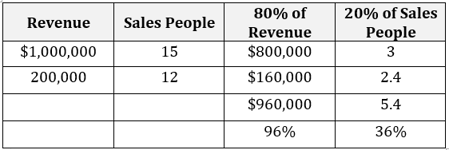
  • The 80/20 rule doubled. If you look at most sales teams that have at least 10 salespeople, normally you find that about 36% of the salespeople are responsible for 90% of the results.  What the heck is the other 64% of the team doing?

How does this happen?  Recruiting, on-boarding, training and development, sales coaching and performance management. 

It is possible to fail in many ways…while to succeed is possible only in one way (for which reason also one is easy and the other difficult – to miss the mark easy, to hit it difficult.)   - Aristotle

How do you minimize the opportunity for failure in recruiting thus minimizing the variability in performance?  Answer: Have a system.  Have a system managed by quality people that are more interested in hiring quality people that will actually sell.  Have partners internally and externally whose objectives are aligned with the ultimate goal – creating a sales team built for growth.  Manage the process like you would manage any other process in your organization.

With all of that said, here are a couple of key things to consider:

  • Have a pipeline process. Imagine for a minute that you were talking to your salespeople about their prospect pipeline and they informed you that they didn't have one. What would your reaction be?  Why then is your company allowed to NOT have a candidate pipeline or a process to build a pipeline when necessary?
  • Have huddles to discuss internal activities designed to generate candidate leads. Internal ownership in the recruiting process is critical. Hiring an outside firm and them blaming them or using them as the excuse for poor hiring is not an option.
  • Profile the results needed to be successful rather than write and publish a job description. Look into what is being done by your most successful salespeople (*Note- These may not be the same people with the biggest revenue contribution). What are they doing? What kind of activity do they have, who do they call on, what is their average size case, close ratio and sales cycle?  How are they being managed and at what level do they succeed? Attract those that aspire to work and succeed at that level.
  • Assess for job fit, sales skills inventory and WILL to succeed in selling. The resumes are going to look good. References are pointless these days and almost all of them will have a decent profile on LinkedIn.  So, use a pre-hire assessment tool so that you have the same set of sales skills inventory questions being asked the same way all the time.
  • Screen for the skills you need. Just as an example: If phone skills are important and the salesperson will often face prospects that are not terribly over-excited about getting a call from a salesperson, then you must first screen for that skill, that talent.  If closing for an appointment is important for sales people to do, then make sure that this candidate closes you for the next step.

These are the big ideas in recruiting. This is the start of the transformation of your sales team.  Stop hiring those people that end up on the wrong end of the 80/20 curve.  Be a leader and break the trend of accepting mediocrity from people you hired to succeed.

subscribe-to-blog.png

Topics: recruiting sales people, getting consistent sales results, variability in sales performance

Top 14 Truths About Managing Salespeople & Increasing Sales

Posted by Tony Cole on Tue, Sep 27, 2016

14_truths-1.jpg

If you’ve followed my blog for any period of time, you know that there are several phrases that I use when discussing sales outcomes, sales management, recruitment and talent development:

  • Your organization is perfectly designed for the results you get today.
  • When you evaluate talent that is not performing as expected, you must ask yourself: “Did I hire them this way or did I make them this way?”
  • Hire people you cannot afford.
  • Hire great people when you find them, not when you need them.
  • Catch them early (refers to performance management).
  • You pay peanuts, you get monkeys.
  • When all else fails, hard work works.
  • They (your underperforming salespeople) either are lying about their activity or they suck at what they do.
  • You should begin the exiting process of an underperformer the moment you have the first thought.
  • All prospects lie all the time.
  • Don’t look, act or sound like a salesperson.
  • When goals are clear, decision making is easy.
  • Events happen to us all, destiny is what happens next.
  • They’ll only do it once.

That's about it.

Do you have favorite business phrases? Share your feedback and comments below!

subscribe-to-blog.png

Topics: sales management, managing salespeople

Variability of Performance – A Side Story

Posted by Tony Cole on Wed, Sep 21, 2016

boy-bike.jpg

I’ve been writing about solutions to variability of performance and, as often happens, I see/find something connected to the theme of sales or sales management.

Earlier, I discussed three reasons for variability of performance:

  • Situational Factors
  • Task Characteristics
  • Individual Differences

Dr. Peter Jensen, sports psychologist, founder of Performance Coaching, instructor at Queen's School of Business, Canadian Olympic Coach and author of Ignite the 3rd Factor, states the following:

“The developmental potential of human beings has three major components: nature, which establishes the physical and mental road map of an individual; nurture, which includes social and environmental factors that help would an individual; and the Third Factor, which is the factor of choice or "the important role an individual plays in his or her own ‘becoming’.”

Nature, nurture and The Third Factor define individual differences.

I was taking my morning walk when I noticed a young boy and what appeared to be his dad riding their bikes in the cemetery across the street from our house.  The boy seemed to be enjoying himself and feeling the excitement of peddling his bike faster and faster.  I turned my attention back to my walk and then looked back one more time.  I noticed the young boy on the ground, his bicycle a few feet on the ground away from him and his dad dismounting from his bike.  It appeared that the boy had tried to take the corner too fast, lost control of his bike and fell.

I stopped to watch and make sure that there wasn’t a serious injury. The dad walked over to the boy, bent down and spoke to him. Then he sat down on the ground and the boy moved over to sit on his lap; it appeared the man was checking for any injuries on the boy’s arms, legs and head.  All seemed to be well.
I continued walking and then crossed the street like I normally do.  I looked over to my right and again saw the man talking to the boy. The boy climbed back on his bike and continued riding.  And then I pondered.

The boy didn’t wait until the next day to start riding. He didn’t push the bike back to his house.  He didn’t sit there for an hour looking at it, debating if he should try again or not.  He didn’t appear to cry or be afraid.  He just got back on the bike and peddled away.

The Third Factor at work.

As a sales manager or hiring manager, it is difficult to assess talent.  There are many contributing factors that make recruiting difficult.  At Hirebettersalespeople.com, we define 8 steps that, when implemented and executed well, can help eliminate hiring mistakes and improve the probability of success once the hire has been made.  But, one of the steps – the vetting step (assessing, qualifying and interviewing) – is always challenging because of the human factor.

Specifically, the vetting process is difficult because of how hard it is to determine “the will” to succeed in selling rather than “the can” succeed in selling.  The will to sell = The Third Factor.  Objective Management Group’s sales talent assessment and pre-hire assessment does the best job of this (Worlds #1 Sales Talent Assessment) with the following findings:

  • Desire
  • Commitment
  • Responsibility
  • Outlook
  • Figure-it-out factor
  • Source of motivation

Why is this important do know?  It’s important to know because resumes and application answers are great works of fiction.  Over the last 22 years in this business, I’ve seen the development of resumes go from a bullet-pointed document about the history of a candidate to a short story of great accomplishment and adventure.  There are no “bad” resumes anymore.

When you calculate the cost of bad hires, hires that don’t produce as expected, hires that are there and then gone in a blink of an eye (calculate the costs of ghosts), the problem can be, as Roy Riley described it, a two-comma problem.  Yes, you want people that have the required technical expertise; yes, you want people that have experience in your industry; and yes, you want people that have experience selling in your environment and have success selling to prospects you are looking to sell to.

But, if you don’t know exactly how they have succeed in the past, if you don’t know if they are wired to sell and help your company grow, if you don’t know the “third factor” choices they make to succeed in spite of all external factors, then you will continue to fall victim to hiring people that fall off the bike and have a difficult time getting back on the seat.


Additional Resources: 

 Assess a candidate

subscribe-to-blog.png

Topics: individual sales success, sales management, Peter Jensen, the 3rd factor, variability in sales performance


    textunder

    Subscribe Here


    Most Read


    Follow #ACTG


    About our Blog

    Anthony Cole Training Group has been working with financial firms for close to 30 years helping them become more effective in their markets and closing their sales opportunity gap.  ACTG has mastered the art of using science-based data and finely honed coaching strategies to help build effective sales teams.  Don’t miss our weekly sales management blog insights from our team of expert contributors.


    Recent Blogs