ACTG Sales Management Blog

Sales & Sales Management Expertise Blog  

Let Silence Do the Heavy Lifting in Sales

Posted by Mark Trinkle on Fri, Oct 28, 2016

A guest post by Mark Trinkle, Chief Sales Officer, Anthony Cole Training Group

Hello, darkness, my old friend.

I’ve come to talk with you again.

Because a vision, softly creeping,

Left its seeds while I was sleeping.

And the vision, that was planted in my brain,

Still remains…

Within the sound of silence.


So, that is the answer, courtesy of Simon & Garfunkel…And the question is this: “What song, released by a duo over 50 years ago, can help salespeople today?”

Yes, the unmistakable sound of silence. Wait a minute…does silence make a sound?  If you are a professional salesperson, you would say it absolutely does.  Susan Scott, the author of the wonderful book, “Fierce Conversations”, offers up some great advice when she suggests making your conversations more impact-ful by allow the silence to do the heavy lifting.

I think what Susan could have in mind are the hundreds of thousands of salespeople who treat silence like it is the Zika virus…they instantly run away from it.  But, what if silence was good within the context of having a powerful conversation?  What if silence led you a deeper level in a conversation?

Most salespeople are afraid of silence because they perceive it to be a) awkward or b) a sign that the prospect has checked out on them.  But, remember that you can speak much faster than people can listen…so sometimes they just need to be given time to allow their internal processor to catch up.

Here’s one more thing I have observed with salespeople.  They ask a great question….a killer question… the prospect goes radio silent…and then our salesperson ruins the moment by collapsing like a poorly dug prison tunnel.

Let the silence do the heavy lifting. I know it will be a strange feeling at first, but sometimes strange is actually a good thing.  Give your prospect some space to process the questions you ask them.

Thanks for listening. Now, go do some heavy lifting…actually, let the silence do the heavy lifting for you…and sell like a champion today.

subscribe-to-blog.png

Topics: Sales Strategies, close more sales, asking sales questions

Close More Sales with AWATL

Posted by Jack Kasel on Wed, Oct 26, 2016

A guest post by Jack Kasel, Sales Development Expert, Anthony Cole Training Group

“What we have here . . . . is a failure to communicate.” 

You may recognize that line from one of my all-time favorite movies, Cool Hand Luke.  If you get nothing else out of this Sales Brew, do yourself a favor and go rent that movie.  You will be glad you did. 

Struther Martin’s character in the movie, Cool Hand Luke, makes that statement when the prisoner’s don’t do what is expected of them.  This same execution problem can occur during the sales process and it can cause problem with moving the sale to a timely close.  It usually manifests itself when something like this occurs . . . . . I think I know what you are going to do and you think you know what I’m going to do, but neither one of us really knows for sure what the other one wants or needs.  Thus, the need for the AWATL.

The AWATL stands for “As We Agreed To Letter”.  It is a brief correspondence that the salesperson should send out to clearly indicate what the expectation is (for both parties) on what is needed and expected.  It can be used early in the process or during the middle and is also extremely effective just before you present your solutions to the prospect.

The AWATL process is pretty simple, but it can be very effective.  It is a bullet-point letter or email which spells out the go-forward expectations for both the salesperson and prospect.  It also contains date-specific deadlines to make sure the process doesn’t get stalled or delayed.  Everything works better with deadlines and that is especially true when closing sales.  As mentioned previously, it can be VERY effective just before your closing presentation. 

The important elements of the AWATL includes:

  • The problems you have uncovered that your prospect NEEDS to fix
  • The budget you need to stay within
  • All the decision makers who will be present
  • Finally, and most important, the agreed-to and anticipated date when a decision will be made.

As sales professionals, we should try to control as many aspects of the sales process as possible.  We believe the AWATL can help you help you accomplish that goal… or at least help eliminate any misunderstandings that may hinder you from closing more business. 

In closing, please remember this, someone needs what you do . . . . make sure you don’t “fail to communicate” with them.

subscribe-to-blog.png

Topics: close more sales, effective sales process

The Best of the Best, Sir!

Posted by Tony Cole on Thu, Oct 20, 2016

In a scene from Men in Black, Will Smith’s character, Agent J, asks, “Why are we here?” (He is in a meeting room with the head of Men in Black, Agent Zed, along with several other recruits all from various branches of the military.)  Agent Zed asks one of the recruits to answer the question.  The young recruit stands and declares, “We are the best of the best, SIR!” (link to watch youtube video)

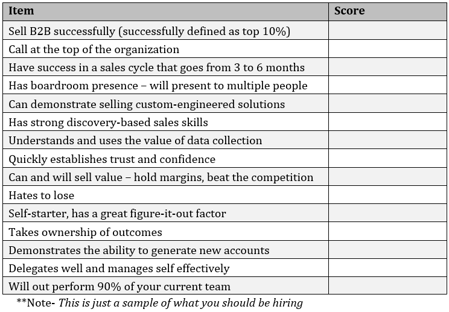
Isn’t that what you should be looking for when recruiting sales and sales management talent?  Yesterday, I wrote a post about hirebettersalespeople.com.  In the post, I mentioned the book, Who.  In that book, Geoff Smart and Randy Street suggest that you create a scorecard to help in the evaluation process.  The scorecard is supposed to be used to find that someone who has a 90% chance of doing what only the top 10 salespeople can do.  I think that is a stretch and unrealistic.

Now, to be fair to the authors, I believe they do a nice job of explaining that an “A” player for a company in New York is probably different than an “A” player for a different company in Manchester, NH.  In other words, not all “A” players need be the same nor are they created the same.  But, aside from that, I still have an issue.

If you look at many great “A” players in sales, the arts or in sports, they just didn’t show up that way.  Many have been groomed and developed over many years to become that “A” player.  The key is to look for the “A” DNA in someone.  We know what that DNA is.  (Click here to request a sample of the ideal fit candidate analysis)

What I believe makes sense is to look for someone that has a 92% chance of success at helping to contribute to the 96% of your results.  Let me explain.

You may or may not have read other articles I’ve written in the past about the 80/20 of the 80/20 and Perry Marshall’s book – The 80/20 of Sales and Marketing.  If you follow the method I’ve described (based on Marshall’s book), you arrive at the following in Figure 1:

8020-talent-chart.pngFigure 1

If you have revenue of $20,000,000 generated by 50 salespeople and then conduct the 80/20 of the 80/20, you discover that $19,200,00 of the 20,000,000 (96%) is generated by 18 of the 50 salespeople (36%).  Based on this, I believe that your best recruiting strategy is to find people that look like your top 36% or have the same DNA as that top 36% that are generating 96% of your revenue.

I’m sure the authors of Who would question the wisdom of this.  “Why…”, they might ask, “would you settle for salespeople that are less qualified than those that are at least as good as your very best?”

It’s not a matter of settling.  It’s a matter of understanding the today’s marketplace and understanding that talent has to be developed

First… the market place:

There has not been a single prospect or client that I’ve talked to in the last 5 years that has not shared with me the challenge of finding, recruiting, hiring and successfully on-boarding new talent - with the biggest challenge being the “finding.”  There are a couple of reasons for that huge challenge:

  • Most companies don’t work at it consistently and so they suck at it when it comes time to recruit.
  • There isn’t a process/system in place that utilizes filtering processes to attract the right candidates.
  • The pool of available candidates is smaller today than it was with the boomer generation.
  • Those available in the candidate pool today have a tendency to find jobs other than sales.
  • The un-steady economy has kept experienced salespeople from seeking other opportunities for fear of “last in, first out”.

Next… talent development.

As stated above, talent just doesn’t fall off of trees and, unfortunately, everyone in your market is vying for the same “A” talent.  If you cannot offer the same compensation as some of your competitors to attract and hire “the best of the best”, then you have to make great selections from the talent that is currently available.  In order to do this, you should have a very good understanding of what your talent looks like. Specifically, you should start looking at the 36% of your current talent that is generating 94% of your results and stop looking for and hiring people that look like your bottom 64%.

  • Identify the results being generated by the top 36%.
  • Identify the activities and behaviors of this top group.
  • Identify the following:
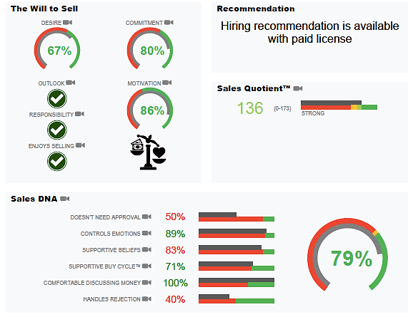
    • Will to sell
    • Sales DNA
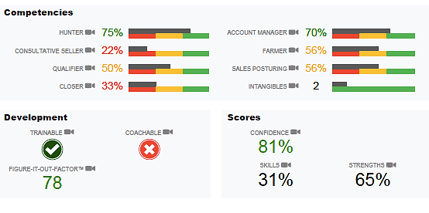
    • Figure-it-out factor
    • Trainability and coachability
  • Determine if you have the talent in the management role to:
    • Coach
    • Motivate
    • Manage performance
    • Mentor, grow and develop people

I grew up on a farm where we primarily grew peaches and blueberries.  I just visited the old homestead and, though many things have changed, one thing has not changed.  In the farm acreage, there are various plots of blueberry plants.  Some plots contain plants that are mature enough to be harvested while others have plants that are still being developed and grown to produce.  In the nursery plots, there are plants with solid DNA that are being cultivated, fed and cared for so that, at the right time, they can be productive.  The same should be done with the talent in your organization.

For further assistance, call us at 513.791.3458 and ask for Alex – our expert at hiringbettersalespeople.com. 

subscribe-to-blog.png

Topics: managing salespeople, hiring better salespeople, Geoff Smart, Randy Street, recruiting sales talent, 80/20 Principle

HireBetterSalespeople.com

Posted by Tony Cole on Tue, Oct 18, 2016

This is a blatant blog post boasting about our hiring deliverable - Hirebettersalespeople.com.  I normally don’t do this in this forum in such an obvious fashion, but I cannot help it today.  Allow me to explain…why this…why now.

I have a book on my shelf, Who, written by Geoff Smart and Randy Street.  Those two are famous in the world of hiring better talent.  Their first book, Top Grading, made the best seller list and is now in its third edition printing.  As I started to read Who, much of what I was reading was familiar and I assumed it was because I had read other materials written by the authors. Turns out that it was familiar because I had started reading that book years ago!

walnut_shell_web.jpg

Here is the premise of the book in a nutshell:  The “what” in your business is the easy part of business.  The “who” is what costs you time, money, freedom and maybe, eventually, your business if you don’t get the right “who”.  The “who” is what separates your business from every other business in your space. It’s the difference maker in your peace of mind and making the “what” actually happen.  In short:

Nothing else matters nearly as much as the “Who”.

In January of this year, 2016, we launched Hirebettersalespeople.com.  Actually, 3 years ago, I managed to capture the domain name and just kind of sat on it.  Over that time period, it seemed that every one of our clients who hired us for sales and sales management development complained about their difficulty in finding talent that would actually perform as expected when they were selected.

Sound familiar?

Based on these discussions with various associations and the on-going noise about the same issue I heard at every conference and workshop I went to, I decided to put our offering together and market it to our clients and prospects.

Hirebettersalespeople.com combines 1) our experience/expertise/knowledge about what it takes to be successful in sales and sales management, 2) Objective Management Groups #1 in the world pre-hire assessment tool and 3) Dave Kurlan’s Sales Talent Acquisition Routine. (STAR).  To learn even more about it, CLICK HERE to view our slidedoc on Hire Better Salespeople.

According to the research documented in the book, a bad hire of $100,000 can cost a firm 15x that amount in salary, training and development, lost opportunities and poor performance by others that this hire was supposed to be managing/leading.  How big is that number for you?

Stop the bleeding. Get the right people on board. Stop spending so much time on the “what” until you get the right “who” in place.  Nothing else you do in 2017 will have as much impact on finding, hiring, and coaching the right people to grow your revenue and company!

subscribe-to-blog.png

Topics: sales assessment, hiring better salespeople

How Do You Sell to a Millennial B2B Decision-Maker?

Posted by Tony Cole on Thu, Oct 13, 2016

A Guest Post by Salesloft.com

How do you sell to a millennial B2B decision-maker? Be aware of what’s important to that individual – just as you would with any client.

You’ve heard the jesting description: Millennials are narcissists, attention-seeking, spoiled clingers still living in their parents’ house, buried under a ton of student debt. They studiously avoid the business of adulting and all that it entails. They don’t stick in jobs, believing a year is plenty of service to a company. They work, gain some experience and move on.

This could lead you to believe, if you’re selling your product or service to a millennial decision-maker, that a little flattery and consistent attention combined with some numbers and a few benefit statements will make the sale for you. And if you’re not successful with the first millennial buyer, another one will be along within a year.

Those aren’t good assumptions and that’s not a good plan. Millennials are flooding the workforce.

According to the Pew Research Center, Millennials have surpassed Generation Xers as the largest generation in the U.S. labor force with 54 million individuals. In fact, this year, Millennials surpassed Baby Boomers. The Department of Labor predicts that by 2025, the workforce will grow to include 74 million millennials. As their career trajectories lengthen, they’ll move into more powerful decision-making roles and you need to be ready.

According to research done by the B2B marketing agency Sacunas, 53 percent of millennials are already involved in B2B buying decisions at their companies. Ignoring the unique priorities of millennial decision-makers is not good business.

So how do you sell to the millennial decision-maker? What prompts a millennial to make a B2B buying decision.

IT’S ALL ABOUT BEING CONNECTED

Millennials are connected. They’re the first generation to be completely wired and they’re more likely to turn to technology to do research when they are making a buying decision for their company. And they research diligently.

According to the Sacunas research, they use Facebook and YouTube to connect with humans who have engaged the services of a vendor. They look at the vendor’s social media feeds to assess customer service. They visit Glassdoor to examine company reviews to determine if the vendor is someone they want to do business with.

They ask friends and colleagues, via social media, if they would recommend a company’s product or services. They value the opinions of other people.

This makes it imperative that your company monitor its reputation on social media, swiftly address concerns and provide outstanding customer service.

VIDEO IS KING

Millennials like video content. They particularly like it if it provides relevant, informative content, such as product demos, training and news about the company or marketplace. Practical information that they see as readily applicable to their specific buying need resonates with millennial buyers. They’re gathering data for the group of decision-makers; if it’s good, they look good. If it’s video, they’re even happier.

Make it visual and valuable and you’re capturing the attention of a millennial buyer.

THEY NEED PROOF

Depending on where they are on their career trajectory, accurate data is important to the millennial buyer. They’re gathering research for a decision-making group – it’s rare for one person to be the decision-maker on a corporate buy today – so the better the data, the happier they are. It solidifies their reputation with the team as someone who does the homework necessary to make a smart decision.

If they’re buying automated revenue analysis software from you, how effective and accurate has it been in similar industries? Do you have numbers? If they’re buying an email tracking program, what kinds of data does it collect and how do they apply it to their business? If they’re looking at your customer relationship management service in the cloud, what kinds of reporting can it generate to help them identify growth channels and leads?

If you can provide that information, you’re arming the millennial buyer with the powerful tools he needs to make the recommendation you want.

THEY WANT TO SEE YOUR FACE

Relationships are important to millennials. There’s no arguing that texting and emailing are viable forms of communication, but millennials like personal contact, even if it’s a meeting by Skype or Facetime. A direct connection with a real human (which is why they turn to social media for confirmation of their thoughts) is critical at an early stage in the sales cycle.

ARE YOU A GOOD CORPORATE CITIZEN?

The Marketing Scope reports that millennials feel good about working with vendors who demonstrate a commitment to a cause, who are philanthropic, who give back to the community they serve. Millennials connect with companies that have clear environmental policies. Social, environmental and philanthropic values have a direct impact on a millennial’s decision to work with a specific vendor.

BOTTOM LINE

We know you’re going to treat every buyer with respect. Millennials may have specific triggers that are important to them, like the environment and social causes, looking professional to their bosses, demonstrating excellent levels of due diligence, so it’s important to be aware of that. But it’s just good business to do a thoughtful needs analysis and find a true and worthy solution to your buyer’s pain.

SalesLoft1clr.png


subscribe-to-blog.png

Topics: selling to millennials, selling in today's market


    textunder

    Subscribe Here


    Most Read


    Follow #ACTG


    About our Blog

    Anthony Cole Training Group has been working with financial firms for close to 30 years helping them become more effective in their markets and closing their sales opportunity gap.  ACTG has mastered the art of using science-based data and finely honed coaching strategies to help build effective sales teams.  Don’t miss our weekly sales management blog insights from our team of expert contributors.


    Recent Blogs