
ACTG Sales Management Blog

Sales & Sales Management Expertise Blog  

Onboarding: One Key to Successful Hiring

Posted by Tony Cole on Wed, Aug 10, 2016

In January, we launched Hire Better Salespeople.  It is the recruiting business solution to help companies profile, attract, screen, evaluate, hire and on –board “A” sales talent.  We specialize in financial services, banking and insurance.  There are actually three differentiators in our approach, but now I only want to talk about one of the three – Onboarding.

Here are a couple of things to recognize before we get into onboarding:thumbs-up.jpg

  1. Your current recruiting process/system today is perfectly designed for the results you are getting today and will get tomorrow.
  2. Assuming you have more than 10 salespeople, the Pareto Principle is probably alive and kicking in your organization. If you double click on the 80/20 rule, you will most likely discover that about 40% of your team is responsible for 90% of your revenue.
  3. Assuming you have 10 people and the 80/20 rule applies to your organization, you have 6 people responsible for less than 10% of your revenue.
  4. If we switch from the 80/20 principle to thinking about a traditional bell curve, you have a large segment of your production team in the fat part of the bell curve. Most likely, those people in the middle standard deviations and those on the extreme left are probably not hitting their production goals.

I have a question about the people who are not hitting goals or are not performing as you thought they would when you hired them.  Did you hire them that way or make them that way? 

If you’ve been following me for any length of time, you’ve probably read that question before.  If you’ve heard me speak or if you are part of our Sales Management Certification program, you’ve heard me ask that question.  It is a question that must be answered because the people that are on your team are your people.  I would venture to guess that you didn’t seek approval to hire someone to be average.  You probably expected them to excel.  So, what happened?

My final assumption (which I really shouldn’t do) is that you hired someone that should be successful, but something happened. Let’s assume those that are not performing were not bad hires. What happened?

Poor onboarding.

In our Hire Better Salespeople program, we “close out” each hiring project with an intensive onboarding process.  We assume that the hiring company will execute its own company onboarding process, but that normally doesn’t address some specific needs. Our system is designed to help the newly hired sales person to get up to speed quickly so that their ramp up time to success is as short as possible.  A solid “sales” onboarding program has several components. 

Here are just a few to-do items that we recommend to our clients or execute ourselves as part of the new hire onboarding.  (This list consist of items normally not covered in typical company onboarding)

  • Competitive information training
  • Company ideology, mission and vision
  • Sales training (especially when more senior salespeople are hired. There is an assumption that, because they are senior, they don’t need additional training or coaching)
  • Accountability processes that will take place
  • Review contact list
  • Joint calling schedule
  • Goals and business plan development
  • Sales and activity tracking system and process
  • Expectations for results, compliance and execution of sales tools
  • Appointment debriefing process

Adding to the onboarding list of to-dos is a list of questions that the hiring manager or sales manager must be able to answer for the new hire.  (Partial list)

  • What are all of the problems we solve?
  • Why are we better?
  • What is our brand promise?
  • How do we position ourselves in the marketplace?
  • Who are our customers?
  • How do we get to them?
  • Why will they see me?
  • What does the first call sound like?
  • What is our sales process?
  • What are the questions I should be asking?

Not only does a company have to execute these two examples, they must also address THE VERY important data acquired during the recruiting process.  That data is the information gained from initial phone contact interview, the pre-hire assessment data and the information gained about the candidate in the resume review and the interviewing process.

Recognize that no matter how good this candidate appears to be, all candidates come with some warts.  No one, I repeat, no one is perfect.  The problem with dealing with weaknesses occurs because typically the hiring manager is so thrilled with getting the position hired they just want to get the person in the chair, on the phone and in the market.  There is given little, if any, recognition that the person had some sales weaknesses, practice management challenges and/or maybe some technical problems to overcome. 

Take a look at this quick snap shot of a small portion of the information provided about a candidate that completes the OMG pre-hire assessment tool (click this link and complete registration form to receive a complementary pre-hire assessment evaluation to use on a current candidate)we use for all our recruiting:

OMG-chart.png

This particular candidate has several areas where work is needed.  Even if this candidate is determined to be hirable and a great fit for your organization, you are hiring someone that also has sales skill deficits in qualifying, presenting and closing.  You MUST have, as part of your onboarding, a sales development partner that addresses these specific areas or else the results you think you are hiring may not show up for a long time… or maybe not at all!

If you are going to spend resources - time, money and effort - recruiting top talent, then take the time to onboard them correctly. 

Here are some links to additional information and resources.

  • FREE WEBINAR - Do you need stronger salespeople to meet current selling challenges? If you answered yes, then this webinar is for you. Register NOW for our September 28, 2016 webinar, "The Magic of the OMG Sales Candidate Assessment.
  • How much are bad hires costing me?  Click this link to complete the formula
  • How well am I onboarding? Click this link to download and complete the assessment
  • I would like a copy of the Hire Better Salespeople slide document:  email Alex@hirebettersalespeople.com.  Subject line – Request Free Slidedoc


Topics: hiring salespeople, sales management, onboarding sales people, key to successful hiring, sales onboarding, hiring better salespeople

My Dad’s Pick Up Truck & Driving Sales Growth

Posted by Tony Cole on Tue, Aug 09, 2016

pickup-1.png

I’ve been working on this post for a week; for some reason, it took a little while to pull it all together. I think I was making it too complicated, so here it goes:

  • In 1971, my dad got his new pickup truck, a powder blue IH 1210.
  • Dad “pimped his ride” by installing an 8-track player with Panasonic speakers.
  • My dad was a slow driver. No matter where we were going or how far, he’d drive 45 mph even when the speed limit allowed 55. 
  • I thought it was a result of his old beater of a pickup.
  • I thought for sure he’d drive faster with his new truck.
  • Nope, he still drove 45 mph in a 55 mph zone.

I’ve been trying to connect this experience with the experience of watching sales organizations look for solutions to drive revenue growth.  Like an engine that needs three things to run, your sales organization needs three things to run.

Spark, fuel and combustion are required to start an engine and make it run. If you have those things, the engine will run.  Get all three at a grade “A” level and the engine runs really well.  If you want the vehicle that the engine is meant to move to perform at “A” level, you need something else.  You need a driver.

Not just any driver; you need a driver that has two things:  Competency and Drive.  Certainly, there are other contributing factors that determine if the driver is right for your vehicle, but basically speaking:

  • Without competency, you might go fast, but there will be lots of damage, crashes and failures.
  • Without drive, there won’t be any risk taken, no failures and, therefore, no success.
  • Without drive, then there will be a lack of coach-ability and trainability.

My point here is this:  The engine size, the transmission, the gear ratios, the tires, the steering, the paint job, the aerodynamics… none of these things really matter if you don’t have a driver or a team of drivers with competency and drive.

When you get ready to put your budget together and are considering where to invest money, time and effort in order to drive revenue growth, focus on three things:

  1. Sales Talent acquisition
  2. Sales Talent development
  3. A Crew Chief with desire, commitment and skills

CRM and other sales enablement tools are nice but, just like my dad’s new pickup, it doesn’t matter unless you want to grow and grow fast.

Hire Better Salespeople Today - Click here!

Topics: sales talent, driving sales, sales competency, running sales organizations

The 5 Why Questions Sales Prospects Ask

Posted by Mark Trinkle on Mon, Jul 25, 2016

5-why.jpg

A guest blog post by Mark Trinkle, Chief Sales Officer, Anthony Cole Training Group

Why…Why…Why…Why…Why??????

My apologies for sounding like a 3-year old wondering why they need to stop doing something, start doing something, or eat something green and not so tasty off their plate.

So, here’s the deal. Do you know who else on occasion has a serious case of the whys?  You guessed it…your prospect.  For the record, prospects are also really good at simulating the temper tantrums of a three-year old when they don’t get their way.

Specifically, according to The Bridge Group, Inc., there are 5 Why Questions that most prospects ask themselves during the sales process:

  1. Why should they listen? I mean, after all, they were not expecting your call.  They were busy doing something and probably have a million things on their to-do list so why should they take the time to even listen to you as you interrupt their day?
  2. Why should they care? Let’s assume for just a minute they decided to listen.  What is going to resonate with your message to the point that it gets your prospect to care?
  3. Why should they change? Who knows how long the prospect has been on the course they are on today?  Why do something different?  Maybe things are going ok.
  4. Why should they pick you? There are probably lots of competitive options, so what is going to cause them to select you?
  5. Why now? Is there an urgency to act now?  What is going to compel or motivate the prospect to do something now instead of later?  Remember that a lack of urgency has torpedoed its share of sales opportunities.


Like it or not, your prospect is asking themselves these five questions….perhaps consciously so they are full aware of it or maybe it is being asked at a deeper subconscious level.

Either way, you better know the answers.

I guarantee you that your prospect does.

Thanks for tuning in…now go sell like a champion today.

Topics: sales prospects, asking sales questions

Social Media & Selling - "Catch Them All"

Posted by Tony Cole on Wed, Jul 20, 2016

Guest Post By Alex Cole, Recruitment Specialist, Hire Better Salespeople

sell-poke.jpg

Unless you’ve been living under a rock, I’m sure you have all heard about the newest craze- Pokemon Go. If you haven’t, then I’m sure you’ve seen random herds of people walking around with their noses in their phones. Well, that’s because the newest and “greatest” game has graced 2016 with its presence.

Though I am not personally a proponent of the game, I have to give it credit for the impact it’s had on our community over the last week. People are getting out, getting exercise and socializing with other people, who are doing the same exact thing as them!

There are two categories of people here - those of us who sit back and chuckle at those running around trying to catch an imaginary character or those getting out and actively trying to “hunt” them down.

So, how is this relevant to you and what does it have to do with selling?

Typically, salespeople are good at one of two things- relationship building or social selling. Social selling is utilizing social media outlets to: share posts, give business updates, recruit new hires and prospect for new leads, stay connected and many other things. Those outlets include sites such as LinkedIn, Twitter, Facebook, etc.

Anthony Cole Training Group partners with Objective Management Group primarily for their highly predictive sales assessment. One of the things that their sales assessment tests for is one’s ability to utilize social selling tools. The experiment OMG conducted included the following theory:

“Those that are not good at relationship building will be better at selling socially.”

After comparing 5,000 pieces of data, they’ve concluded this: 11% of salespeople are good at social selling, 16% are good at relationship building and only 5% are good at both. That means 68% of salespeople are ineffective at both social selling and relationship building.

I would say those are pretty concerning statistics. Do your salespeople stink at building relationships? If they do, are they at least good at selling socially? Per the statistics mentioned, it would not appear that way. So, how do you fix the problem?

Well, here are 3 simple tips to help you with your team’s social selling problems:

  1. Make an ACTUAL effort - When people are unsure/frightened/nervous about doing something, they tend not to put in 100%. Change your mindset to be one that says “I can do it” as opposed to “I can maybe do it.”
  2. Set time aside just for social media - I’m on social media 3 to 4 hours per week: writing posts, recruiting for my clients or sharing articles that I find interesting and helpful. If you set time aside and put it in your calendar, you are more likely to stick to your schedule and get it done.
  3. Join groups - It is the easiest step to becoming immersed into the social selling world. Twitter, LinkedIn and Facebook all have communities and chat groups for sales professionals. Joining these types of groups can help you expand your knowledge base, promote your business and get your name out there.

So, next time you see a group of twenty-something year olds wandering around the local park or gym, know they are chasing an imaginary character, but you are chasing the real thing.

Happy hunting!

Topics: social media, pokemon go, selling and social media

The 80/20 Power Curve and Your Sales Organization

Posted by Tony Cole on Thu, Jun 16, 2016

coffeecurve.jpg

5 Things to Do to Own a Sales Team Built for Growth

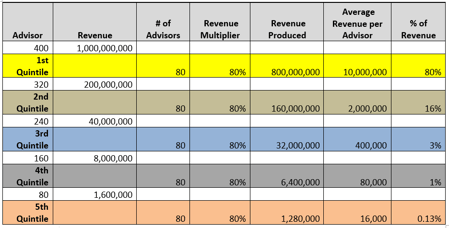
I’m working on an article discussing the 80/20 Power Curve.  It’s the concept Perry Marshall discusses in his book:  The 80/20 of Sales and Marketing.  Normally, I focus on the top part of the curve. The part of the curve that represents about 95% of all the production generated by a sales team (See Figure 1 below)

If you look at your total sales results, you would find something close to the following:

                                         Figure1

80_20_chart_for_blog_1.png

Last week, I presented to a group of CEOs at the BISA CEO Summit held at Vanderbilt University.  This slide alone raised a few eyebrows and caused some thinking about the relevance, importance and cost of the 64% of the sales team only representing 4% of the results. (32 sales people responsible for 800,000 of the 20,000,000 in revenue.)  What alarmed me was the bottom part of the 80/20 power curve.  What does the bottom look like? (See Figure 2)

                                             Figure 2

80_20_curve_for_blog_2.png

Trust my excel spreadsheet.  The numbers add up and they don’t lie.  They may not represent your team exactly, especially if your team has less than 10 sales people, BUT do the math and you will arrive at a similar finding.  Figure 2 is telling the president of the company that of the 50 sales people in his company, the bottom 20 (40%) Represent 32,000 of a 20,000,000 book of business (.0016%).

Regardless of how you dissect it, spin it, negotiate it or defend it, this cannot be what you expected when you hired these 20 people.

So, what do you do? Here are the 5 THINGS:

  1. Start with your sales manager. This is the person responsible for sales, productivity, and sales effectiveness. If ROI is one of the metrics you use to determine success, how would you evaluate the ROI on the bottom 20% of the sales team?
  2. Next, I would look at the recruiting practices. As difficult as this might be, you have to answer the question about under performers – Did you hire them this way?
  3. You will also want to look at the on-boarding and the development plan in place that should be there to improve the probability of success. As above, you have to answer the question – Did you make them this way?  If you didn’t hire them this way – already failures – then you’ve made them this way – turned them into failures.

* I anticipate you might say – “I didn’t hire them, I inherited the team.”  Like it or not, after a year, they are yours!

  1. Look at your systems and processes to make sure they are designed, implemented and executed to support successful sales growth.
  2. Look at your sales system and evaluate how well it is being executed top to bottom. My guess is that your best people execute a sales process and they execute it consistently.

Additional resources:

Hirebettersalespeople.com

Perry Marshal – 80/20 Power Curve

Sales Management Certification Program

Topics: sales management, managing sales teams


    textunder

    Subscribe Here


    Most Read


    Follow #ACTG


    About our Blog

    Anthony Cole Training Group has been working with financial firms for close to 30 years helping them become more effective in their markets and closing their sales opportunity gap.  ACTG has mastered the art of using science-based data and finely honed coaching strategies to help build effective sales teams.  Don’t miss our weekly sales management blog insights from our team of expert contributors.


    Recent Blogs