ACTG Sales Management Blog

Sales & Sales Management Expertise Blog  

Is it Selling or Giving?

Posted by Jeni Wehrmeyer on Thu, Aug 04, 2022

We work with many community banks and while the commercial side of the bank usually has some “sales chops”, we often hear from leadership that retail bankers are less comfortable with “selling.” Or they may even avoid that word altogether. We like how the book Go-Givers Sell More positions the process of selling:

  • Your influence is determined by how abundantly you place other people's interests first.
  • The most valuable gift you have to offer is yourself.
  • The key to effective giving is to stay open to receiving.


Retail bankers have an incredible opportunity. They are the front door to the entire bank and even more importantly, they are the key to financial wellness for their clients. So, what happens when your current banking client comes into the branch?  Do your frontline bankers feel influential, authentic and receptive? Creating giving relationships is the core of what is most needed and is what your bankers must develop. To gain more confidence in sales they must ask the pertinent questions, like “How does this savings account contribute to your overall retirement plan?” Selling IS all about the client and how the bank can help them. We have found that when we focus on that aspect of a frontline banker’s role, they are more receptive. Understanding selling is understanding humanity and how people work.

Here are some specific areas that you can focus on when you are coaching your retail bankers that will help them to gain more confidence in sales:

  • Help them to stay in the moment – they should not be thinking about what products they can sell.  They need to listen and probe with good, interested questions.
  • When they find an area of concern, they should uncover compelling reasons to buy – ask a question like “Why is this home equity loan important to you?”  And…
  • They must really listen to the answer and ask more questions about that issue so they have more information and understanding.
  • This approach will build trust – the client’s needs are front and center and it is clear the banker wants to help them.
  • In order to help, the banker must be able to ask tough questions and that is where courage comes in. If their end goal is always to help the client, asking a question like “Do you have other deposit accounts elsewhere that we could help you with?” should not be that hard.  But it may take practice!
  • Good bankers take nothing for granted – meaning they always seek clarity and that means getting your client to talk, not you and…
  • They must have an appropriate amount of patience. Again, if the banker’s focus is on giving and helping, they should not need to push! It is more important that through their questions and discussion, the client comes to their own decision on their actions.
  • All of these actions, lead to developing strong relationships. And what retail bank does not want more of those!

A final thought on gaining confidence in sales - In life, in banking and in sales, it is always wise to have a healthy skepticism.  It may not work out that this client will take action, so it’s OK if they do not. If your banker has done their best to help and understand the client’s needs (and not push product), then they can move onto the next opportunity. They should continue to give, which is the essence of selling!

Learn More About Our  Bank Sales Training Approach

Topics: achieving sales success, confidence in sales, gaining more confidence in sales

What are Soft Skills in Sales?

Posted by Jeni Wehrmeyer on Thu, Jul 28, 2022

It would be great if you could hand a new salesperson a manual, ask them to read it, take a knowledge test and they could successfully begin their job. Selling is a different animal and you will often hear the term “soft skills” in reference to training a salesperson. What are soft skills in sales? Let’s try to demonstrate that with a short example.

Salesperson walks into prospect's office (or enters Zoom room), they greet each other and salesperson says:

“Thanks for seeing me. I know we have many solutions that could help your business.” or

“What could we accomplish today that would make this a great meeting for you?”

Which of these approaches demonstrates a more skilled approach to a sales conversation? We certainly hope that you chose the second. That is just one example, but a salesperson’s ability to deftly open a meeting, ask enough, great questions and really listen are examples of what soft skills are needed in sales.

Since the most important soft skill for us to learn in selling is how to master our ability to ask not just questions but masterful questions, let’s explore that a bit. 

  • How do we get information from other people? We ask questions, right? 
  • When you ask a question, what kind of question do you ask? Are they technical in nature or for gathering data? 
  • Do your questions really probe and make people think?
  • Are your questions focused on the prospect’s core business issues or problems or are they about your products?
  • Do your questions sometimes make the prospect uncomfortable and do they bring out the real issues?

What about after you ask those questions?  How well do you listen?  I mean, really listen.  How often can you repeat what someone is saying to you?  How often do you take a key word in their answer and use that to phrase your next question or questions? Typically, there are two things going on in most sales conversations.  Salespeople are hearing and not listening.  Secondly, if they are listening, they are listening to themselves instead of their prospect. 

Try this the next time you are in a conversation with someone and you ask them a question.  Really focus on listening. Identify who you are listening to.  Are you making internal statements or creating internal thoughts about their answer?  If you are, then you are listening to yourself.

The Soft Skills of Selling - Asking Questions

It is a universal truth that often in a selling situation; salespeople will not ask the question because they do not want to disqualify a prospect.  Be truthful, hasn’t this happened to you?  The best part about mastering the soft skills of asking questions is that you will become more courageous as you get more comfortable ‘drilling down’ with your conversation.  This will not only help you become better at qualifying your prospects, it will help you clean the deadwood out of your sales pipeline. And that gives you more time for prospecting, the number one job for all salespeople.


Need More  Sales Management Training?

Topics: selling skills, sales skill, soft skills in sales

Will the C-Suite See You?

Posted by Mark Trinkle on Thu, Jul 21, 2022

While there are many differences between elite salespeople and average salespeople, two of the more important distinctions are the ability to sell value (they can sell at a slight premium on price) and the ability to reach the top levels of the prospect’s decision-making team (typically the C-Suite).

It is the second of those two distinctions that serves as the title and the focus of this blog.  Average salespeople are quite comfortable and successful seeing the non C-suite members of the decision-making team.  Why are salespeople so comfortable with these people?  The answer is quite simple – because these people are easy to see.  They offer very little resistance.  So here is a general rule of thumb:  the easier the person is to get in front of, the less likely they will play a significant role in making the ultimate decision. To quote Eleanor Roosevelt, “never let anyone tell you no unless they also have the power to tell you yes.”

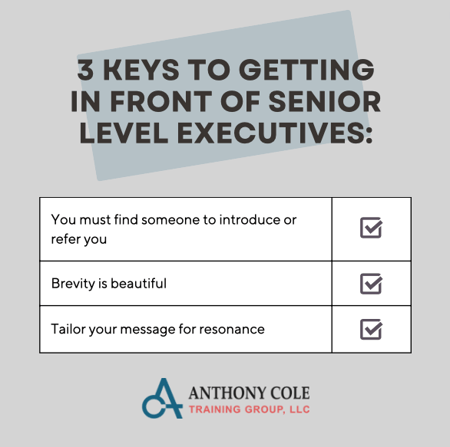
Here are 3 keys to getting in front of senior level executives:

  1. You must find someone to introduce or refer you. Recent studies have revealed that 80% of senior executives when surveyed have responded that they are extremely unlikely to meet with you or return your call or reply to your email if they don’t know you and your firm.  Cold calling, while for the most part is never effective is even worse when you are calling the top level of the organization.
  2. Brevity is beautiful. As Thomas Jefferson once said, “the most valuable of all talents is never using two words when one will do.”  C-Suite executives have the attention span of an 8-year-old in front of a broken-down ice cream truck on a hot summer day.  Keep it simple.  Keep it short.
  3. Tailor your message for resonance. Are you talking about issues that matter to senior executives?  Are you speaking their love language (talking about problems and solutions)?  If not, you are easy to ignore.

Happy selling.  I need to go.  I think I hear the ice cream truck heading by our office.

Screen Shot 2022-07-21 at 3.49.19 PM

Topics: sales succes, sale skills, decisions

10 Tips to Building Confidence in Sales

Posted by Jeni Wehrmeyer on Thu, Jul 14, 2022

Selling is a “slight edge business.” By that, we mean that the line that separates high performers from mediocre performers is usually a very small difference.

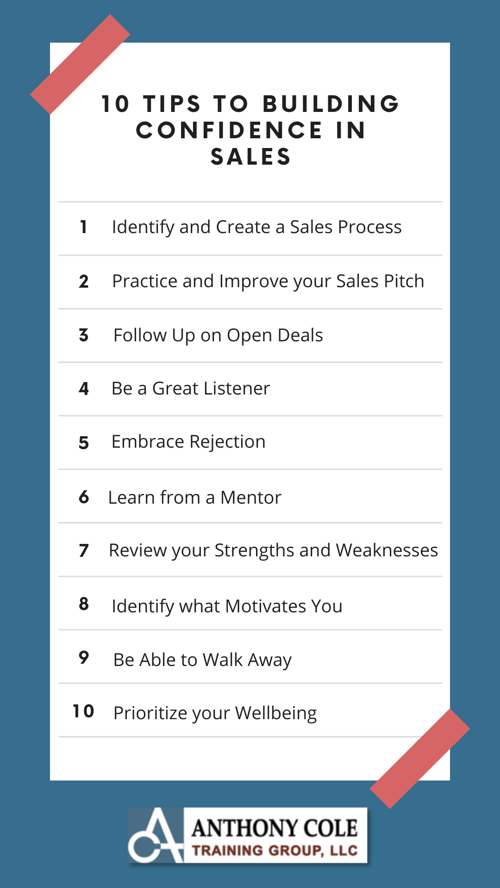
There is very little you can control in selling. You can’t make prospects take your call.  You can’t make prospects agree to meet with you. You can’t make them move forward in your sales process and you certainly can’t make them buy from you. However, there is a multitude of things you are in control of and mastery of these 10 tips will give you greater confidence in sales.

How to Build Confidence in Sales

  1. Identify and Create a Sales Process
  2. Practice and Improve your Sales Pitch
  3. Follow Up on Open Deals
  4. Be a Great Listener
  5. Embrace Rejection
  6. Learn from a Mentor
  7. Review your Strengths and Weaknesses
  8. Identify what Motivates You
  9. Be Able to Walk Away
  10. Prioritize your Wellbeing


  1. Identify and Create a Sales Process

First and foremost, you’ll need a repeatable sales process that you and your sales team can implement. Based in the #1 sales evaluation, “elite” salespeople utilize a consistent, stage-based selling system. Having a sales process keeps salespeople on track on the stages a buyer goes through on the path to a decision and will help to remove any inefficiencies from the sales cycle. Just by implementing a great sales process alone, salespeople can see better results in a short period of time. 

  1. Practice and Improve your Sales Pitch

Much like your sales process, sales reps need to hone, craft, and practice their perfect sales pitch. You can start creating a better sales pitch by doing more research on your prospects, always put yourself in their shoes and ask through their lens “what’s in it for me?”. As a salesperson, you must invoke confidence. You can do this by practicing and perfecting your sales pitch. We call this your Unique Selling Approach and when you share it, your prospect should react with “That’s me” or “How do you do that?” Practice this so that your USA is natural and conversational to build your confidence in selling. 

  1. Follow Up on Open Deals

A good sales rep follows up on open deals.  It’s great to get the word out, but as a salesperson, you will have more success following up on your existing prospects. It’s estimated that nearly half of salespeople never follow up on a prospect, and only 10% follow up three times or more. In fact, it’s estimated that 80% of all closed deals occur between the 5th and 12th outreach.

Following up also shows the prospect that you’re organized and considerate to reach out again.  Most people will appreciate your follow up, and just by reminding them of your previous conversation, you can be more top-of-mind amongst your prospects, and build credibility.

  1. Be a Great Listener

Having an open dialogue is critical in nurturing your prospects and giving them a voice.  Make sure you’re really listening to what they’re saying as it can help you close more deals. By listening to better understand your prospects, you can better identify what your prospect wants, how they want it, and why. Listening to understand takes concentration and the ability to not get distracted by what you can offer as a solution. Only by understanding what your prospect wants and needs from you, will you build confidence in sales that will allow you to better align your sales pitch to meet and exceed their expectations. 

  1. Embrace Rejection

In sales, you will always be met with rejection.  Accepting this fact, and learning from your no’s is key in becoming a better salesperson. A better way of dealing with rejection is by better uncovering why the prospect did not buy from you.  This will help you build confidence and improve your sales process with better prospect information.

Elite salespeople are quick to get back on track and have robust sales pipelines. Rejection in sales is just part of the job that helps them move on to the next opportunity.

  1. Learn from a Mentor

Learning from a mentor is one of the best ways to build confidence in sales and become a better salesperson. Having someone who can show you the ropes and provide constructive feedback, can drastically improve your sales abilities. If your company is looking for professional sales training, guidance, and leadership, check out our sales growth coaching program

  1. Review your Strengths and Weaknesses

All great salesperson take time to evaluate their strengths and their weaknesses and focus on leveraging their strengths, while working on strengthening their weaknesses. Purposely identifying areas where you seem to excel in prospecting, communicating with prospects, or closing deals, can help you increase more of those desired actions. Sales evaluations can provide salespeople insight in areas they may not recognize, to help build confidence in your selling approach. And by identifying your weaknesses, you can improve upon your weakness or work around it. Successful and confident salespeople are continual learners that intentionally gather information about their own strengths and weaknesses.

  1. Identify what Motivates You

We all have motives behind everything that we do.  Identifying what motivates you can be one of the best things you can do to become a better salesperson. Are you motivated to become a better version of yourself?  Do you seek praise and want your work to be recognized?  Are you trying to achieve the lifestyle of your dreams? By recognizing what motivates you, you can start to put into play an action plan that gets you to your goals. This can be all the motivation to become a better salesperson and close more deals.

  1. Be Able to Walk Away

Earlier we mentioned the importance of following up.  But it’s also important to know when to fold the cards and walk away. If you’re reaching into double-digit attempts in outreach to a prospect, or they have seemed very standoffish, it might be in your best interest to recognize the situation and walk away. This can be hard to do the further you are down the sales pipeline, but you must be able to let go of a prospect and move on to your next opportunity. If a prospect is not returning your emails or phone calls, your time is better spent on new leads.

  1. Prioritize your Wellbeing

You have to prioritize your work/life balance and mental health. You’re no good to your company or your prospect’s time if you have too much going on, are burnt out, and distracted. The world of sales can seem like it’s always moving and moving quickly, which can be stressful.  Taking frequent breaks, getting fresh air, taking time off, and prioritizing a personal life can help counter balance the stress of your job and prevent burnout. In order to be relaxed and confident in selling, you must be healthy of mind and body!

 In Summary

Selling is not going to suddenly become easier.  Leads are not likely to become more plentiful. So, the question that is worth asking is this:  What will you do to create your slight edge in selling? What are the little things that when done week in and week out will amount to great progress in terms of your production? Try out one or all of these 10 tips for building confidence in selling and let us know how they work for you.

 

Confidence in Sales


Topics: sales techniques, confidence in sales

How to Deal with Rejection in Sales

Posted by Jack Kasel on Thu, Jul 07, 2022

Back in the early seventies there was a group called The Main Ingredient. At the time, they had a hit song and the lyrics went something like this… “ So you’re heart broken, you’re sitting around moping, crying and crying. You even feel like dyin’. Well, before you do something rash, dig this- everybody plays the fool!”

In our world of selling, maybe everybody doesn't play the fool, but we know this, dealing with rejection in sales is part of the job. Everybody gets rejected. So, the question is when that happens, what happens? Does it take you two minutes, two hours, two days, two weeks to recover, or are you able to get right back into the fight? When we find people have a hard time recovering from rejection, it’s probably one of two reasons. Number one: they're way too emotionally involved in this sale. “If I don't get this sale, I'm in trouble. If I do get this sale, my year is made!”

And the second reason is people don't have the pipeline that they should have. It's not as robust and filled with other good prospects as it could be. So, when those two things happen, maybe we take the rejection a little harder than we should.

Here's a formula that I believe you can use that'll help you get past your fear and help you deal with rejection. The formula is simply this; SW3 N. And that stands for this…

Some will. Some won't. So what. Next!

Keep that mantra chanting in your head! Some of the salespeople I work with even write it down on their desk and refer to it as they’re saying goodbye to one prospect and trying to find their next opportunity. Somebody needs what you do, go find them. And when you do, don't fear rejection.  Remember SW3 N.White and Blue Did You Know Interesting Fact Instagram Post

Topics: rejection, overcoming rejection, handles rejection


    textunder

    Subscribe Here


    Most Read


    Follow #ACTG


    About our Blog

    Anthony Cole Training Group has been working with financial firms for close to 30 years helping them become more effective in their markets and closing their sales opportunity gap.  ACTG has mastered the art of using science-based data and finely honed coaching strategies to help build effective sales teams.  Don’t miss our weekly sales management blog insights from our team of expert contributors.


    Recent Blogs