ACTG Sales Management Blog

Sales & Sales Management Expertise Blog  

Guests, Fish and Job Candidates

Posted by Chuck Smith on Mon, Jun 26, 2017

As the owner of Hire Better Salespeople, one thing I hear consistently from my clients in regards to hiring is “I’m tired of looking through the same set of resumes over and over again.” If you have had the same thought, trust me, you’re not alone. Resume sites are flooded daily with recycled candidates. So, how do you go about finding the new, fresh candidates out in the market place? This week, our guest blogger and one of HBSP partner’s, Chuck Smith, President of NewHire, explains why fresh is best and how to eliminate the rest.-- Tony Cole

I thought it was my mother-in-law, but it turns out to be Benjamin Franklin who said, “Guests, like fish, begin to smell after three days.” If you’ve had house guests who’ve overstayed their welcome, I know you will relate. But did you know that the same rule, more or less, applies to candidates for work?

How so?

When we are recruiting to fill an open position, our primary goal is always to find the right person for the job. In fact, we often mean “the right person for the job, RIGHT NOW!” It’s not so helpful if that right person were to be available six months before or six months after.

This is why so many people get frustrated searching for resumes online using LinkedIn, Indeed and Careerbuilder. These sites and others have built businesses based on the idea of aggregating candidate resumes. The sites claim that the ability to search 20, 30 or 100 million resumes is a benefit. I call it a bug. We shouldn’t care about everyone who ever placed a matching keyword on their resume.

We should only care about the actual people interested in our actual job right now. This is what makes the NewHire™ system of recruiting so powerful. Rather than asking you to spend your valuable, limited time going from site to site (at great expense for access) searching for matching candidates among millions and millions of non-matching candidates, NewHire™ brings the candidates to you. Small databases of candidates who have expressed interest in your job. These candidates are prescreened, pre-qualified candidates who have already answered many of the key questions you have for them.

NewHire was invented to help employers recruit and screen candidates for very specific, time-bound open positions. Stop searching resumes and start getting matching candidates with Hire Better Salespeople and NewHire.

Sourcing great, qualified candidates is only a piece of the very complicated puzzle. At Hire Better Salespeople, we work with our clients to: learn the intimate details of the position, build a compelling job attraction post, call on active as well as passive job seekers, assess applicants based on the specific job criteria, disqualify and vet candidates, provide initial interviewing support and administer onboarding and coaching for your new hire. Visit our site TODAY to learn more! 

DOWNLOAD FREE eBook -  How to Hire Advisors Who Will Sell More

Topics: New hires, hire better salespeople, aquire sales candidates

Busting 5 Myths (Secrets) of Successful Selling

Posted by Tony Cole on Mon, Jun 05, 2017

Ok, let’s start here - there are no secrets!  The Internet and the digital world have pretty much eliminated ignorance and secrets to success in sales... and about how to do almost anything else.  All you need is a mobile device (could even be a watch) with access to the internet and you can find just about anything you want to know.

car-duct-tape.png

Myth Busters used to be one of my favorite shows.  I searched google to find the Discovery Channel episode about lifting a car with duck tape. Here is the link (but, unfortunately, you won’t get the complete show).

With facts and strategies being so readily available, why do most salespeople (about 80%) still struggle to be successful? A lot of it has to do with beliefs and myths. What about you? Do you accept any outdated myths as facts? Since I short-changed you a little on the video, I will share a list of some other common myths:

  1. People only use 10% of their brains
  2. There is a dark side of the moon – Pink Floyd led us astray (Here you go, rockers!)
  3. Behavior is affected by the full moon
  4. Sugar makes children hyperactive
  5. Lightning never strikes the same place twice

THE BEST METHOD - GET TO THE ROOT OF THE PROBLEM

As many of you know, Anthony Cole Training Group has specialized in providing specialized sales growth solutions for banking, investment advisory and insurance.  Primarily, those growth solutions include:

  1. Hiring better salespeople
  2. Executing an effective sales process
  3. Sales Management certification

During our years of developing and delivering content to hundreds of sales organizations, we have used the #1 sales assessment tool on the planet.  Not only is the accuracy of the sales inventory assessment tool unbelievable, but the Sales Effectiveness and Impact Analysis has been game changer for every one of the clients in our niche:

“The Sales Person Skills Assessment Tool has enabled us to discover some interesting information about our sales process, current sales capabilities as well as potential opportunities for growth and improvement in sales competencies. This assessment tool has also changed how we go about hiring for our sales force.”

President & CEO
F&M Trust

One of the most interesting segments revealed in the assessments is about personal beliefs.  Each of us has personal beliefs that dictates our behaviors and thus determines our outcomes.  This holds true for all areas - sales, sales management and sales leadership.  Whether aware or not, we all have beliefs about what we do that impacts our opportunity for success. 

5 MYTHS MOST SALESPEOPLE ACTUALLY BELIEVE

Here are the beliefs that many salespeople hold near and dear to their hearts that simply are not true:

  1. People buy from people they like – Now, you may have purchased something from someone that you liked, but the “liking” didn’t drive your decision. What drove your decision was your confidence and trust in the person, the product and the company behind the product.
  2. People make buying decisions based on price – Staying with you and your purchasing habits for a second, let’s talk automobiles. According to autobyel.com, the cheapest car available today is the Hyundai Accent SE with a MSRP $15,580.00.  If you own one, then you are a rare breed.  The volume of sales of this vehicle in 2016 was only .38% of all vehicles sold in the U.S.  If people simply bought on lowest price, this would not be the case.
  3. Closing skills are the most important – This might be surprising to you, but in the last three studies I personally conducted in the banking segment, the top 33% of bankers, wealth managers and private bankers severely lack closing skills still led their teams in sales.
  4. The customer is always right – Actually, the customer is rarely They are more right today than they USED to be when it comes to product knowledge, availability, options and pricing as a result of information available on the Internet; but to assume they are right about everything is just SO wrong. However, this in and of itself is not the problem. The problem is this: if salespeople believe this, then they will never be gutsy enough to execute the challenger sale, the value-based selling system, the SPIN System or our Effective Selling System.
  5. Prospects are honest – 95% of respondents in all of our studies believe prospects are honest. That is… until we conduct our first meeting with our clients and go through the process that buyers to go through when executing their buying process. g.  If a prospect was completely honest, they would tell the insurance agent who just cold-called them that they just got a renewal that they think is too high and they want some competitive bids to keep the incumbent honest.  We all know that doesn’t happen!

TRAINING ALONE DOES NOT GET LASTING RESULTS

Time and again, companies spend money on sales training to introduce them to a new…

  • sales language
  • sales approach
  • prospecting method
  • time management process
  • cross-selling strategy

What happens is that the company spends a lot of time, money and effort and yet, at the end of the event or training, they cannot point to any discernable difference in outcomes.  Behaviors stay the same, problems that existed before are still there, effort changes for a while but soon returns to pre-training levels and salespeople still blame the economy, the company or the competition for lack of success.

Top people still are performing at the top, people in the middle of your sales bell curve are still “at leasters” and your bottom 20% are not performing any better than the bottom 20% you had the year before.  Why?  Because the root problems associated with beliefs were never addressed.

I grew up on a farm.  I know about planting things and making them grow, and if it’s a fruit tree or bush (blueberries), I know that there is a time to harvest.  What I also know is that you can buy the best plants and trees in the world, but if you don’t take care of the root system with good soil, fertilizer and water, they will not produce.

GIVE ME A CALL - I WILL HELP

For more about growing blueberries, peaches and salespeople, call me! This is your call to action to get more productivity out of yourself or your sales team, so call me NOW at 513.791.3458.

Additional Resources

  • # 1 Sales Assessment in the world
  • Identify Your Systems and Processes – The Sales Effectiveness and Impact Analysis Sample (SEIA)
  • How do my salespeople compare to industry standards – Get 3 people on your team (the best three that do the right things, have the right fit and blow out their numbers consistently) to take the sales skills inventory assessment and compare. Be prepared to take a call from us, discuss the results and answer the question: Do you want our help?

 Get a 14-DAY FREE TRIAL of ACTG's Online Sales Learning Center

Topics: close more sales, managing salespeople, assessing sales talent, getting consistent sales performance

What is Your Sales Team's Motivation?

Posted by Tony Cole on Fri, May 19, 2017

QUESTIONS THAT COMPANIES NEED TO ANSWER

As many of you know, we use the Objective Management Group's (OMG) assessment to evaluate every organization that we do sales and sales management training, coaching and consulting for.  The process helps us (and helps our clients) determine with great accuracy the answers to these 4 questions:       

  1. Can we be more effective (sell more, more quickly at better margins)?
  2. How much more effective could we be?
  3. What would it take?
  4. How long would it take?

Answering these four questions requires the ability to uncover at least two important contributors to improved effectiveness:

  1. Their “will” to improve in selling and sales management
  2. Their ability (sales and sales management DNA)

6 FACTORS THAT DETERMINE THE WILL TO SELL

There are 6 known contributing factors that OMG uses to determine “will to sell”  (click here for a review of the OMG pre-hire assessment tool).

  1. Desire to succeed in selling
  2. Commitment to succeed in selling
  3. Motivation
  4. Outlook
  5. Responsibility
  6. Enjoyment of selling

A CONSISTENTLY RECURRING QUESTION

I don't believe there is a way to effectively rank those factors in terms of relevant importance.  Having used the tool and delivered results to dozens of companies and hundreds of people, my experience is that these 6 work together to form a puzzle that gives you an overall picture of someone’s “will to sell”.  In this article, however, I want to focus on motivation because, over and over again, when attending my workshops, attendees consistently the question, “How do I motivate or keep my people motivated?”

FINDING INSPIRATION

I was getting ready to work out at my club the other day and, when walking to the men’s locker room, I stopped and looked at this sign.  Now, I’ve seen this sign literally hundreds of times and have read it dozens of times. I have always found it interesting and a bit inspiring. 

i-am-pic.png

I can imagine being a young tennis player who has big dreams of playing tennis on a large stage someday.  And that young person might take a photo of this poster and put it on their phone, locker room, door or wall at home.  They might even post it to social media – Facebook. Twitter, Instagram or Snapchat.

It all depends on that person’s motivation.

This person could be driven by pride, satisfaction, mastery, achievement, competition, enjoyment or recognition.  They could even be motivated by the love of winning or that hate of losing. They might just be trying to prove the naysayers wrong!

ARE YOU MOTIVATED?

What motivates you?  If you are a manager, what is motivating your people?  If you are not motivated to:

  • Be more effective
  • Be more successful
  • Compete to be the best
  • Sell more to make your lifestyle dreams a reality
  • Make sure your children receive an education without the debt

I have to ask: Why?


ALL ENCOMPASSING - MOTIVATION INVOLVES EVERYTHING

Let me address two things:

  • Personal motivation
  • Motivation of others

My experience – my own true, personal experience - about motivation is that when you desire something greatly in your heart, then you will live and breath the desire to make the dream a reality.  Many of you know I played football at UConn.  I always considered myself blessed beyond reason to have had the opportunity to make my dream a reality.  But blessed does not stand alone as the only contributing factor for the scholarship.  Yes, I had some God-given talents (nature), but I also had some external factors (nurture) that contributed to my success.  Those factors were Mom and Dad and the attitudes they instilled in me regarding hard work, anything is possible, don’t give up, success requires commitment.  I learned early on that, if you really want to accomplish something great in your life, you must be willing to give up some things to get where you want to go.

  • When my classmates were going to Lee’s house to party after a game, I did not.
  • I hated vegetables, but my dad told me he would tell Coach Cacia I wasn’t eating right – I wasn’t going to let that happen.
  • At the end of a long day – 12 hours – working on the farm, I still ran my miles and lifted weights.
  • When I got beat on a certain play during practice, I would make that person pay the price on the next play.
  • I ran sprints every day at the end of practice.
  • I played hurt.
  • I studied and got the grades needed to get into college.
  • I did all of those things for 13 years.

MY STARTLING WAKE-UP CALL

On the other side of that coin are the years between 1998 and 2003.  Those 5 years are lost to me because of the event of our son's (Anthony) cardiac arrest and subsequent severe brain injury.  I could think of nothing but his full recovery to health.  Nothing else mattered and it showed up in the shrinking of our business.  One day, Linda walked into the office and said, “We need to talk.”  I thought it had something to do with Anthony.  Instead, she asked, “Are you ever going to start working again?”

Man, did that piss me off!

But, I started to work again because I had new motivation.  And that is my point.  I believe most people go through stages of motivation.  The stages probably look like the side view of a roller coaster – lots of ups and downs.  If you find yourself in the down, don’t assume that you will go back up.  You may be at the end of the ride.  If you are there, you need to find new and different reasons to get back in the seat and ride to the top.

THE REAL DEAL – MOTIVATION IS PERSONAL

When I answer the question - How do I motivate my people? - for workshop attendees, I tell them, “You cannot motivate them.  Motivation is an inside-out job and they have to come to the table with their own motivation.  The best you can do is create an environment where people want to come and they want to be motivated and excited because they have personal reasons to be successful.”

I remember having a discussion with Tom. Tom was a COO of a large insurance holding company and we were talking about his next day’s presentation to the troops.  He told me about his agenda and the key points in the speech.  One of the topics was shareholder value.  When he finished, I asked permission to ask a question and then make a comment.  “Permission granted,” Tom said.

I asked, “How many people in the audience are shareholders?” One, he said.

I then said, “Tom, with all due respect, those people don’t give a rat’s #@%  about shareholder value. What they care about is having enough money to retire, pay for a wedding, have the dream vacation, pay for college, and eliminate debt.  Talk to them about how the company will support their efforts to make those things happen and then you will have an audience who will listen and respond.”

THESE 3 FAILS = NO MOTIVATION

The problem, in many cases, is that the sales executive in charge of getting more out of the sales team has no idea what motivates those people on the team.  Without knowing that, how could you possibly create a motivated environment?

While assessing numerous organizations, we have found three things that hinder the motivation and success of the sales team: 1) 90% of the sales managers don’t believe they need to know what motivates their sales people.  2) 25% of the sales managers are not motivated to be successful in the role of sales manager and 3) Virtually 100% of the salespeople lack personal goals, lack a personal goal plan and fail to have a process in place to track if they are achieving goals.

How could you possibly have a motivated sales team?

ADDITIONAL RESOURCES AVAILABLE:

Motivation Quotes in Unlikely Places – Dave Kurlan

Pavarotti and Motivation – Music and Self Motivation

Robert De Niro Inspiring Speech at NYU School for The Arts - Youtube

Motivation – What Would You Attempt If You Knew You Couldn’t Fail?

DOWNLOAD FREE eBook -  How to Hire Advisors Who Will Sell More


Topics: developing sales talent, Motivational, getting consistent sales performance, predictable sales growth

Fixing a Broken Sales Environment with 3 Essential Sales Tools

Posted by Tony Cole on Fri, May 12, 2017

The 3 Es

work on1.png

THE 3 ESSENTIAL SALES TOOLS

  1. Speed to failure
  2. Conversation is still king (the person with the best conversation wins)
  3. Technology that supports SELLING – NOT finance

Before I get to the 3 essential sales tools, consider for a moment all the systems and processes you have in your organization:

  • IT
  • Communication
  • Marketing
  • Finance
  • Physical plant
  • Hiring
  • Technical training
  • Underwriting
  • Risk management
  • Sales
  • Customer service

(Also watch this video – it is worth every minute of your invested time).   

ARE YOU OK WITH ONLY A PARTIAL SOLUTION?

I know the list above isn’t a complete list, but let’s pretend for a minute that you just invested $500,000 in new technology.  It could be a website enhancement, new finance applications to improve billing and financial projections, improved communication equipment or a sales CRM.

Let’s pretend that the investment was for finance.  Your expectations are to “tighten up” the reporting on payables, receivables, compensation reports, taxes and forecasting.  The company you bought the service from told you that it would probably take about 90 days to work any bugs out, but certainly, by year end, your expectations would be met.  You meet with your CFO and ask, “How’s it going?”  She responds, “Pretty good!”  You then inquire, “Pretty good means?”  She replies:

  • Our payable reports are about 66% correct, but trending the right direction.
  • Our overdue receivables still average 45 days, but we’re making progress.
  • Our compensation expenses are off by about 5% and we’re not sure why, but we’re working on it.
  • Taxes? Well, my best guess is that we are going to owe between 10% and 20% more than last year.
  • As far as forecasting revenue, well…our pipeline shows $5,000,000 to be closed in the next 6 months, but we’re not confident that the number is accurate.

How do you feel about your investment?  What is your reaction to a complete lack of success at meeting expectations?  Whose head is on the block as a result of this?  How long would you tolerate the continuance of this failure?  I’m not sure you’d fire your CFO, CTO, President, HR or your consultant, but I’m pretty sure you wouldn’t say, “Okay, let’s give it another 30 days.”

WHAT NOBODY TALKS ABOUT

I know I created a bit of a stretch scenario, but the point I want to make is that you probably get a report like this about your sales team; you just don’t know it.  What isn’t revealed in a sales meeting or in your monthly meeting with your sales manager is the detail behind the big numbers you talk about.  You talk about year over year results, you talk about sales YTD against plan, you might even talk about how you are doing against other sales divisions or peers in your industry.  What you don’t talk about is this:

  • Over 90% of your results are probably coming from 36% of your sales team. (LinkedIn article on the 80/20 of the 80/20).
  • What doesn’t get reported that would make you jump out a window is that the bottom 36% of your sales team is probably responsible for less than 4% of your total sales.
  • What the sales manager doesn't tell you is that - of the last 4 hires - only 1 of them is doing better than the people that were replaced with the new hires.
  • What you won’t talk about - but need to talk about - is the cost of putting the other 3 in the market for 12 months and then the cost of replacing them with 3 more that won’t make it either. (By the way, over a 5-year period, that is a 2 comma problem).
  • What is also probably not part of the discussion is that, if you really wanted to drive profit, you could probably eliminate the bottom 36% and increase profitability significantly.
  • You probably won’t have a discussion about how some of your more senior people are not performing nearly as well as some of your new people.

 WHAT MATTERS MOST

The challenge to organizations (and what matters most) is the answer to the question:  Are we hitting our numbers?  As long as that answer is yes, you’re okay.  BUT, if you are unwilling to accept 90% correct in your tax estimate or compensation projections… or 90% of the calls getting through or 75% of the customers being happy… or your website being operational 66% of the time, why are you settling for anything less than 100% execution from your entire sales team?

What I know and what I’ve stated before:

  • You don’t intentionally hire sales people to fail; so, if they do…
  • You either hired them that way or…
  • You made them that way

HOW TO FIX A BROKEN SALES ENVIRONMENT

What does this have to do with the 3 Essential Sales Tools?  Maybe not everything, but these 3 tools have a lot to do with fixing a broken sales environment.

  • Speed to failure – With your new hires, do your best to find out quickly if both of you made the right decision. Make sure that, as you are making the offer, you let them know all the crap they are going to have to go through, what they will be managed to and what is exactly expected in the first 90 days and the following 6 months.  Let them know that the hire is going to be probationary and that you have a 3 Strike Rule.  (Call me at 513.226.3913 about the 3 Strike Rule).
  • Conversation is KING – Despite all the technology that is available to help your salespeople create opportunities, nothing yet has replaced the value of quality conversations. This means you need to have a very high standard for training, practice and preparation before you put people out into the market.
  • The technology that you buy to support sales has to support sales not finance. Finance should find its way to use the appropriate sales tool to get the information they need not the other way around.  Your sales technology should make it easy for salespeople to communicate to suspects, prospects and clients.  It should be easy to use and provide extremely useful information for the sales manager as well as salespeople.  It should make it easy for your people to consistently follow your sales process.  Finally, it should help you predict with a high level of validity what is actually going to get sold over any given time frame.

Implementing these three sales tools will go a long way to helping you improve your sales environment and improve the productivity of the entire team.  In my next blog – What do you know (really know) about your sales manager’s and your team’s WILL TO SUCCEED in sales management and sales?

ADDITIONAL RESOURCES

Call 513.791.3458 now to get a copy of a recent case study on Will to Succeed and the productivity of the sales organization –Ask to speak to Jeni.

Find out about the WILL of your sales team as defined by The World’s #1 Sales Skills and Sales Manager Skills Assessment

Find out about the #1 Assessment HERE

Topics: developing sales talent, hire better salespeople, predictable sales growth, consistent sales results

What You Don’t Know Can Kill Sales Growth

Posted by Tony Cole on Tue, May 02, 2017

I had a conversation this week with 3 executives that run bank-owned investment programs.

seia-chart.png

  • The first executive is restructuring his program to go from $3 million to $8 million in revenue and will do that via a team approach to the credit union membership.
  • The second executive is looking to improve the effectiveness of junior advisors and improve the quality of new hires. He is the president/program manager and sales manager.
  • The third executive has sales management executives, and is part of a very large bank that has a robust training department, several leadership programs, a very tenured group and a full calendar of training programs scheduled for the balance of the year.

WHERE TO BEGIN FOR SALES GROWTH

If any of these rings true for you, consider the following:

If you’ve read any of my posts over the last 10 years, you know that our initial step in any engagement is to first assess the current state of the sales organization.  In our initial conversation with any prospect, we attempt to explore…

  • What’s happening
  • What’s not happening
  • What the objectives and expectations are
  • The gap (money) between where they are and where they need to be; Attempt to uncover the symptoms that indicate the “why”
  • If the problems are “have to fix” or “want to fix”

If we arrive at a “have to fix” state, then we discuss the process required to “fix” it.  To help paint the picture, I normally describe a situation where someone has a “have to fix” problem.  I choose improving my golf game as an analogy because I’m in a constant state of saying that I want to improve my golf game.  (Apparently, improving my game isn’t that important because I always fail to take one really important step – I don’t take lessons.  But… that is another story…)

I go on to ask, if my prospect was my new golf coach and we were in our first lesson, what would the golf coach do in our first lesson?  Almost everyone (over 90%) replies, “Ask you to take a few swings with a club.”  I ask why would the pro want to do that.  Again, almost everyone responds with, “So they can see what might need to be fixed.”  I respond with, “Perfect - that is exactly what we have to do.  We can’t go about fixing the problem unless we know the root cause.”  We have to have some insight into:

  • The skills of your salespeople
  • The strengths and weaknesses that support or hinder effective selling
  • The systems and process that exist
  • The skills of the sales manager, their tendencies and where (in the 4 functions of sales management) they are most effective
  • The actual performance of the entire team
  • Answers to 19 critical sales growth questions

A TALE OF TWO MANAGERS

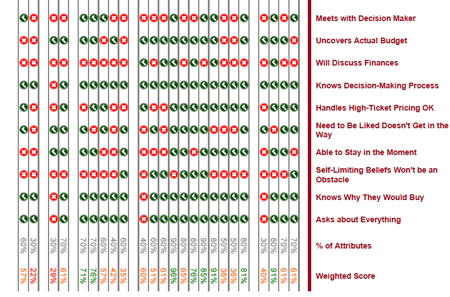
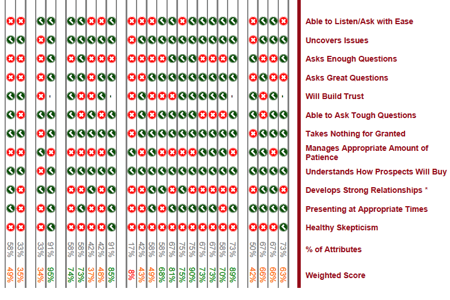
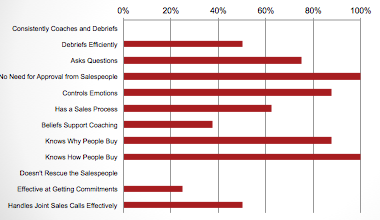
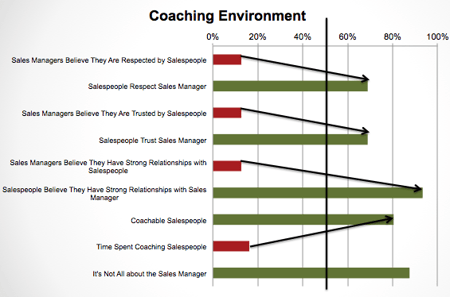
As an example of what we find out, look at the chart below that describes the leadership and sales management skills, tendencies and effectiveness of two sales managers.

skill-chart.png

The names have been changed to protect the innocent, but the data has not been altered.  Here is just one example of one of the findings from the assessment that companies find so useful when attempting to analyze the “why” of productivity and sales outcomes:

#1 – The score tells you how well Gene and Paul scored in their skills for the various data points evaluated as sales managers and sales leaders.

#2 – This helps us understand what a manager’s “go-to move” is when there is pressure to drive performance.

#3 – This tells us how effective the manager is when executing to a skill (recruiting, coaching, motivating, performance management, strategic thinking)

Looking only at the sales manager’s skills - performance management, recruiting, coaching and motivating - you can see that there are problems with motivating and recruiting effectiveness for Gene.  Both of these are his strongest tendencies, but he lacks the skill and perhaps has a problem with the make-up of his sales team (not coachable). Therefore, he is not very effective.  You would want to know this prior to implementing any type of sales management coaching program.

Paul, on the other hand, is average at best at 3 of the 4 sales management skills needed to effectively drive sales growth.


KNOWLEDGE IS NOT POWER

I once heard Tony Robbins declare that “Knowledge is NOT power.”  He went on to say that “Knowledge in Action is Power.”  That is the purpose of this post.  Too many companies create budgets for training and development without good intelligence.  Too many companies believe that training salespeople on the latest sales process concept is the way to drive sales.  Suppose you have people that lack desire?  Suppose they are un-coachable?  Suppose you have managers that don’t have the skills to support the dollars and effort you spend on training your salespeople? 

Before investing time, money and effort to train and develop your sales managers or salespeople, strongly consider doing a study - an x-ray, if you will - of the team that you have. Find out why they perform the way they perform, how coachable the team is , what the opportunity for growth is and if you’re going to help them with those contributing factors that support effective execution.

Supporting information:

Root Cause Analysis Training Video

Find out Why Selling is So $#$%! Hard?

Talk to Tony about the Sales Effectiveness and Impact Analysis – 513.226.3913 (Text:  SEIA – provide your name)

How Do I Grow Sales? – An article that answers that question

Request a Free Demo or Sales Assessment Sample

Topics: developing sales talent, how to manage salespeople, effective sales management, predictable sales growth


    textunder

    Subscribe Here


    Most Read


    Follow #ACTG


    About our Blog

    Anthony Cole Training Group has been working with financial firms for close to 30 years helping them become more effective in their markets and closing their sales opportunity gap.  ACTG has mastered the art of using science-based data and finely honed coaching strategies to help build effective sales teams.  Don’t miss our weekly sales management blog insights from our team of expert contributors.


    Recent Blogs