ACTG Sales Management Blog

Sales & Sales Management Expertise Blog  

Fishing/Selling – It’s an Exact Science… Kinda

Posted by Tony Cole on Wed, Apr 27, 2016

I went fishing with a very good friend of mine from First Citizens Bank in NC and he took me to his favorite fishing hole - Lake James.  Keith claims it is the most beautiful fishing lake in the country.  I don’t know if it is - I’ve not seen them all, but this is one beautiful lake!

fishing.jpg


Equipment - You gotta have equipment.  According to my guide, Keith Walker, there is no such thing as too much equipment.  I didn’t count everything, but I’m guessing we had 12 fishing rods and rigs, well over 100 different types of lures, and enough different types of hooks for another 25 different types of plastic lures.

Electronic Technology - Two radar screens to determine depth of water, temperature of water, structure underneath the water and visuals to determine schools of baitfish and predator fish.

Boat - A boat well-equipped to handle two people, rod holders, bait well, and a 40 hp four-stroke Suzuki engine to get us to various spots on the vast lake where the fish might be feeding or nesting. And a trolling motor at the bow of the boat so that we could quietly and slowly approach fishing areas.

Intelligence - Most importantly, we had human intelligence.  (That's a bit of a stretch with Keith… but I’ll give him credit for intelligence in fishing, North Carolina basketball J and managing a team of investment advisors.  Any other intelligences attributed to Keith is questionable as it is with all former coaches of any kind as they never fail to let the facts spoil a good story.) All the fishing enablement tools are needed but, without the human intelligence to put the pieces together to develop a strategy to find the fish, lure the fish, and catch the fish, the equipment and technology is, well, just equipment and technology.

As an example, the first place we fished is a place known as the rock pile.  It a rather shallow place in the lake with very clear water and, about 7 feet down, you can see rocks, lots of rocks.  Without the human intelligence, I would have not known to go there first thing in the morning, but that is exactly where we were at 6:30 AM on Saturday where we landed 3 fish and hooked another 3.  Then we moved on… because, after about an hour after sunrise, the fish move on.  Human Intelligence.

The same is true in selling.  You can leverage all the technology available to you, but at the end of the day, the technology cannot do what Dan Sullivan described many years ago in his great book - Selling for the 21st Century Agent.

Technology cannot replace what human intelligence and skill can do:

  • Development mutually beneficial relationships
  • Provide creative solutions to people’s problems
  • Get people to take action

If you find yourself not doing those three things on a consistent basis, then you will find yourself in a boat, in a lake and wonder why you aren’t catching any fish.

Topics: sales success, selling skills, fishing

Would You Buy from This Salesperson?

Posted by Tony Cole on Wed, Apr 20, 2016

boss_think.jpg

Time for an Honest Assessment of Your Sales Team

There are many factors involved in the business of selling.  As any salesperson can attest, the sales process can be a complex and daunting experience fraught with obstacles like aggressive competition, tight markets, shrinking budgets and incumbent vendors.  While there are many obstacles like these that are outside a salesperson’s control, there are many others they can control.  So, as an effective sales manager, what do you need to do to understand how and why a salesperson is performing or not performing? 

The obvious metric to use to measure performance are the sales results of the individual. If they hit or exceed goal, all is good.  So, that takes care of about 10 to 15% of your sales force.  But how about the rest of them?  Sure, the results numbers tell you they are not performing but, as an effective sales manager, you need to find out why.  The only way to do that is to look at additional data points.

Data points that you must observe to measure performance:

  • Critical ratios in the success formula
    • Are they doing the right effort?  (dials, networking, LinkedIn)
    • How effective are they? What do the critical ratios tell you? (10% of the conversations turned into an appointment– that is an example of a critical ratio)
  • Observation
    • Joint calls – Are they executing the company sales steps/process?
    • Joint calls – Are they executing the fundamental sales skills…?
      • Asking enough questions
      • Asking the right questions
      • Using stories, analogies and metaphors to weave a story and be conversational
      • Effectively listening
      • Inquiring for further information to clearly understand the impact of problems described by the client
    • Role-playing
      • Do they understand the fundamentals of your sales steps/process?
      • Do they intellectually understand what you mean by consultative selling, challenger selling, and client-focused interviewing?
      • Do they demonstrate in the classroom what you expect them do to in the field?
    • Additional data
      • Pipeline data – Is the volume increasing? Is it becoming more reliable?
      • Stack ranking - Are the various quintiles in your organization performing better this quarter/year than last quarter/year?
      • Sales activity – Are they doing enough effort to give them enough at bats to be successful?

In particular, for this article, I want to share a thought on observing your people perform.  Either in role-play or in live selling situations, you immediately get a reaction when you observe your people perform.  My guess is that your reaction could fall into 1 of 4 categories:

  1. I would not buy from this person ever; in fact, I would love to compete against them.
  2. I would not buy from them right now based on what I just saw/heard.
  3. I’m on the fence post with them; I need more information or more time to make up my mind.
  4. I would buy from this person; they were compelling, they got me engaged, made me discover some things that bother me that I need to fix and got me to a point where I was thinking I could undo any current relationships, add a new relationship and spend money that I didn’t think I needed to spend.

I have a client that just had a sales meeting that included about an hour of role-play covering a very specific step in their sales process. One of the product line specialists/experts commented the following: “With the exception of 2 people that I observed, I don’t believe I would buy from anyone else that I saw in that one hour.”

Wow, what a courageous, honest assessment.

My comment or suggestion to the team is to go back and review all the video or audio recordings of the role-plays and grade them using the standards I suggested above. 

As a sales leader, effective performance management requires the following:

  • Supportive beliefs about what it takes to coach people and get them to perform. If you believe you can manage people better if they like you, then you’re in trouble.
  • Recovering from rejection – If you cannot recover from rejection or fear of rejection, then you probably won’t tell one of the salespeople you work with that you wouldn’t buy from them.
  • Knowledge of desire and commitment - If you believe that all of your people are trainable and coachable, then you will spend a great deal of time with the same people covering the same sales execution problems.
  • Data nutcase - If you don’t look at data, then you won’t be able to have any intentional coaching sessions.
  • Time allocation - If you don’t take time to do ride-a-longs or role-plays, then you are missing two important/non-negotiable data points.

These are just a few of the requirements of effective sales management, leadership and coaching.  The key point in the message though is to do an honest assessment of your talent and then have discussions with them about how you honestly feel about their performance.  Yes, it will be difficult.  Yes, you might lose somebody over this.  And, yes, you might actually get people to work harder at their craft.

Resources to help you improve performance management and intentional coaching:

To inquire about distance learning, call me or text me directly: 513.226.3913

Topics: sales performance, sales results, evaluating salespeople, managing salespeople

How to Win Business in Any Market at Any Time!

Posted by Tony Cole on Fri, Apr 15, 2016

moneygraph.jpg

Selling in Any Market is one of my favorite keynote/workshops to deliver. When addressing a group of sales people or sales managers, I always create a stir when I loudly pronounce that the way to sell in any market is to “STOP making excuses and JUST SELL.”

When there are disruptions/economic conditions in your industry that cause you to get out of your normal flow in business, sometimes you end up spending more time playing defense than you do playing offense. 

In our primary markets – insurance brokerages, banking and investment services - disruptions have become a quarterly occurrence.  In my 20+ years in this business, I have asked audiences across the country if they have ever gone through a three-year period in their business when there wasn’t some sort of the disruption in the “normal” flow of business.  In short, their answer was no. In fact, disruptions in flow of business have become the norm.

In a recent discussion with one of our current client’s brokers, they described that the market is a hard market right now meaning that some prices are stable and some are going down.  As a result, some of the markets/carriers were lowering prices to grab market share.  When this happens, a broker’s own clients sometimes decide that it’s time to go for better premiums with the same coverage.  So, when this happens, brokers (like my client) have to play some defense to protect their turf.  And when that happens, brokers have a tendency to take their eyes off of prospecting – they stop playing offense.

I have several clients in the bank-owned investment brokerage business.  Last week, the Department of Labor passed new fiduciary regulations that have caused and will continue to cause a MAJOR disruption in that business.  Studies indicate that companies will literally spend billions of dollars to make sure they are compliant with the new regulations.  Not only will this require an investment of an enormous amount of money, but it will also take millions of hours invested by many for compliance training.  None of these activities are offensive in nature and so, in the end, will actually cost millions, maybe billions, more in lost productivity.

This is not necessary!  Here are just a couple of things to keep in mind as you attempt to manage performance during difficult periods:

  • Unlike 2008 (when a substantial piece of the market DID shrink), the current situation is not the same.
    1. Businesses are not going out of business because insurance premiums are going down.
    2. The amount of money in play in retirement and personal savings has not shrunk. If it’s a multi-billion/trillion dollar pile of money today, it will still be a multi-trillion pile of money once the Department of Labor regulations are fully implemented (January 1, 2018)
  • If your clients have a tendency to want to shop in a tough market, so do the clients of your competitors. Companies are in play, but you have to take the phone “off of the hook” and call them.
  • People that have invested their money with advisors that have not treated them in a way that is consistent with the new regulations (client focused/fiduciary responsibility) will be in the market to find an investment advisor/representative who will.
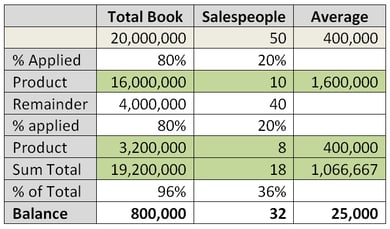
  • If you find that it is your smaller clients that want to shop – let them. My guess is that, if you let the bottom 20% of your insurance clients go, it will represent less than 5% of your total revenue.  One new client that looks more like your top 20% will replace at least 10 of your bottom clients.
  • If you are a financial advisor – DITTO. Frequently, my friend, Kevin Mummau from CUSO Financial, and I discuss the segmenting of books of business. Time and again, the 80/20 rule applies. Actually, based on his business intelligence, that industry looks more like 30/70.  But, still let the smaller accounts work with licensed bank reps or bring in an associate that can grow by growing with smaller accounts.

The bottom line is this: as a sales leader in an organization, you have the responsibility to keep your people focused on what it takes to win in any market, any environment.  Regardless of the score of the game, you have to…

Just like in a sport of any kind, stuff happens.  A team gets a big lead, catches a break, the wind shifts and the kick goes wide.  It doesn’t matter!  You cannot win just playing defense.

Sooner or later, you have to score more points than the opponent. That is offense!

Topics: sales prospecting, performance management, increase sales, selling in today's market

Who is Your Superstar?

Posted by Tony Cole on Thu, Apr 14, 2016

Kobe Bryant will be retired from NBA basketball when the final buzzer sounds in tonight’s game against the Utah Jazz.  If you are not a basketball fan or sports fan, this may mean nothing to you.  My intent is to frame a very important discussion about performance around a living legend of the LA Lakers and NBA.

As I listened to ESPN Radio Mike and Mike in The Morning, I heard commentary from former teammates, coaches and opposing players. There was a common theme in there discussion about Kobe Bryant and elite performers in athletics.  To be clear, I don’t believe the common theme is limited to athletic top performers.

 KOBE.jpg

As I started this article, I sent a question to my niece, Laura Wehrmeyer Fuentes.  Laura is an elite performer and vocalist who performs in the greater DC/Baltimore area.  I asked her if she ever bailed on a performance because she felt a little off or hadn’t prepared properly.  Her response:  “No way!  I’ve sung through bronchitis and pneumonia hopped up on steroids when I had to.  The show must go on!”

Elite performers prepare and perform at the highest capabilities regardless of the situation, the score, the environment or circumstances.

Some comments made about Kobe made me think about the content and theme of this article.  Here is just a sampling of what was said about Kobe and other top performers:

  • They demanded the best of others. When others were not performing at their best, giving it their all in practice or in a game, they call them out.
  • When it’s game time, nothing else matters. When Kobe’s family came to LA to watch him play, they stayed at a hotel instead of his spacious home.  He focused on the task at hand.
  • Regardless of the score of any game, if you watched Kobe play, you would swear that the Lakers must be down by 20. His intensity for playing the game rather than playing the score made him elite.
  • When comparing Kobe to Magic Johnson, the comment was made about Magic after they lost the championship to the Lakers. “You couldn’t find Magic in LA.  Here is a guy that likes to be out, is normally seen out and is everywhere where the lights are.  After the loss you could only find him in one place – the gym.”
  • Elite players make other players better. They recognize that they are a big piece of the puzzle, but still only one piece.  They elevate the game of others in order to win the team
  • Elite players have a tendency to rub others the wrong way. Not because they are arrogant individuals, but they have an arrogance about how they view the game and how it should be played and how one should be prepared to play.  They are haters – haters of losing and those un-willing to pay the price to win.

I could go on, but this makes the point and takes me to the question in the title of this article – Who are your elite players and are they doing the things that superstar/hall of fame players do? 

  • Are they elevating others?
  • Are they demanding of others?
  • Are they team-objective focused or focused on their own stats?
  • Do they do everything possible to win individually and get others to win as a team?
  • Are they your go-to people in a crisis?
  • Do they grind and grind to get it done?
  • Do they work relentlessly on their skills?
  • Do they focus on the details of the game so as to eliminate repeated errors or mistakes?
  • Do they call others out?

*Data on approximately 100,000 sales managers

  • Have, on average 43% of the Sales Coaching Competency 
  • Only 39% have at least 50% of the Sales Coaching Competency.  
  • Only 7% have more than 75% of the Sales Coaching Competency and
  • Only 3% spend at least 50% of their time coaching their salespeople
  • Only 7% of sales people assessed fall into the elite status based on performance, sales DNA and 21 core sales competencies.

As a CEO, president, national sales manager, vice president of sales or sales manager, the responsibility you have is to drive revenue.  When that seems difficult or impossible there needs to be more to the solution than work harder, see more people, increase the marketing budget, do more social networking, expand the sales force, etc.  Just like you would look into the numbers (expenses) to figure out how to improve profit, you need to look at the root problems impacting revenue.

It isn’t the latest sales enablement technology that improves sales results.  It is the human technology that drives sales today and will drive sales tomorrow.

Helpful Links/Resources:

Objective Management Group – White Paper on Talent Selection

Anthony Cole Training Group – Link to Sales Management Certification Program

Hirebettersalespeople.com – Self-explanatory link

Burning platform issue – You have a problem now, You want it fixed now – call me directly:  Office: 513.605.1301 or call/text  Mobile 513.226.3913.


Picture of Kobe – link to YouTube

Topics: hire better sales people, increase sales, sales habits, upgrade your sales force

What to Keep Doing, Part 3 of 3

Posted by Tony Cole on Mon, Apr 04, 2016

keep-doing-arrow.jpg

I continue to learn from my clients and the training director of a large national bank once said to me, “This is what we would like to keep doing. This is what we would like to start doing. And this is what we would like to stop doing.” Of course, all of this was framed up with lists of actions and initiatives because we were meeting to discuss coming years of training content, focus and delivery. However, this simple take-away can be applied to nearly any complex situation.

Some thoughts on What to Keep Doing:

Keep Learning 
As human beings, we continue to age and evolve. In order to thrive and survive, we must keep learning. Imagine if a child stopped learning—say your son turned 12 and stagnated and did not move forward mentally. Of course, you would find this odd and abnormal and you would go to great lengths to uncover issues so that you could fix this.

Unfortunately, adults sometimes do this and salespeople often feel like they know enough about selling. While a sales person may know that he must learn about new products, he often does not continue education in his craft of selling. Yet, to compete well in an ever evolving environment, one must know as much as possible and be well-rehearsed—after all “Perfect practice makes perfect performance.”

Play Like this is Your First or Last Game or Performance 
In the final season of Hall of Famer George Brett’s career, he was asked what he would like his last at-bat to be like—a signature double to right center field? A rocket single to left field? Brett said “No, I want to hit a hard ground ball to the second baseman and run as hard as I can to first base so that every young guy on our team will know that that’s how the game is supposed to be played.”

Prepare as though You’ve Never Done this Before 
It is an unfortunate fact of life that we tend to get sloppy over time. We think we know what we are doing. We think we don’t need practice or preparation.

Captain Edward John Smith had been commanding vessels for over 25 years. In 1012, he took command of an unsinkable cruise ship- The RMS Titanic. We all know what happened. While the stakes in selling do not usually involve hundreds of human lives, we cannot lose sight of the need for preparation. After all, “Perfect performance is a result of perfect practice.” (Am I repeating myself?)

Continue to Risk
Sailing in calm waters doesn’t teach.”  I don’t know the origin of that expression, but it defines this particular Keep Doing.  I majored in physical education while at University of Connecticut. In physiology, I learned the SAID principle, which I believe in and continue to preach.  SAID stands for Specific Adaptation to Imposed Demand.  In other words, your muscles don’t grow unless you put them under strain – put them in a position that exceeds their ability. 

I believe our brain power and our emotional stamina work the same way-- In order for us to grow, to learn, to become better, stronger, sharper, we must take on risks, including the risk of failing.  Get outside of comfortable. 

Continue to Fall Down & Get Up 
As we get older and have more experiences, we learn that life is up and down. One day is great successes and the next brings difficulty and defeat. This is particularly true in sales, since rejection and loss of a prospect/proposal/sale is a common occurrence. So, I imagine you have a long history of falling, dusting yourself off and getting up.  

Unfortunately, as we get more tenured in our professional career and accumulate a revenue stream, we can get knocked down and decide to be comfortable with what we have amassed over the years. We can get comfortable because we don’t have the drive and motivation that we once had. SO--

Set Higher and Bigger Goals 
Identify the goals that inspire you to do all the Keep Doing activities above.

  • Set goals that require learning something new or different
  • Set goals that excite you
  • Set goals that risk failure because they are a stretch


Topics: sales skills, key to sales success, keep, start and stop


    textunder

    Subscribe Here


    Most Read


    Follow #ACTG


    About our Blog

    Anthony Cole Training Group has been working with financial firms for close to 30 years helping them become more effective in their markets and closing their sales opportunity gap.  ACTG has mastered the art of using science-based data and finely honed coaching strategies to help build effective sales teams.  Don’t miss our weekly sales management blog insights from our team of expert contributors.


    Recent Blogs